At fifteen, António Lucena de Faria discovered that glass, silicone, sand and a few fish could become something people would buy. He assembled aquariums and sold them to his family. His grandmother, he later recalled, was probably his first customer. It is an unusually domestic opening for a career in entrepreneurship: the first market was within visiting distance, and the product had to hold water.
Fábrica de Startups, the company he helped establish in April 2012, carries that practical instinct into a more elaborate setting. It helps people find opportunities, assemble teams, test business models and launch companies. The appealing idea is that entrepreneurship can be taught through repeated contact with reality. Inspiration gets a seat at the table. Customers get the deciding vote.
- The work: ideation, business validation, acceleration, incubation and corporate innovation.
- The audience: aspiring founders, startup teams and companies developing new ventures.
- The current twist: FabStartLab combines customer testing with AI tools in a six-week program.
Nine boxes, several inconvenient questions
The company’s FastStart methodology works through the nine components of the Business Model Canvas, testing critical assumptions along the way. A business idea becomes a collection of propositions that can survive examination or require revision. Who is the customer? What creates value? How will revenue arrive? The canvas supplies structure; potential buyers supply the uncomfortable answers.
This places Fábrica de Startups in the business of reducing uncertainty before a launch. Its expertise includes customer discovery, business model design and the organisation of practical learning. A founder can enter through FastIdea to develop opportunities, FastStart to validate an idea, or FastGrowth to work on marketing, sales and processes. The names are brisk. The underlying work demands patience.
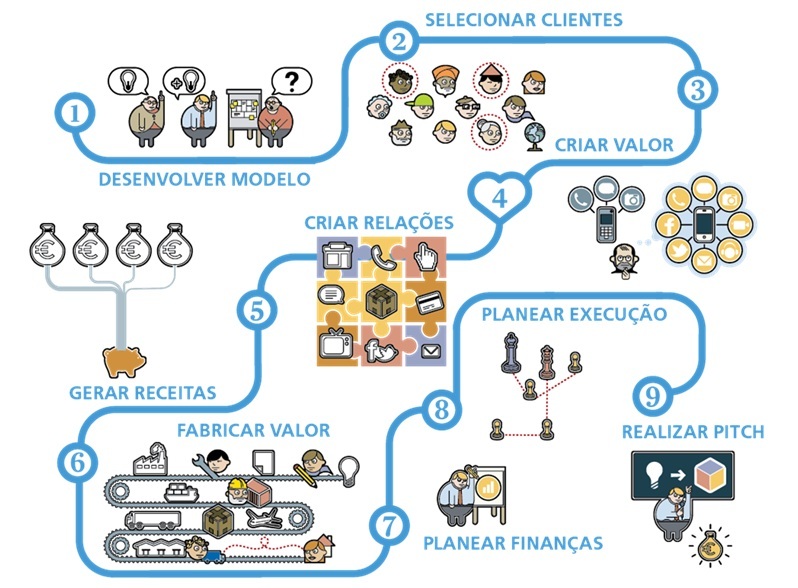
Starting, its virtual acceleration offer, makes that work tangible: workshops, individual mentoring, landing pages, advertising campaigns and questionnaires. Physical incubation, coworking and virtual incubation offer another layer of support. The distinction matters when choosing a service. A registered address solves an administrative problem. A customer experiment addresses a commercial one. A founder may need both.
A classroom with twelve front doors
One of the company’s useful ideas concerns geography. Tourism Explorers, developed with Turismo de Portugal, began in 2017 with an ambition to encourage tourism entrepreneurship beyond the largest urban centres. The program used live streaming to teach simultaneously across twelve cities, supported by local institutions. A shared curriculum could travel while the regional relationships stayed close to home.
There was a rehearsal. Consultores Digitais had used distributed streaming in 2015. The technique later gave Tourism Explorers a way to combine ideation, acceleration and investor presentations without gathering every participant in Lisbon. For someone designing a regional program, the transferable ingredient is the pairing: central instruction and local delivery partners, each doing a different job.
“Think and work like an entrepreneur. For a big company.”Entrepreneurs-in-Residence program
That invitation opens another door. Entrepreneurs-in-Residence describes two-person teams combining commercial and technical profiles to develop a large company’s strategic project. Participants need not arrive with an idea. They receive mentoring and monthly financial support while working from business model through prototype to market implementation. The commitment is full-time. Corporate venture creation has a different rhythm from an evening workshop.
Free tuition has a timetable
FabStartLab gives the company’s approach a contemporary instrument: AI. Its second-edition rules scheduled a program from April 20 to May 28, 2026, with capacity for up to forty teams. Twelve bootcamps, each ninety minutes long, ran twice weekly after working hours, with attendance available in person or through Zoom. Participation was advertised as free. The timetable alone amounts to eighteen hours, before homework.
*12 × 90 minutes. Practical assignments require additional time.
The economics are specific. A public project sheet lists €150,000 of eligible investment and an equal, non-repayable incentive under the PRR incubator-voucher project. Its objectives include strengthening the team, AI training, developing Fabstart Academy and creating virtual assistants. That grant supports capacity building; it should not be mistaken for a startup investment round.
FabStart.ai, the proprietary platform advertised alongside the program, supplies entrepreneurship prompts and generators for tasks including market research and competitor analysis. FabStartLab says seventy percent of the program is devoted to building and validating ideas with real customers. AI can shorten preparation. The commercial test still requires contact with people outside the program.
The market is allowed to change its mind
Tourism supplied a severe test of this thinking in 2020. In a founder interview, Lucena de Faria described changed visitor preferences and the need for existing startups to revisit their models during the pandemic. Larger accommodation, autonomy and outdoor space had gained importance. The customer assumptions needed attention before a business could sensibly resume its plans.
The same interview reported a Tourism Explorers impact exercise involving 242 contacted startups: sixty percent remained active, twenty-three percent had received investment and thirteen percent had internationalised. Those are historical, company-reported outcomes. They help describe the program’s experience, but do not establish that acceleration caused survival or investment.
Borrow the discipline
Fábrica de Startups serves both founders and corporate clients, with institutional partnerships supporting particular programs and incubation adding ongoing services. Its offer sits between entrepreneurship education and venture development: structured work on a commercial proposition, with people and tools around it. That is useful when a team’s central problem is an untested model.
The lesson a reader can copy is modest: name the assumption, choose a customer group, run a test and let the result alter the plan. This approach depends on access to potential customers and willingness to revise the idea. Mentoring cannot supply either automatically. As of October 2026, FabStartLab marked second-edition applications closed and invited interest in the next edition. The program has a calendar. Customer discovery can start today.
Keep investigating
Explore the company website, FastStart methodology, FabStartLab and its public project sheet.
Follow LinkedIn, Instagram and Facebook. Read the company blog and 2020 founder interview, or watch the Erasmus exchange introduction and entrepreneur exchange story.