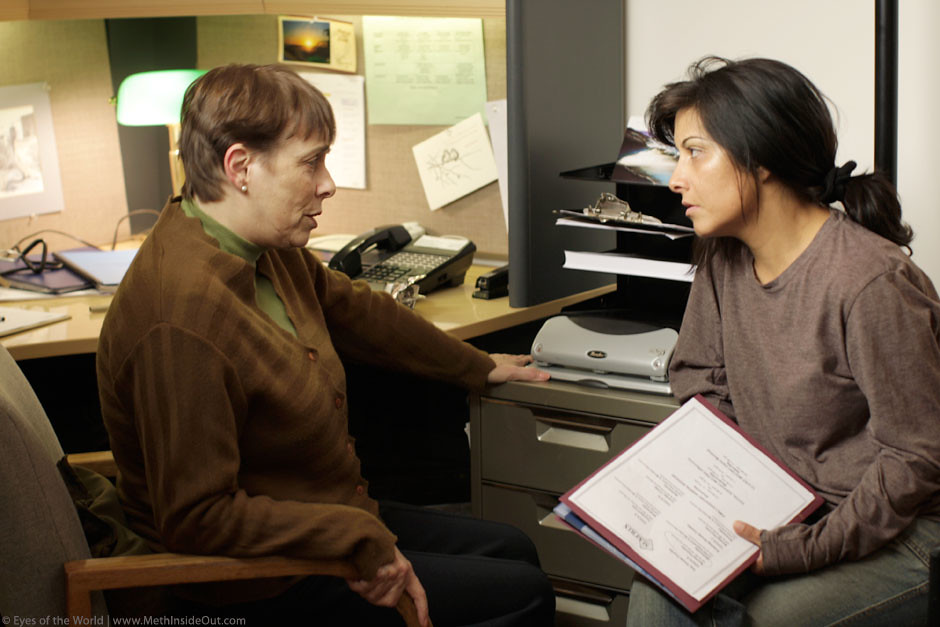
Two women sit beside an office desk. One holds an open folder. Behind them are stacked trays, a telephone and a noticeboard. The photograph, published by Eyes of the World Media Group under the title Meth-Individual-Attention, is almost aggressively ordinary. There is no visual shorthand for catastrophe. There is a conversation.
That makes it a useful doorway into this company. Its work includes an educational film series about methamphetamine, a subject that could easily swallow every frame with spectacle. Yet here is the quieter unit of attention: two people, close enough to listen. The desk is cluttered. The composition is clear.
Eyes of the World Media Group makes videos, websites and graphic design for organizations with something to explain. Its distinctive territory emerges from the projects: difficult knowledge, institutional expertise and an audience that needs more than a technically correct statement. The practical question running through this work is how to give information a form someone can use.
01 / THE BRIEFStart with the person watching
The company’s Meth Inside Out curriculum, co-produced with UCLA Integrated Substance Abuse Programs, divides its subject into three films: Human Impact, Brain & Behavior and Windows to Recovery. Consider the order. First comes the human situation. Then an explanation. Then what the process of recovery involves.
Human Impact examines why people use methamphetamine and what happens to individuals, families and communities. The intended audience includes people using the drug, relatives and professionals. That is a demanding combination. A family member and a clinician can watch the same scene while bringing very different questions to it.
Brain & Behavior brings together three-dimensional brain animation, plain explanations and personal accounts. The format gives the viewer several ways into the material. Animation can make an invisible process visible; testimony can give an abstract description a human setting. The distributor describes a film concerned with how changes in the brain relate to behavior and experiences during addiction and recovery.
Windows to Recovery moves toward the everyday work of change. Its description emphasizes structure, activities and coping strategies. The editorial progression is useful even outside this subject. A communications team can borrow the sequence: show the stakes, explain what is happening, then make the next part of the process understandable.
THE SERIES’ EDITORIAL SEQUENCE / NOT AN OUTCOME MEASURE
02 / THE FOUNDERAn MBA behind the camera
Emily Meyers brought a business background to this kind of work. In an Indiana University alumni newsletter published in spring 2008, she described earlier strategic and financial consulting for companies including General Electric and Countrywide Financial. She also described earning an MBA at Indiana and participating in UCLA’s Producers Program.
Her account of starting Eyes of the World was explicit about the intended audience effect. She wanted to use media and social entrepreneurship to “impact the maximum number of hearts and minds.” Educational, promotional and advocacy videos were the means she named.
That is a broad ambition. The portfolio gives it narrower, more interesting edges. A brain animation is a specific choice. So is a documentary for engineering students. Each requires decisions about what to retain, what to explain and what a viewer can reasonably absorb. Here, a mission statement becomes a series of editorial judgments.
“impact the maximum number of hearts and minds”
Emily Meyers · Indiana University alumni newsletter · 2008
03 / THE RANGEEthics gets a screen credit
Between 2010 and 2012, Eyes of the World worked with UCLA REMAP on Recoding Innovation, a National Science Foundation-supported project making short multimedia documentaries for undergraduate and graduate students. The subject was ethics in science and engineering.
The project’s stated premise was that ethics could help generate innovation. That changes the assignment for a filmmaker. A list of prohibitions has one dramatic shape; an investigation of the ideas that motivate someone to create has another. The project treated ethical thinking as part of the creative process. That was its declared educational approach, rather than a documented change of mind inside the company.
A separate credit takes the studio from moving images to the printed page. Population Reference Bureau named Eyes of the World Media Group as designer of its 2013 World Population Data Sheet infographic. PRB’s accompanying description covered demographic indicators for more than 200 countries. The design credit belongs to the studio; the demographic research belongs to PRB.
There is a family resemblance between these assignments. Both ask a creative team to work with knowledge produced elsewhere. The design must help the audience follow the material while preserving who knows what. That makes collaboration with subject specialists central to understanding the studio’s place in the market.
04 / THE ECONOMICSThe buyer is not always the viewer
The company lists clients including PBS, the UN, the State of California, Edelman, UCLA and Room to Read. That mix places its services among institutional communications, educational production and cause-oriented creative work. The buyer may be commissioning a public explanation, supporting a program or preparing material for a particular audience.
For Meth Inside Out, the intended settings include treatment centers, correctional facilities, social-service agencies and universities. Those settings matter commercially. An institution selects a resource that other people will watch. A useful purchasing conversation therefore needs to address the viewer, the setting and how the material will be introduced.
There is also a tangible retail object. Australian distributor 360Edge lists the three-DVD set at A$150, reduced from A$300, and describes remaining stock as limited and the videos as no longer in production. That is a distributor’s purchase price for a finished resource. It should never be mistaken for what it cost to research, film, animate or edit the series.
Three DVDs · 360Edge retail listing
Reduced from A$300. Limited-stock offer, checked September 2026.
The work also entered a research-funding structure. UCLA’s 2012 biennial report describes Inside Prescription Drug Abuse, a Phase I Small Business Innovation Research project supported by the National Institute on Drug Abuse, with UCLA ISAP as a subcontractor. The proposed web resource was intended to supplement prescription-opioid treatment. The report describes assessing feasibility, perceived value and knowledge acquisition: a development-and-evaluation brief.
05 / THE USEFUL PARTDesign for the second showing
An educational film can keep finding contexts after its original release. Flinders University’s Worklife resources link to Meth Inside Out excerpts about triggers and the crash. A professional trainer guide dated July 2020 includes a short recovery excerpt. These are concrete examples of later reuse, without requiring a guess about the series’ total audience.
For someone commissioning similar work, the lesson is to specify the viewing situation early. Will an educator pause the film? Will a short extract need to stand alone? Does the audience need a human example, a visual explanation or a discussion prompt? Those are editorial recommendations suggested by this portfolio, not a claim about a proprietary company method.
The limits follow from the same logic. A film can support an explanation; its existence does not establish a treatment result. Old educational material needs appropriate review before a new use. And an institution still has to choose, introduce and make room for it. Distribution and context are part of the assignment.
Eyes of the World’s most useful idea is visible in that first photograph. The subject may be large, technical and emotionally charged. The audience encounters it in a particular moment. Sometimes the creative job is to get that moment down to a size that fits between two chairs.