There are two ways to discover a cybersecurity company. The fashionable way is to name a fresh category, sketch an ominous attacker in a hoodie, and start selling fear. ExtraHop took the longer route. It built a machine for answering a stubbornly ordinary question: why is the application slow? Then customers looked at the same network evidence and asked a more expensive question: who is moving through our systems?
That change of question is the ExtraHop story. Jesse Rothstein and Raja Mukerji, two senior software architects from F5 Networks, founded the Seattle company in 2007 around a conviction they still repeat: the wire does not lie. Devices, users, databases, cloud workloads, and applications have to communicate. Those conversations leave traffic behind. If software could decode that traffic in real time, without burdening the systems being watched, it could reconstruct what was actually happening.
The idea was clean. The engineering was rude. Enterprise networks were already moving roughly 150 million packets per second, according to Mukerji's account of the early years. ExtraHop needed to observe that torrent passively, extract useful details, store enough evidence, and avoid becoming the reason the network slowed down. The first prototype took about two years. That was the first real obstacle - not a clever rival, but physics, processing, and scale.
The product before the product
ExtraHop first sold application delivery assurance and network performance monitoring. The product listened to mirrored traffic rather than asking teams to install an agent on every machine. It translated packets into transactions and metrics that operations people could use: which service was stalling, which database call was misbehaving, where an error began, and whether the network or the application deserved the blame.
That is still useful work. One public travel-company account describes a search for certain web errors shrinking from days to about 30 minutes. A university reported cutting troubleshooting time in half. The pitch is not mystical: when every team brings a different dashboard to the war room, shared packet evidence can stop the ceremonial finger-pointing.
But traffic describes behavior as well as performance. An unusual login, a new device, lateral movement between servers, a suspicious data transfer, or an encrypted connection at the wrong time can all create patterns. ExtraHop's customers began using its visibility to investigate security events. The company had detected activity around major vulnerabilities such as Heartbleed and Shellshock before it formally sold a security platform. Customers kept pointing at the adjacent job.
“The wire doesn't lie.”ExtraHop's founding thesis
What changed management's mind was not a slide about the total addressable market. It was repeated evidence that buyers already valued threat detection. ExtraHop followed the use. In January 2018, exactly 11 years after its founding, it launched RevealX and made network detection and response, or NDR, an official business.
What RevealX actually sells
RevealX now combines four jobs that buyers often purchase separately: network detection and response, network performance monitoring, intrusion detection, and packet forensics. Sensors can sit in data centers, virtual environments, containers, branches, campuses, and public clouds. They decode protocols and build a live inventory of devices and conversations. Behavioral models look for departures from normal. Analysts can move from a detection to the underlying transaction and, when retained, the packet.
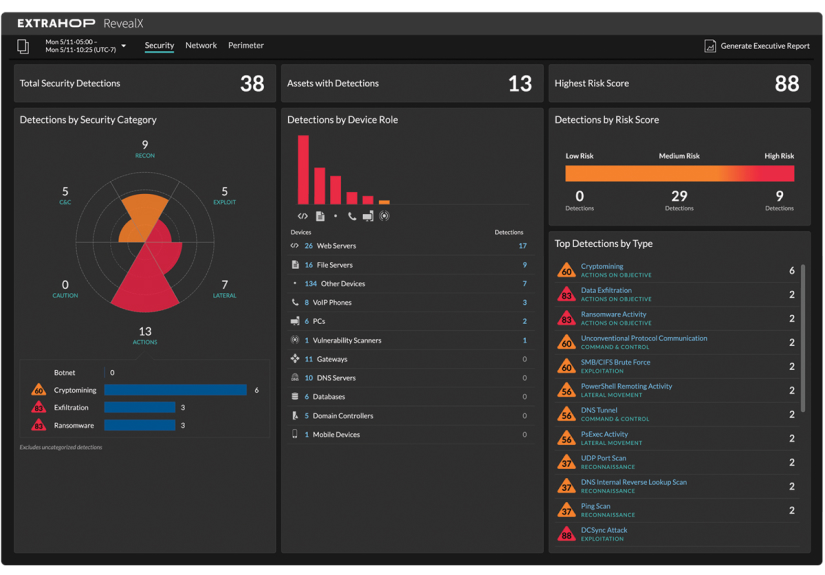
The distinction matters because most security tools see only their assigned patch. Endpoint software watches machines where it is installed. A SIEM collects logs that systems choose to emit. Identity products watch accounts. RevealX watches the conversations among them. ExtraHop says it can expose unmanaged devices and east-west movement inside a network, including behavior conducted through legitimate tools. Its decryption and protocol analysis are meant to recover context that a simple flow record would miss.
Customers include large operators with messy estates and real consequences: The Home Depot, Ulta Beauty, Seattle Children's Hospital, Prisma Health, MEDHOST, the City of Dallas, BAC Credomatic, Brewin Dolphin, Asante, bet365, and others. Dallas used the platform across more than 14,000 servers, workstations, and connected devices. A global telecommunications provider reported discovering more than 650 devices missing from its configuration database. These are environments where “what is connected?” is not a rhetorical question.
ExtraHop earns money as enterprise software usually does: negotiated subscriptions and contracts, SaaS or self-hosted deployments, sensor capacity, support, and services sold directly and through partners. Public list pricing is not part of the pitch. That makes the buying calculation operational: can one shared view reduce tool sprawl, return analyst time, shorten outages, or surface an attack early enough to justify the contract and the traffic infrastructure around it?
Pure-play NDR peers
Darktrace, Vectra AI, Corelight, and NetWitness compete most directly for network-centered detection budgets.
Platform alternatives
Cisco, Arista, Fortinet, NETSCOUT, Trend Micro, Trellix, and Gigamon can fold network visibility into broader estates.
ExtraHop's angle
Full-packet roots, passive deployment, decryption, forensics, and performance monitoring on one data foundation.
Still required
Endpoint, identity, SIEM, SOAR, preventive controls, and humans remain complements, not obsolete accessories.
The business hidden in the byproduct
The financial arc makes the patient route easier to see. ExtraHop raised a disclosed $5.1 million Series A in 2009, $14 million Series B in 2011, and $41 million Series C in 2014, following an earlier seed round. Bain Capital Private Equity and cybersecurity-focused Crosspoint Capital Partners agreed to acquire it in 2021 for $900 million. In early 2024, the owners added $100 million in growth capital. ExtraHop said it had ended 2023 at approximately $200 million in annual recurring revenue.
Those numbers do not prove a smooth journey. They show the cost of building, distributing, and repeatedly repositioning serious infrastructure software. ExtraHop did not discard performance monitoring after the security pivot; it made the inherited capability part of the distinction. An outage and an intrusion can look related in their early minutes. The same packet history helps a network operator find a bad dependency and a security analyst reconstruct lateral movement.
That gives ExtraHop a credible answer to “why you?” in an NDR market containing specialists such as Darktrace, Vectra AI, and Corelight, plus network and security suites from larger vendors. Its answer is breadth without pretending to be everything. ExtraHop explicitly says RevealX can consolidate several network tools but does not replace the entire security stack. It integrates with CrowdStrike, Splunk, Gigamon, Netskope, and other systems that supply or consume context.
The company is extending that argument into AI. It says it holds more than 70 AI and machine-learning patents. In July 2026, it launched the Agentic SOC Alliance with CrowdStrike, LangChain, Torq, Dropzone AI, ReversingLabs, and other companies. The proposed architecture separates real-time context, the harness that governs agents, and interchangeable models. The interesting claim is restrained: a clever model cannot compensate for missing evidence.
A month later, ExtraHop announced a sensor designed to analyze data-center traffic at 400 Gbps line rate, with general availability planned for the fourth quarter of 2026. It is a striking loop back to the first two-year prototype. Models change. The old engineering problem - see an enormous amount of traffic without dropping the useful parts - remains.
Where the method stops working
Network truth is not omniscience. A sensor cannot interpret traffic it never receives. Cloud mirroring must be available and configured. Branches, containers, virtual networks, and encrypted sessions create coverage choices. Decryption brings technical, privacy, and key-management constraints. Packet retention costs money. A team also needs a process for tuning detections and acting on them. Otherwise, an expensive source of evidence becomes another glowing screen.
NDR is also a weak standalone answer for activity that never produces useful network behavior. A compromised endpoint, stolen identity, malicious cloud control-plane action, or data event may be clearer in endpoint, identity, application, or audit telemetry. ExtraHop's integrations acknowledge the limit. The platform works best as connective tissue in a mature operation, not as a substitute for every other control.
Scale changes the economics. A global bank, hospital system, retailer, or city has enough unmanaged equipment, lateral traffic, and operational complexity to make passive visibility valuable. A small company living almost entirely in a few managed SaaS applications may get more from endpoint, identity, and cloud-native controls first. The method also disappoints when a buyer wants prevention in a box. RevealX can trigger and inform response, but observation earns its keep only when somebody can respond.
The part worth stealing
- Build a difficult primitive that solves a real job, not a decorative feature.
- Watch for customers using it sideways. Repeated misuse can be market research.
- Package the new job clearly, but keep the old capability when it strengthens the moat.
- State the boundary. A product becomes more credible when buyers know what still belongs elsewhere.
For founders, the copyable insight is not “start an NDR company.” It is to inventory the exhaust your product already creates. Which data, workflow, or technical advantage is valuable for a second job? Which customers are bending the product toward it without permission? ExtraHop's security company was not invented from nothing. It was observed in the behavior of existing users.
The patience is harder to copy. Eleven years is several startup lifetimes. The product had to survive as a performance business while the adjacent security signal strengthened. The founders had to believe that a deep technical capability could travel across categories without becoming generic. And they had to accept that customers might understand the next market before the company did.
ExtraHop now describes its mission as revealing cyber risk and building business resilience. That sounds far from a tool for diagnosing slow applications. Underneath, the job has barely moved: listen to the systems, reconstruct what happened, and give the operator evidence before the meeting becomes an argument. The packets were always talking. The company changed when it learned which question was worth asking.