The patient in the corner of the waiting room was healthy. She was younger than many of the couples around her. She was also asking a different question: could she have a child later? Joshua Klein, a reproductive endocrinologist, saw an “awkward fit”. An infertility clinic was organized around getting pregnant now. This patient wanted to preserve the possibility of getting pregnant someday.
- Extend began with egg freezing, then added infertility treatment.
- A cycle costs $8,500 before medication, assessment and storage.
- Its research follows patients beyond the freezer. Outcomes still depend on who returns and what happens next.
That distinction became Extend Fertility. Co-founders Klein and Ilaina Edison opened its Manhattan facility in August 2016. The proposition was specific: design care around people planning ahead, lower overhead through specialization and charge less. The launch announcement said prices were 40% below traditional clinics. That was the opening argument, rather than a timeless comparison with every competitor.

The patient in the corner
The insight involved more than marketing. A person freezing eggs might need fertility education, help with injections and reassurance about a procedure she has chosen before experiencing infertility. The clinic could change the conversation without pretending to change biology. Its customers today also include people struggling to conceive and couples preserving embryos. Planning ahead and seeking treatment eventually meet in the same laboratory.
Klein did not initially expect to run the project. In a 2022 interview, he recalled imagining himself as a consultant. Conversations with an associate assembling investors made the idea more attractive, until he wanted to do it himself. His subsequent education was less glamorous: staffing, responsibilities and discovering that an MBA did not come with a magic formula for the cost of a cycle.

“people are the hardest thing”
Joshua Klein / Inside Reproductive Health, 2022
A bill with a long memory
The current self-pay menu puts the egg freezing cycle at $8,500, including monitoring, retrieval, anesthesia and vitrification. Medication adds $3,000-$5,000, paid to a pharmacy. Assessment and consultation cost $250; a one-year storage plan is listed at $800. Add those items and the first-year illustration becomes $12,550-$14,550 for one cycle. A second cycle changes the arithmetic considerably.
Self-pay list prices checked October 2026. One cycle; no later IVF. Actual medication costs vary; prices can change.
There is another bill if the eggs are used. Thawing and fertilization are listed at $6,500, and frozen embryo transfer at $4,900, before applicable extras. A reassuringly tidy cycle price can therefore conceal a very untidy lifetime budget. Patients should compare the whole sequence. Extend lists employer benefit partners including Maven, Progyny, Carrot and WINFertility; having a benefit or an in-network insurer still requires checking the individual plan.
Gaia adds financing and optional protection. Its minimum egg guarantee costs an additional $1,340 and requires patients to be under 38 with AMH of at least 1.25 ng/mL. The advertised monthly payment is a financing arrangement with interest and credit approval. Fine print has a habit of being where the actual product lives.
The window at body temperature
Consider a less photogenic detail: the laboratory’s pass-through window to the operating room. Its workstation surfaces are warmed to 37°C, body temperature. The compact layout connects retrieval to the people handling eggs. Individual benchtop incubators control temperature and pH. Here, the interesting design choices are about what happens to a cell when it leaves the body.
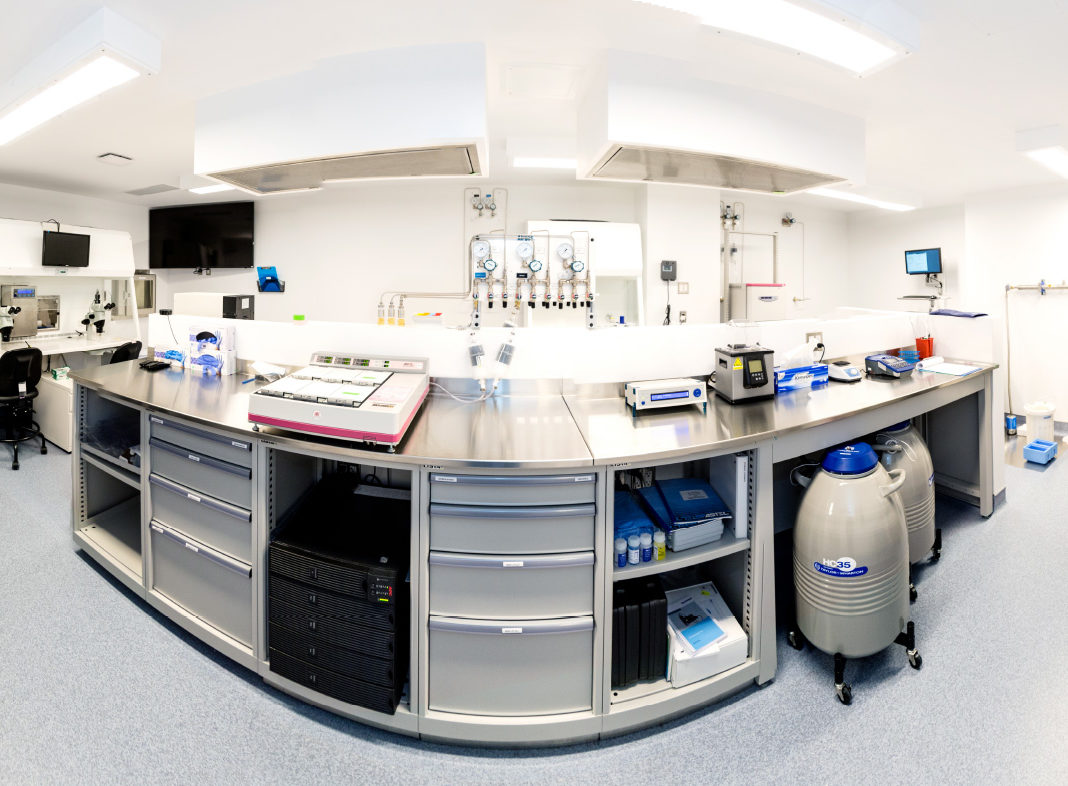
For the patient, the process begins with ultrasound, AMH testing and a consultation about personal expectations. Training covers injections. Stimulation and monitoring take roughly 8-12 days, with short visits approximately every other day. Retrieval is a brief procedure under sedation, followed by vitrification. It is a medical undertaking that needs room in a calendar, even when the eventual family plan remains wonderfully undecided.
Count the return journey
The eight-year study, published online in December 2025, recorded 4,659 planned freezing cycles for 3,138 patients between 2016 and 2023. Among patients who froze before 2020, allowing at least four years of follow-up, 10.4% returned to warm eggs. Across 271 warming cycles, mean egg survival was 90.7%. These percentages describe different events and different denominators. Neither says that nine out of ten patients had a baby.
Return rate is about patients. Survival is about eggs. These are not birth rates.
For the analyzed warming cycles in patients who froze at 40 or younger, cumulative ongoing pregnancy/live birth was 70.3%: 97 of 138 cycles. The combined endpoint includes ongoing pregnancies. The retrospective, single-center study cannot establish that Extend outperforms other clinics, and returners do not represent everyone who froze. It does make the conversation more useful. An egg surviving thawing is one milestone on a much longer journey.
The clinic grew up with its patients
By 2018, Extend had expanded into infertility services through Expect Fertility. A $15 million Series A from Regal Healthcare Capital Partners followed in February 2019. Today, IVF, IUI and diagnostic care sit alongside preservation. Embryo freezing adds another choice: fertilize before freezing, using partner or donor sperm, rather than postpone that decision. The business earns fees for treatment and storage, sustaining a relationship that can span years.
The clinic’s account of Alessia gives that interval a human scale. She froze 27 eggs in 2016, returned three years later and conceived after her first embryo transfer. Her daughter arrived in May 2020. It is one patient’s experience, with a happy ending; its value is showing the service from beginning to end, rather than supplying odds for the next person.
Against alternatives such as CCRM, RMA and Kindbody, Extend’s distinctive history is its starting point. It built around preservation, then broadened. For a prospective patient, the useful comparison involves appointment access, laboratory experience, plan coverage and the cost of returning for treatment. A lower retrieval price may matter greatly, but it is only one line in that comparison. The lesson worth copying is to notice the patient whom the existing service treats as incidental. The constraint is equally practical: an option is useful only if its cost, medical prospects and eventual use make sense for that person. A freezer cannot settle the rest of life’s negotiations.