The modern university knows almost everything about its alumni and still manages to know very little about most of them. A database may remember a 2014 gift, a home address, an old employer, and perhaps a reunion check-in. The major-gift team, meanwhile, is concentrating on a thin slice at the top. Everyone else receives the institutional equivalent of a supermarket circular: same campaign, same subject line, same polite distance.
EverTrue was founded to close that peculiar gap between possessing data and recognizing a person. In 2010, Brent Grinna was volunteering as a fundraiser for Brown University when he noticed that advancement teams worked with technology well behind the relationship tools used in the private sector. His first insight was not that nonprofits lacked information. It was that their useful information lived in static systems and rarely arrived at the moment a fundraiser needed to decide whom to call.
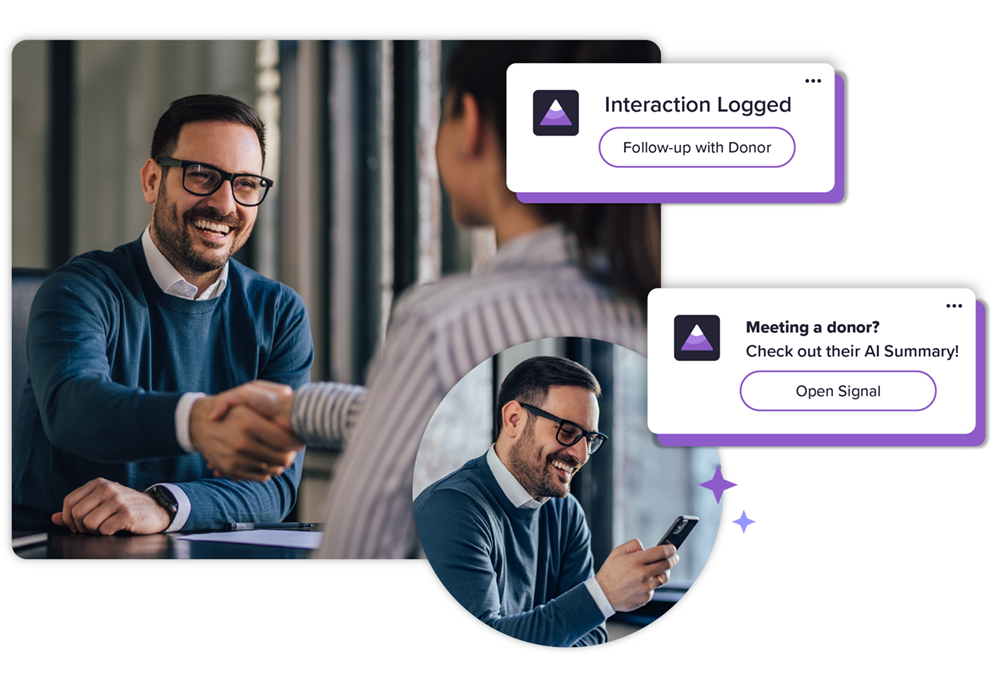
Sixteen years later, EverTrue looks less like the mobile alumni product it began as and more like a vertical operating system for fundraising. Signal organizes donor profiles, portfolios, cadences, and alerts. DonorSearch supplies wealth and philanthropic intelligence. ThankView records and distributes personal video. Pledgemine designs and sends targeted mail. Balance handles endowment accounting, while Impact and ODDER turn fund data into donor-facing reports. The stack runs beside established systems such as Blackbaud, Salesforce, and Ellucian, translating a system of record into a system of action.
What failed first was the assembly line
The clearest demonstration comes from the University of Wyoming Foundation. Its student phone program had flattened: about $145,000 a year from a little more than 1,000 gifts. Roughly 20,000 donors in the $1,000-to-$24,999 range deserved more attention, but voicemail and mass solicitation were not creating much of a relationship. In 2021, the foundation dissolved the phone program and moved that budget into an EverTrue Donor Experience Program.
This was not a channel swap dressed up as transformation. Wyoming hired three donor experience officers, assigned each a portfolio of around 1,000 people, and gave them a daily cadence across phone, email, and social channels. EverTrue’s software supplied prioritized tasks and updated engagement, career, and wealth clues; EverTrue staff supplied coaching. The institution changed ownership, frequency, and context at the same time.
What changed leadership’s mind was not a fashionable distaste for phones. It was flat performance plus visible unused capacity. The board could see both the stagnant baseline and the arithmetic of giving named fundraisers larger, better-directed portfolios. Wyoming also reported another $700,000 in leadership and major gifts supported by collaboration between the new officers and development staff. Those are the institution’s results, not a promise that every database contains the same rabbit.
Everything is outcome-based. We can have the best ideas in the world, but if we don’t see the appropriate outcomes we need to shift, change, and pivot.Mary Shafer-Maliki, University of Wyoming Foundation
Four moves, repeated without drama
EverTrue’s playbook can be reduced to four operations. First, enrich the record until it contains evidence of capacity, affinity, or behavior. Second, assign the person to someone who can act. Third, run a planned sequence rather than wait for inspiration. Fourth, preserve the response so the next interaction starts warmer. None is exotic. Their value comes from happening together and happening again tomorrow.
The surprising bit is how often an ordinary signal beats an ornate campaign. Union College searched for alumni who had liked at least five Facebook posts in a year, found nearly 700 people, and targeted 500 of the most engaged. The resulting campaign raised an additional $5,900 in a month. UConn reported that giving fundraisers direct access to EverTrue cut internal list requests by two-thirds. One story is about revenue; the other is about hours returned to the staff. Both begin by removing a small piece of friction between curiosity and action.
The bigger customer programs follow the same shape. TCU replaced a declining phonathon model with eight student “Campus Creators,” personal video, and managed portfolios; it later reported $700,000 in new revenue and $5.2 million in major-gift pipeline over six months. KU Endowment combined Signal’s cadences with ThankView’s video and connected $17.7 million in gift transactions to donor-experience assignments after its 2023 launch. These institutions did not automate affection. They automated the clerical work surrounding it.
A roll-up with one thesis
EverTrue funded its early growth like a conventional SaaS company: approximately $1.3 million in 2011, $5.25 million in 2013, $8 million in 2014, and another $6 million in 2017. Its shape changed in 2021, when Rubicon Technology Partners made a strategic majority investment supporting EverTrue’s merger with ThankView. The combined business said it served more than 2,000 nonprofit customers, including over 1,000 colleges, universities, and independent schools.
Then came The Solas Group for predictive analytics, Pledgemine for direct mail, Fundriver for endowment management, and, in 2025, DonorSearch for philanthropic and wealth data. Acquisitions can produce a junk drawer of tabs. The logic here is at least coherent: research a prospect, decide what to do, make contact, and report what the gift accomplished. EverTrue’s 2026 roadmap makes integration the test, promising intelligence that moves through the full lifecycle rather than marooning fundraisers in a collection of specialist tools.
That position distinguishes EverTrue from a donation form or a single-purpose prospect database. It also puts the company into a crowded ring. Blackbaud, Salesforce, Ellucian, Bonterra, Bloomerang, Virtuous, Neon One, iWave, WealthEngine, and Gravyty each overlap some portion of the job. EverTrue’s answer is not necessarily to rip out the core CRM. It integrates with more than 40 fundraising systems through DonorSearch and sells the layer that tells teams what to do with the records they already own.
What does it cost?
There is no public rate card. EverTrue sells quote-based enterprise subscriptions and services. Public records show how widely scope can vary: one 2020 university purchase was $17,500; a 2024 donor-management contract was $147,100; and a 2026 notice anticipated $162,364.98 over three years for EverTrue Pro. Another university disclosed a $313,000 arrangement replacing a Fundriver contract. Those are contract examples, not menu prices.
Copy the operating system, not the shopping list
A fundraising team can borrow much of EverTrue’s method before procurement receives a calendar invitation. Audit who receives personal attention. Pick one neglected cohort with a reason to care. Give it a named owner. Define a short sequence across two or three channels. Record replies, meetings, asks, gifts, and handoffs. Compare the result with the old program’s revenue and staff hours. The software becomes valuable when volume makes that discipline difficult to maintain manually.
Choose one visible signal - a recent gift, event attendance, a career move, repeated social engagement - and test whether it improves response.
A promising record without a responsible human is still an abandoned record. Assignment is the bridge between analysis and action.
Write the follow-up sequence before the first message. A calendar beats heroic memory, especially across portfolios of hundreds.
Track qualified leads passed to major-gift staff, not only immediate gifts. Today’s middle is supposed to become tomorrow’s top.
AI now sits inside the proposition. EverTrue introduced an opt-in mobile profile summary in 2023 and has since outlined custom summaries, relationship briefings, generated email, readiness signals, and autonomous actions. The useful version saves a gift officer from assembling a biography before a meeting. The dangerous version converts a dubious data point into confident prose, then sends it at scale. Philanthropic capacity is not intent; a promotion is not permission; personalization assembled from public traces can still feel invasive.
The system will not work everywhere. A small nonprofit with a short donor file and no dedicated fundraiser may be buying an aircraft carrier to cross a pond. A large institution with duplicate records, disputed definitions, weak consent practices, or no agreement about portfolio ownership will merely automate its confusion. Teams that cannot sustain follow-up should not enlarge portfolios simply because software makes the list easy to generate. And an organization seeking only payment processing has simpler alternatives.
Wealth is a starting point. Understanding why people give is where we go.EverTrue’s stated product philosophy
The line captures EverTrue’s best case and its hardest obligation. Wealth screening is easy to mistake for a relationship. A genuine fundraising program has to notice behavior, listen for motivation, make a relevant invitation, and report back with care. EverTrue can arrange the clues and keep the promises from falling off a spreadsheet. It cannot supply the curiosity.
That is why the company’s most instructive artifact is not an AI summary or a purple dashboard. It is the changed org chart at Wyoming: three people, 3,000 names, explicit ownership, daily work, measured results. The neglected middle of a donor pyramid does not need another blast. It needs somebody to notice. EverTrue built a business around making that noticing operational.