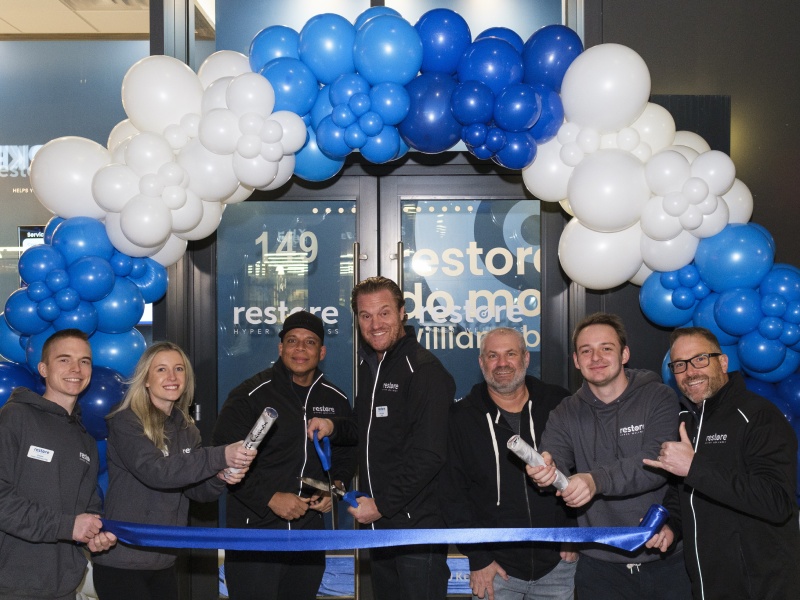
On a February evening in Williamsburg, a blue ribbon stretched across the entrance at 149 Kent Avenue. Balloons crowded the glass doors. Oversized scissors appeared, because even a business devoted to modern machinery must submit to the ancient technology of a ceremonial snip. Erik Geisler stood in the middle of the group, zipped into a black Restore jacket, grinning with the particular relief of someone whose plans had finally become a place.
The photograph is a tidy summary of his career and a quiet joke about it. Geisler spent decades helping brands enter new channels. Now the channel had hinges, rent, staff schedules and a Brooklyn address. The customer did not merely scroll past it. The customer had to walk in.
Geisler is the CEO and founder of Restore Hyper Wellness of Brooklyn and Westchester, a regional, multi-franchise operation within the larger Austin-born brand. That distinction matters. He did not found Restore's national company. He founded the local enterprise that brought its service model to neighborhoods including Park Slope and Williamsburg, then farther north into Westchester County. By 2025, a public congratulations for the Port Chester opening called it the group's fifth location.
The card in the wallet
His first useful interface was smaller. In 1994, while studying marketing at Boston University, Geisler became a founding partner at Student Advantage. The company built a membership and discount program for college students. Before apps turned every loyalty scheme into an icon, Student Advantage had a physical card, campus relationships and a growing database.
In product operations, Geisler was the company's only employee with substantial information-technology responsibilities at an early stage. The web was not yet the obvious answer to every commercial question. Student Advantage's first site began as basic information, then expanded through a "Student Studio" staffed by Boston University students. The business learned to connect member data, corporate partners and student identity while the rules were being written.
That origin explains more than a polished founder bio can. Geisler was not simply around an early internet company. He worked in the untidy translation layer between a new technology, a customer group and established brands. The tools were primitive. The commercial question was durable: how do you make a network useful enough that every side wants to remain inside it?
- 1994Student Advantage
- 2005Early Facebook campaign
- 2010sFacebook agency leadership
- 2020sNew York storefronts
Before the feed became furniture
By 2005, Geisler was a partner and chief strategy officer at the digital agency Noise. That year the agency produced an early marketing campaign on Facebook for Chase card services. Today, a bank appearing in a social feed is as remarkable as a chair. Then, it required a client willing to experiment and an agency able to explain why a collegiate social network belonged in a media plan.
The symmetry with Student Advantage is almost too neat. Once again there were students, identity and a platform that brands did not quite know how to use. Geisler's work sat between the new behavior and the old budget. He has described the common theme of his early companies as changing the way brands advertise. The useful word is changing. In his career, a channel rarely arrives fully formed. Someone has to turn novelty into a legible business case.
He later joined Facebook itself, where he led the platform's technology and telecommunications team for more than four years before directing its U.S. agency team. He also served as managing director of North America agency partnerships and an executive sponsor for premium video.
The durable skill was never mastery of one channel. It was knowing how to make an unfamiliar channel feel usable.From college cards to social feeds to storefronts
This was the institutional version of the translation job. Agencies had clients, habits and billing structures. Facebook had products, audiences and a pace of change that could make last quarter's instruction manual look quaint. The work demanded fluency in both rooms. Geisler emphasizes the "why" behind consumer and business behavior, plus the work of simplifying a complicated idea into a persuasive narrative. Those are marketing virtues. They are also diplomatic ones.
A business with a front desk
Then came the second act. The pixels gave way to premises. By 2023, Geisler was attached to construction and signage work for the Williamsburg and Eastchester studios. Park Slope operated near Barclays Center. Williamsburg opened at the corner of Kent Avenue and North 5th Street. Port Chester followed in a shopping center on Boston Post Road.
A regional franchise group may sound like a narrower canvas after Facebook. Operationally, it is the opposite. A platform executive can influence an enormous system while remaining several steps from an individual transaction. A local operator lives beside the whole chain. The message, booking, staffing, handoff and return visit all land in the same ledger. When something breaks, geography removes the alibi.
Geisler's public comment about automated scheduling is revealing for its lack of grandeur. "It's fun to wake up in the morning and there's somebody new on the schedule that we'd never heard about before because they booked in the middle of the night," he said in a TrueLark customer story. "You'll never get over that." The quoted case study reported 16 new leads booked per month and an eight-times return on the scheduling system for his operation.
It is an operator's delight: not artificial intelligence in the abstract, but an appointment that appeared while everyone slept. The old advertising executive can see acquisition. The founder can see tomorrow's calendar. The front desk can see a name to greet. Technology earns its keep by making a very ordinary morning slightly better.
In a local service business, the funnel has an address. Every digital promise eventually meets a door, a clock and another person.
Brooklyn as a strategy
The local chapter became clearest in August 2024, when Geisler's group became an official partner of Brooklyn Football Club for its inaugural seasons. Corporate partnerships often arrive inflated with language about alignment. This one had a practical neighborhood logic: a new professional club and a growing local operator, each trying to become part of Brooklyn's weekly habits.
"Brooklyn Football Club understands the importance of wellness and recovery and how it impacts its players' ability to shine, so we felt that this partnership was a perfect match," Geisler said in the announcement. He invited players to the group's Park Slope, Williamsburg and Westchester locations, then widened the point to amateur athletes. It was partnership marketing, certainly, but with a map underneath it.
Geisler's known connections tell the same story at different scales. Student Advantage linked students, merchants and universities. Noise connected a bank to an unfamiliar social platform. Facebook connected agencies and advertisers to products that could otherwise feel opaque. His Restore group connects a national franchise system to landlords, staff, local partners and customers in a compact New York territory.
The thread is not a particular industry. It is orchestration. Geisler appears most at home in businesses where several parties need to understand the same proposition from different angles. His public preference for strengths-based teams fits that pattern. So does his career-long curiosity about motives. A good operator must be interested in what the customer wants, but also in what the employee, partner and platform need in order to deliver it.
The second-act advantage
There is a fashionable story about leaving technology for the physical world. It usually presents the former as empty and the latter as authentic. Geisler's record is more useful because it resists that melodrama. He did not throw away the digital playbook. His studios use marketing systems, online scheduling and a large technical stack. The new work adds constraints to the old knowledge.
A storefront cannot be patched at midnight without consequence. A team is not an audience segment. A neighborhood remembers. Scale still matters, but repetition has to preserve the particulars: the greeting, the timing, the cleanliness, the follow-up. Software can remove friction. It cannot perform every act of hospitality.
This is where three decades become an advantage rather than a résumé. Geisler has watched channels pass through a familiar cycle: novelty, explanation, adoption, habit. Student discounts moved online. Facebook advertising moved from experiment to infrastructure. Automated booking is making around-the-clock responsiveness feel ordinary. Each transition rewards the person who can see the new behavior without becoming hypnotized by the tool.
Away from work, Geisler has reassuringly analog interests: cooking, golf and snowboarding. All three punish abstraction. Dinner is edible or it is not. The ball lands somewhere. Gravity keeps its own score. They suit an executive whose latest chapter is measured not only in reach but in open doors.
A career built around consumer behavior eventually reaches the most honest metric: did somebody show up?The appointment book answers every morning
At the Williamsburg ribbon cutting, the answer was visible. Staff and partners filled the frame. The doors were finished. The address was real. Behind Geisler, white letters on the glass repeated the company's invitation to "do more." It is the sort of phrase a veteran marketer knows must eventually survive contact with operations.
The observable work is practical: open local businesses, make them easy to enter, and connect them to the communities around them. There is no need to decorate it. The hard part comes after the ribbon, when the balloons are gone and the calendar begins again.