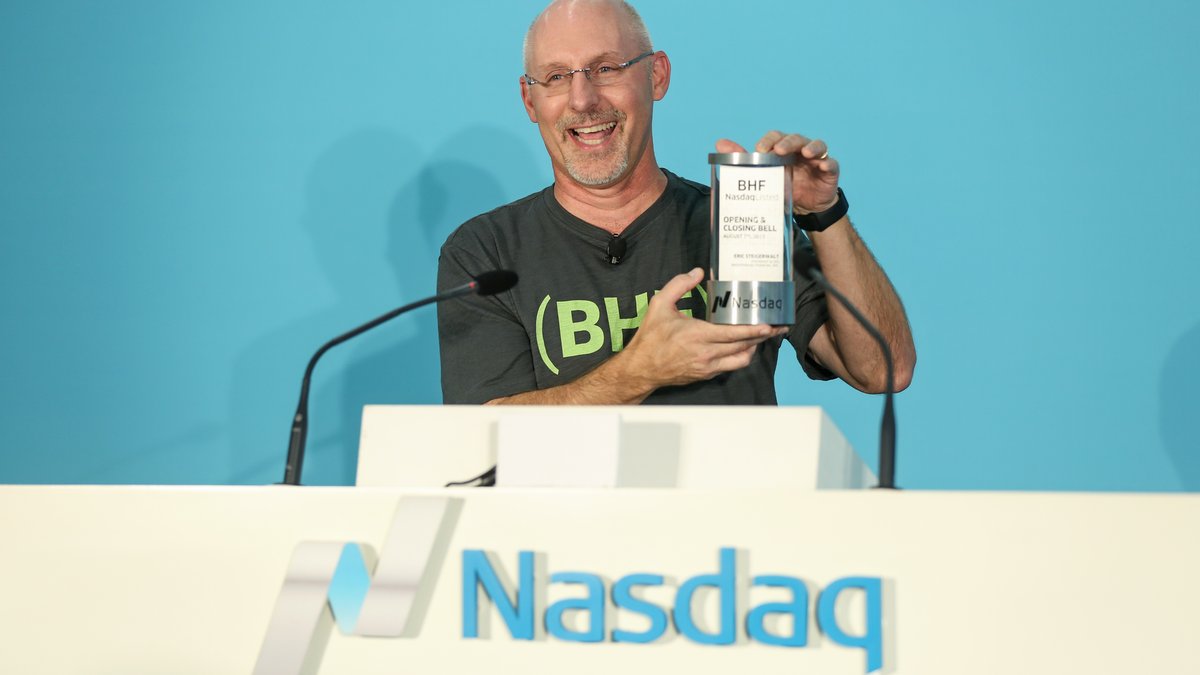
Eric Steigerwalt had two bells to ring on August 7, 2017, and they were in different cities. The morning belonged to Times Square, where Brighthouse Financial marked its first trading day on Nasdaq. The afternoon belonged to Charlotte, where employees joined their chief executive for the closing ceremony. Between the two came a flight south. A company becoming independent apparently required a return ticket.
The photographs show an executive enjoying the occasion. In Charlotte, Steigerwalt held up a commemorative Nasdaq plaque, wearing a dark shirt with BHF across the chest. The stock symbol had become something you could wear. For a business emerging from MetLife, one of insurance's familiar names, those three letters carried a considerable assignment: persuade people that a newly independent company could keep very old promises.
There was a small comedy unfolding in New York, too. Tourists photographed Steigerwalt beneath the enormous Brighthouse display without necessarily knowing who he was. “It was like Brighthouse 3-D,” he recalled that autumn. Corporate recognition had arrived in its most democratic form: strangers taking pictures, just in case. For an insurer introducing its name, even accidental curiosity had its uses.
A new name with an old balance sheet
Brighthouse's separation from MetLife was completed on August 4, three days before the ceremonies. At launch, it reported $219 billion in assets and more than 2.7 million insurance policies and annuity contracts in force. Those figures give the occasion its peculiar character. Steigerwalt was helping introduce a new public company that already had millions of obligations. There was no leisurely period in which to discover whether the machinery worked.
He had been appointed to lead Brighthouse in 2016, while it was still inside MetLife. His preparation ran through the financial workings of the parent: individual-business chief financial officer, treasurer, U.S.-business chief financial officer, interim group chief financial officer, then head of U.S. Retail. Read consecutively, the jobs describe a widening view of the same institution. Each promotion brought more of the balance sheet, and more people, into the frame.
The dates matter because the new company did not materialize on the morning of a bell ceremony. Its leader had already spent years inside the business from which it emerged. His task involved separating an operation he knew, while giving it an identity people outside MetLife could recognize. Familiarity offered a practical advantage. It also meant that declaring independence would be much easier than completing it.
The apprenticeship in going public
Steigerwalt graduated from Drew University with a bachelor's degree in economics. Before MetLife, he worked in finance at Equitable Companies and traded derivatives at Fossett Corporation. In 1998 he joined MetLife, managing operational aspects of its demutualization and initial public offering. He subsequently became its first head of investor relations. Long before Brighthouse had a ticker, he had worked on the complicated business of giving an insurance institution one.
Demutualization changes an insurer's ownership structure; an IPO introduces its shares to public investors. Both require an institution to explain itself to a new constituency. Investor relations adds another discipline: keeping that explanation intelligible after the celebration ends. A financial executive can understand a business perfectly and still discover that shareholders have understood something else. Steigerwalt's early MetLife assignment put him near that intersection of operations, ownership and explanation.
His later appointments added responsibility for funding, financial management and a large retail operation. By the time he took on Brighthouse, the résumé combined technical finance with running a business. That combination helps explain the shape of the challenge he accepted. A spin-off needs someone who can discuss a capital structure and then deal with the less elegant question of how the company will function on Monday morning.
The unglamorous work after the bell
Brighthouse's first annual report makes a useful companion to the celebratory photographs. In their letter to shareholders, Steigerwalt and board chairman C. Edward Chaplin described the next priorities: leaving transition service agreements, developing distribution, investing in technology and establishing the brand. The list is admirably resistant to confetti. A separate stock listing is a moment. Separate operating systems are a project.
The company had begun selling products under its own name in March 2017. In June it issued $3 billion in bonds, split equally between ten-year and thirty-year maturities. It entered public life with a capital structure to maintain and a distribution network to develop. The shareholder letter set out an ambition to become more cost competitive, with outside service providers playing a role in a more variable expense structure.
For Steigerwalt, that made independence a collection of connected decisions. Product design affected capital needs. Distribution affected sales. Technology affected the cost of serving business already written. Brand recognition affected whether financial professionals would put the new name in front of clients. An insurance executive's work can look abstract from a distance; here, the abstractions had an unusually practical address. Someone had to make each of those pieces fit.
“We want simplicity as part of the DNA of the company.”
Eric Steigerwalt, 2017
A chief executive on the new-hire calendar
By Brighthouse's fifth anniversary, Steigerwalt was describing another kind of infrastructure. He said he met new hires every month, recorded employee podcasts and used engagement feedback to change training and recognition programs. He also described lunches with the company's Values Award winners. These are modest details, which makes them useful. A monthly appointment tells us more about an executive's stated management practice than another adjective attached to “leadership.”
These accounts are his own description of how he worked. Their interest lies in the mechanisms: a meeting, a recording, a survey, a response. For a company trying to develop its own habits after a separation, repetition has an obvious purpose. Employees need opportunities to understand the organization they have joined, and management needs ways to hear what working there is actually like. The calendar is where those intentions acquire a cost in time.
The paycheck after the paycheck
In April 2024, Brighthouse joined BlackRock in announcing the availability of LifePath Paycheck in defined contribution plans. Brighthouse was one of two insurers selected for the arrangement. The target date strategy would include annuity contracts over time, with participants ultimately able to use part of their account balance to buy an individual retirement annuity. The aim was to make lifetime income more accessible through workplace retirement saving.
That partnership brings Steigerwalt's business into a familiar household problem. A retirement account supplies a balance. People still have to decide how that balance becomes spending money. LifePath Paycheck offered a route from an investment strategy toward an optional guaranteed income stream. The distinction matters: access to a product and a participant's decision to purchase it are separate steps. Brighthouse's role was to help supply the insurance behind that option.
The proposal also illustrates the distance between a CEO's title and the work customers eventually encounter. An executive may negotiate with another financial institution; a worker encounters a choice inside a retirement plan. Steigerwalt's announced ambition was to help more Americans prepare for retirement. In this instance, pursuing it meant working through an investment manager and employers, extending the chain of relationships between the insurer and the eventual individual buyer.
Another board, another ownership question
In March 2025, FTI Consulting elected Steigerwalt and Janet Zelenka as independent directors. His appointment brought his insurance and finance experience to a professional services company's boardroom. He described organizational culture in terms of collaboration, accountability and continuous learning. The vocabulary was consistent with his earlier attention to employee feedback. FTI's appointment also placed him on the oversight side of another institution's decisions, alongside his responsibilities as a chief executive.
Then Brighthouse's own ownership returned to the foreground. On November 6, 2025, the company announced an agreement for an Aquarian Capital affiliate to acquire it for approximately $4.1 billion in cash, or $70 per common share. The announced plan retained the Brighthouse name, Charlotte headquarters and Steigerwalt as president and CEO after closing. The executive who had led the company into independent public ownership was now supporting a different structure for its future.
The negotiations had required more than agreement on a headline price. During August 2025, Steigerwalt discussed the risks of a prolonged sale process with the board and told Aquarian's Rudy Sahay that committed financing was needed to advance discussions. That episode gives a sharper view of his role than the eventual announcement alone. Supporting a transaction also meant establishing what the other side had to demonstrate before the company could proceed.
Common stockholders approved the merger agreement on February 12, 2026. Regulatory review remained a separate matter. In August, Delaware's insurance department described an examination involving outside specialists and coordination with other regulators. It said the transaction could proceed only after a final order. Ownership of an insurer involves people whose relationship with the business is a policy or contract, so the process extends beyond the shareholders voting on a price.
The business continues between announcements
Brighthouse's second-quarter 2026 results offered a snapshot of the operation Steigerwalt continued to lead: $2.4 billion in annuity sales, including more than $2.1 billion in Shield Level Annuities. Overall annuity sales rose from the previous quarter but fell from the same quarter a year earlier. The two comparisons belong together. A productive product line and a softer total can occupy the same earnings release without either cancelling the other.
His career has repeatedly brought him to moments when an institution changes how it is owned or how it presents itself to the outside world. The lasting work happens around those moments: financing, operating decisions, relationships with distributors, conversations with employees. The plaque from 2017 records a satisfying day with a beginning and an end. The promises on the company's books run on a considerably longer schedule. That is the timetable Steigerwalt's job has always had to accommodate.
Continue reading
- Brighthouse Financial
- Eric Steigerwalt on LinkedIn
- The Long View interview
- Brighthouse newsroom
- FTI board appointment
- 2017 annual report
- Aquarian transaction announcement
- Delaware acquisition review
- Brighthouse videos on YouTube
- Leadership biography
- The 2017 launch interview
- Second-quarter 2026 results
- Merger background and negotiations