There is a troublesome gene called DUX4 that most adult muscle cells keep silent. In people with facioscapulohumeral muscular dystrophy, or FSHD, that silence breaks. The gene is heard where it should be quiet; muscle weakens over time. Epicrispr Biotechnologies has organized an entire company around the idea of restoring the hush.
The company does not propose to cut the offending DNA. Its lead experimental medicine, EPI-321, is designed to add an epigenetic mark to the D4Z4 region linked to DUX4 expression. Think of it as changing the instructions for reading a page while leaving the letters on that page in place. A single intravenous dose carries the machinery to muscle in an adeno-associated virus, or AAV. The therapy is still in a first-in-human study, with no approved Epicrispr product for patients to buy.
- What it does: develops gene-regulating medicines, led by a treatment intended to suppress DUX4 in FSHD.
- What happened: the first three evaluable patients at six months gained an average of about 370 mL of lean muscle volume in a company-reported interim analysis.
- What it costs: Epicrispr has announced $55 million, $68 million and $90 million financing rounds - $213 million in those disclosed raises.
- What remains: a small, open-label signal must survive longer follow-up and controlled testing.
The quieter kind of CRISPR
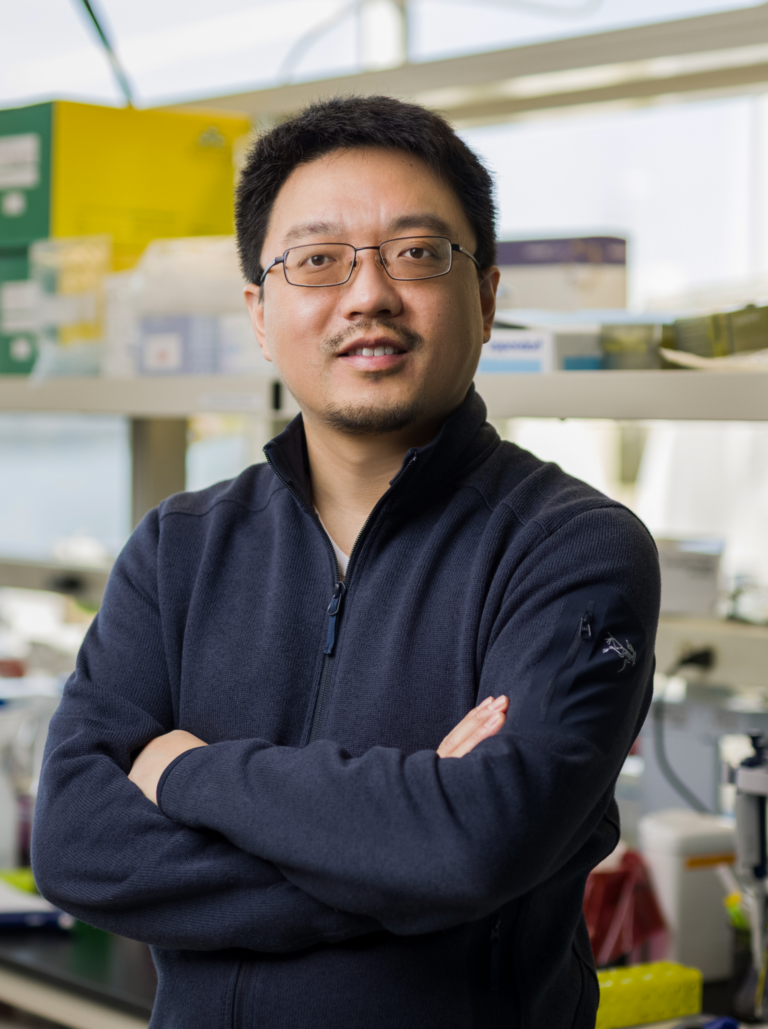
Scientific founder Lei Stanley Qi helped invent CRISPRa and CRISPRi - ways to activate and interfere with gene expression. When Epicrispr emerged publicly in 2022, the attractive claim was that these ideas could become medicines. Its Gene Expression Modulation System, or GEMS, pairs a DNA-binding protein with a guide RNA and a modulator. The guide gives an address. The protein gets there. The modulator changes the volume.
A platform diagram, not a claim that every program uses the same components.
Smallness matters here. An AAV vector has limited cargo room, so Epicrispr has invested in compact proteins and effectors that can fit in one delivery vehicle. The company has an exclusive human-use license to CasMINI, a miniature Cas protein developed in Qi's lab. Yet the star of this clinical story is another member of the toolkit: Epicrispr says EPI-321 uses CasONYX. A modular platform earns its name when the company selects a part for the job instead of insisting the famous part play every role.
Why this disease, and why this measurement?
FSHD is a demanding place to start. It affects muscles unevenly, and its pace differs from person to person. Epicrispr chose a target with a defined biological story - DUX4 should be silent in healthy muscle - and a delivery route with clinical precedent. EPI-321 aims to re-methylate D4Z4, the region whose loss of methylation helps let DUX4 speak. Before human dosing, the company reported DUX4 suppression and improved muscle measures in preclinical systems. Those experiments made a trial reasonable; they did not prove a human benefit.
The company also chose to look closely. In 2025 it partnered with Springbok Analytics to analyze whole-body MRI scans, measuring lean muscle volume, fat infiltration and other features in individual muscles. MRI is an exploratory measure in this trial, rather than its primary endpoint. That distinction matters. A sophisticated ruler does not turn a preliminary result into a verdict, but it may reveal which questions to ask next.
In June 2026, Epicrispr said the first three evaluable patients at six months had all gained lean muscle volume, by about 370 mL on average. The company also reported biomarker changes consistent with DUX4 suppression and favorable trends in strength and function. At its May data cutoff, nine people had received EPI-321 and no serious adverse events had been reported. By July, all twelve participants in the study's dose-escalation portion had been dosed.
“Although these are early results and additional follow-up is needed, the observed changes in lean muscle volume are encouraging.”Russell Butterfield, principal study investigator
The attractive phrase is “muscle gain.” The necessary phrase is “three evaluable patients.” The study is open-label, with no randomized placebo group in that early analysis. FSHD itself varies considerably. Those facts do not erase the signal; they tell us how hard it will be to establish that EPI-321 caused it, that the gain lasts, and that it helps people move, function and live better.
The first deadline did not survive contact with reality
At its 2022 launch, Epicrispr said its lead FSHD program was on track for clinical initiation in 2023. A 2024 company update projected dosing that year. The first patient was actually dosed in August 2025, after regulatory clearances and a $68 million Series B. This is the least glamorous and perhaps most instructive part of the account: a biotechnology promise can be scientifically coherent and still take years longer to reach a person than its opening slide suggests.
What changed publicly was the level of proof the company had to produce. The broad 2022 pitch named five initial indications. The current pipeline leads with one clinical program and shows research-stage work in Duchenne muscular dystrophy and retinitis pigmentosa 4. The focus is understandable. A platform is an invitation to imagine dozens of medicines; a clinical trial requires one medicine, one disease, a manufacturing process, dose choices, endpoints and actual volunteers.
Five initial disease areas, a compact Cas license, and a plan to enter the clinic quickly.
One lead FSHD candidate in people, objective MRI analysis, and a financing round aimed at pivotal studies.
A market waiting for proof
There is no approved disease-modifying FSHD therapy. That does not mean Epicrispr owns the field. Avidity Biosciences is developing a DUX4-directed RNA therapy called del-brax. Dyne Therapeutics has an FSHD program. Fulcrum Therapeutics' losmapimod, a different kind of drug, missed the primary endpoint of a Phase 3 FSHD trial in 2024. The lesson is uncomfortable but useful: an appealing mechanism and earlier promising measures do not settle the question of clinical benefit.
Epicrispr's commercial position is still provisional. It is a venture-funded drug developer, not a seller of an approved treatment. Potential future customers are patients and health systems if a medicine clears the scientific, regulatory and reimbursement hurdles. There is also a business-to-business route: Kite, a Gilead company, licensed access to Epicrispr's gene-regulation platform for research on next-generation CAR T-cell therapies against blood cancers. Financial terms of that agreement were not made public.
The three announced funding rounds add to $213 million: $55 million at launch in 2022, $68 million in the first close of a 2025 Series B, and a $90 million Series C in August 2026. The latest round, co-led by Octagon Capital and Janus Henderson Investors, is intended to carry EPI-321 toward pivotal testing and expand the pipeline and manufacturing. Capital can buy more experiments. It cannot buy their outcome.
One investor in the Series B is SOLVE FSHD, a venture philanthropy organization founded by Chip Wilson, who lives with the disease. Its participation gives the round a particular human weight, though philanthropy's conviction is no substitute for trial evidence. Meanwhile, what a future EPI-321 dose might cost is unknowable from a preapproval program: manufacturing scale, clinical results and reimbursement decisions still lie ahead. The current price tag is therefore the cost of finding out, not the price of treatment. That is a useful way to read a biotech financing announcement, especially when a single promising graph threatens to become a sales pitch.
The part worth copying
Epicrispr's reusable idea is a discipline of constraints. Start with a clear disease mechanism. Build the therapeutic parts around the delivery vehicle's capacity. Choose a biological readout that may register change before a slower functional endpoint does. Name the denominator every time a result is announced. And allow a platform's ambition to be judged by one candidate's performance in people.
There are circumstances in which that approach may disappoint. If the AAV cargo fails to reach enough affected muscle, if DUX4 suppression is too weak or too brief, or if an MRI change does not translate into durable function, the elegant design will be insufficient. The current study is built to begin answering those questions; later controlled work will have to answer them more convincingly. For now, Epicrispr has done something consequential but narrower than the headlines can make it sound: it has moved a non-cutting gene-control idea into humans and found an early signal worth testing harder.