The most revealing moment in Energy Exemplar’s history involves a young consultant, a model he did not trust and a quiet act of professional rebellion. In the late 1990s, Glenn Drayton was testing electricity-market designs. The commercial software available to his firm kept returning answers that, in his telling, did not make sense. So he dusted off code from his operations-research PhD and slipped his own simulation results into the project. The workaround gave him a business idea: energy planners needed a model flexible enough to change with the market, rigorous enough to optimize the system and transparent enough to explain itself.
That code was first called Wemsim, for Wholesale Electricity Market Simulator. It became PLEXOS, then the center of a company founded in Adelaide in 1999 as Drayton Analytics. A quarter-century later, Energy Exemplar says it serves more than 600 clients in roughly 90 countries. Blackstone and Vista Equity Partners acquired it in May 2024 in a transaction widely reported at about $1.6 billion, though the companies did not publish the price.
The joke lands because the product now sits close to decisions that are anything but academic. Grid operators use it to test whether the lights stay on during extreme weather. Utilities compare power plants, batteries, transmission projects and retirement schedules. Developers study the economics of an electrolyzer. Traders forecast congestion. Banks stress-test energy portfolios. Governments explore how policy changes what gets built. PLEXOS does not produce the future. It produces a disciplined argument about several possible futures.
The product is a rehearsal, not an oracle
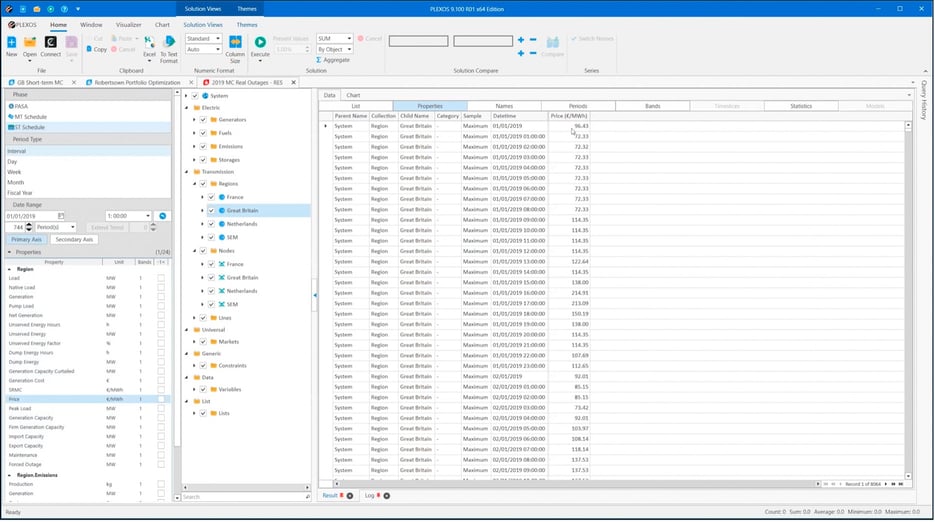
An energy system is an intricate queue of constraints. Demand must be met each moment. A wind farm depends on weather and transmission. A gas plant depends on pipeline capacity and fuel price. Hydro depends on water. Batteries must decide when to charge and discharge. Carbon rules change the economics. The software represents those assets and rules, then uses optimization to search for a least-cost or otherwise preferred result. Customers can run long-term capacity plans, medium-term risk studies and short-term dispatch schedules, down to intra-hour resolution.
The distinguishing pitch is co-optimization. Many tools model one commodity or one horizon. PLEXOS connects power, gas, water, hydrogen, carbon and data, so a constraint in one system can alter the result elsewhere. It also exposes equations, objective functions and constraints for inspection. In a field vulnerable to black-box confidence, auditability is not decoration. A regulator, executive or investment committee needs to know why the model preferred one path.
Energy Exemplar has wrapped that engine with a broader shelf. Aurora is a faster, approachable North American power-market forecasting and portfolio tool. Simulation Ready Datasets reduce the grim prelude to analysis: gathering, cleaning, documenting and calibrating assumptions. PLEXOS Cloud adds hosted compute and collaboration. PLEXOS Playbooks provide editable starting templates. Pulse and PLEXOS Intelligence add conversational analysis, agents and workflow automation. Adapt2, acquired in 2024, handles bidding, scheduling, trade capture, settlements, renewable certificates and compliance in North American markets.
What failed first became the sales pitch
The first failure was not a grid. It was the incumbent modeling workflow. Drayton needed to compare market designs with small but important differences without hardwiring a new linear program each time. Existing commercial results frustrated him; his own engine automatically built the formulation from data and settings. That flexibility became PLEXOS’s organizing idea.
Then the company hit a more ordinary constraint: talent. For its first six years, the team had only four or five people in Adelaide. Instead of pretending it could staff every market, Energy Exemplar partnered with consultancies that already had regional expertise and customer access. Users at SMUD and NCPA helped point California ISO toward PLEXOS after the California energy crisis. Drayton remembers taking a California ISO call in the family laundry, during the rinse cycle. The subsequent work pushed the model from smaller systems toward full commercial scale.
What changed Drayton’s mind about outside capital was not the first purchase offer. He had received approaches for years and thought the company was not ready. What he wanted was a partner to professionalize the operation and accelerate growth. Riverside invested in 2017, recruited CEO David Wilson, built an international management team, funded cloud products and grid databases, and expanded sales, support and development. Riverside says the employee base grew sevenfold and the company posted roughly 30 percent compound annual growth from 2018 to the announced sale in 2023.
Faster models buy more questions
The cleanest customer result comes from the Australian Energy Market Operator. AEMO runs electricity and gas systems and produces planning studies that can shape national investment. By 2018, its forecasting and technology teams believed their legacy stack would not cope with more data and more scenarios. After internal governance and due diligence, AEMO worked with Energy Exemplar to build the investment case for PLEXOS Cloud.
The central planning scenario fell from 22 hours to five. A step-change scenario dropped from 58 hours to four. A constrained reliability run went from 39 hours to 17. The payoff is not merely saved compute time. Shorter runs let analysts test more assumptions before a deadline, rerun after a challenge and spend more time interpreting the result. In planning, speed widens the space of doubt.
Customers apply that space differently. MISO uses PLEXOS for resource adequacy and to study wind-hydro coordination with Manitoba Hydro. National Grid ESO selected PLEXOS and its cloud platform under a multi-year agreement to model British grid expansion, offshore wind, gas-power interactions and pathways toward net zero. CenterPoint uses it for gas forecasting, purchasing, scheduling and hedge evaluation. Finnish developer Flexens modeled electricity procurement and the economics of utility-scale electrolysis. The buyer is usually not seeking a generic dashboard. It is trying to defend a particular decision in a room full of engineers, executives, regulators or capital providers.
A software suite moves closer to the control room
The business model follows enterprise infrastructure software: sales-led subscriptions and licenses, cloud compute, recurring datasets, implementation, training and support. Public list pricing is absent. That matters for buyers. The invoice is only one part of the cost; model construction, data governance, scenario design, solver compute, training and validation all consume scarce expert time. A sophisticated platform can reduce repeated work, but it cannot eliminate the need to know the system being modeled.
Energy Exemplar’s acquisitions reveal where it wants to sit. Aurora broadened North American forecasting. Adapt2 moved from studying the market toward submitting bids and reconciling settlements. On September 1, 2026, the company bought Prague-based SIMONE Research Group and Germany’s LIWACOM. SIMONE brings more than 50 years of physical gas-pipeline simulation, plus network monitoring, leak detection and modeling for biomethane, hydrogen and carbon dioxide. The planned combination closes a useful loop: test an economic gas scenario in PLEXOS, then check whether the physical network can actually carry it.
Competitors occupy parts of the same map. Yes Energy’s EnCompass, Hitachi Energy’s PROMOD and GridView, Siemens products, specialist forecasting platforms and in-house Python stacks all offer alternatives. Energy Exemplar’s claim is breadth: multiple commodities, time horizons, datasets and workflows in one environment. Breadth can also be the burden. If the question is narrow, the data poor or the team inexperienced, a simpler model may be cheaper and more honest.
What another company can copy
- Build around the failure users already work around, not a fashionable feature list.
- Borrow distribution from expert partners when the product needs local domain knowledge.
- Make consequential outputs inspectable. Trust grows when assumptions can be challenged.
- Sell the boring layer too: maintained data, training and repeatable templates reduce adoption friction.
- Expand along the customer’s workflow, from planning to decision to operation, rather than collecting unrelated products.
None of this works by installation alone. Optimization will confidently solve the world described by its inputs, even when that world is stale, incomplete or politically convenient. The approach struggles when organizations cannot maintain datasets, lack people who understand market rules and physical constraints, or treat one scenario as prophecy. It is also excessive when the decision is small and a transparent spreadsheet will do. The best users keep humans in the loop, calibrate against history, document assumptions, run adversarial scenarios and explain the range rather than worship the midpoint.
Energy Exemplar’s durable insight is less glamorous than artificial intelligence: major energy choices deserve rehearsal. The founder learned it when a commercial model failed his sniff test. AEMO learned it when legacy runs consumed days. Investors learned it when a niche Adelaide product grew into infrastructure software with a reported ten-figure price. The grid still has to survive weather, politics, fuel shocks and human judgment. PLEXOS simply gives those arguments somewhere cheaper to happen first.