There are founders who begin with a spreadsheet, founders who begin with a grievance and founders who begin by staring at the floor. Emily Splichal belongs to the third sort. For years, the New York podiatrist and movement educator watched an industry obsess over shoes while giving less thought to the thing shoes touch. The ground was treated as scenery. Splichal wondered whether it was actually part of the plot.
Her answer became Naboso, a company whose name means “barefoot” in Czech and whose products are built around a textured material. The company started in 2017 with a fitness mat, a familiar rectangle carrying an unfamiliar argument: the surface beneath a person could be designed to provide more sensory information. The same argument later migrated into insoles, socks and compact tools. A single observation became a product family.
The origin sounds neat in retrospect. Splichal’s route to it was anything but linear. Before she was a doctor, she was a competitive gymnast for roughly 13 to 15 years. Before she ran a technology company, she taught fitness classes. She studied podiatric medicine, completed surgical training at Beth Israel Medical Center and Mt Vernon Hospital, and earned a master’s degree in human movement from A.T. Still University. Each room taught her a different dialect of the same subject: how people meet the world through movement.
The gymnast kept her vote
Medical training gave Splichal technical authority, but gymnastics supplied the older intuition. In a gym, the floor is never neutral. Its spring, firmness and texture change what the athlete can feel and do. Gymnasts learn body tension, contact and control before they possess tidy scientific language for any of it. Splichal carried that embodied education into fitness and then into podiatry.
She has described herself as a sprinter rather than a distance runner, drawn to quick movement, aerial straps and silks, and later the ballroom dance floor. She has named New York City Ballet and Cirque du Soleil among the performances she enjoys watching. The detail matters because her work did not emerge from a purely clinical fascination with anatomy. It grew from delight in movement: doing it, studying it and watching other people make difficult motion look inevitable.
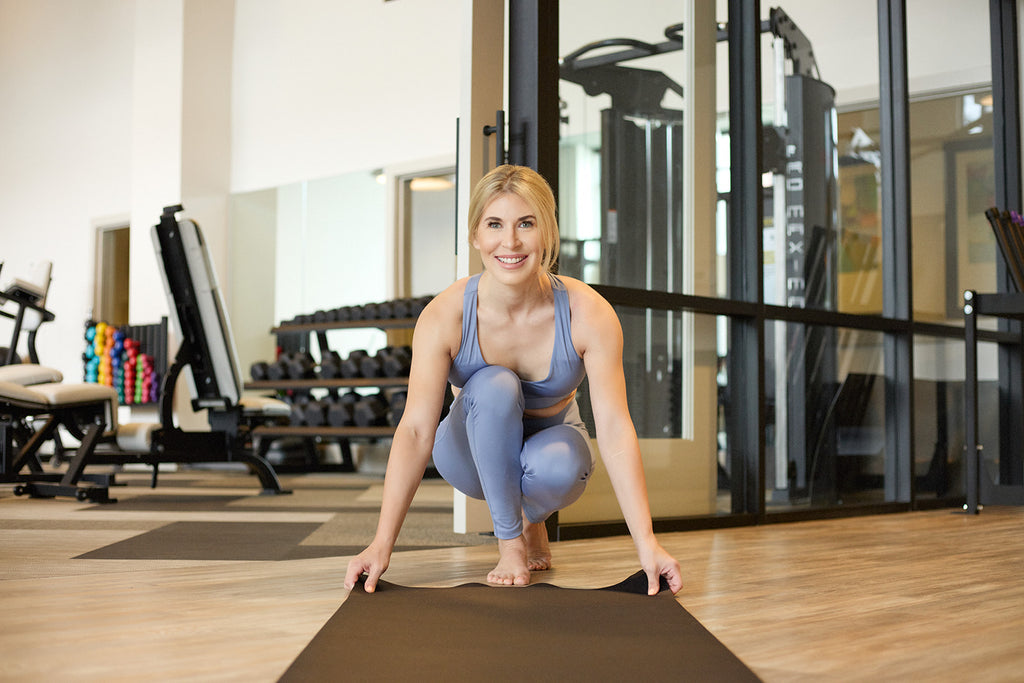
That pleasure also explains why teaching became central. Beginning in 2012, Splichal traveled internationally to teach barefoot science, foot function and human movement. She has taught in at least 35 countries and reached more than 25,000 professionals. She created programs including the Barefoot Training Specialist certification, BarefootRx and the BARE Workout. The teacher came before the product founder, which gave her an unusually useful form of market research: years of hearing how practitioners interpreted an idea once it left her mouth.
Teaching also trained her for the awkward work of introducing a category that does not explain itself. A shoe looks like a shoe. A textured insole asks for a minute of attention. Splichal had already practiced turning specialist language into demonstrations, workshops and memorable phrases. Television appearances on programs hosted by Oprah Winfrey, Rachael Ray and Meredith Vieira widened that practice; podcasts and online video made it continuous. Her favored line, “Life is sensory,” compresses the technical premise into three portable words. It can sit above a lecture, beside a product or inside a social post without changing clothes. For a founder, that kind of verbal economy is not merely branding. It reduces the distance between an unfamiliar object and the customer’s first useful question. Naboso sells physical products, but Splichal’s fluency as an educator helps create the conceptual shelf on which those products can sit.
A narrow question with room to travel
While traveling, Splichal noticed a curious asymmetry. Minimal footwear and barefoot training had become lively topics, yet the design of surfaces and insoles remained comparatively conventional. Her question was almost childlike in its clarity: if changing a shoe matters, why would the thing touching the foot inside that shoe not matter too?
Naboso began with one textured fitness mat. People liked it, Splichal later explained, but the mat carried an obvious commercial ceiling. Not everybody exercises barefoot; not everybody exercises at all. Instead of abandoning the underlying idea, the company separated the thesis from its first container. Texture could leave the mat. It could live in an insole, a sock or a smaller tool.
This is the most stealable part of the Naboso story. Product expansion did not require the company to invent an unrelated reason to exist every season. It required identifying the smallest durable idea inside the original object, then asking where that idea could travel. The forms multiplied while the argument stayed recognizable. In a market crowded with objects, consistency can be its own kind of wit.
Look for the assumption your industry treats as furniture. It may be the product.
Separate the core thesis from the first format. A mat can be finite while a material travels.
Education is infrastructure when customers need a new vocabulary for what you sell.
Teaching the texture
Splichal’s instrument remained translation. A sensory-material company cannot rely on a shelf label to do all the work. Its customers and professional partners need to understand what the texture is meant to do and how the products differ. Her certifications, speaking, articles and books form an education layer around the objects. Barefoot Strong became a book, blog and philosophy. Sensory Sapiens, published in 2025, extended the same broad thesis into a new volume. That year she also launched Root to Rise, a podcast that lets her explore the ideas in conversation and solo episodes.
Growth, with its shoes off
Naboso’s expansion became international in a different way in 2021, when the company entered Japan with a small group of mats and insoles. The assortment there grew to more than two dozen products. In December 2024, Naboso closed a $3 million funding round and strategic partnership with Protea Japan, whose executives joined the board. The stated plan was to grow the team, speed up the product roadmap and support a wider global presence.
The deal suited Splichal’s view of partnership. She said it was important to find backers who understood both the product vision and company mission. Money can accelerate a catalog; aligned distribution can teach it to speak in another market. Naboso’s history in Japan before the investment gave the arrangement a courtship rather than a blind date.
By 2026, Splichal remained CEO, signing Naboso’s annual report filed with the U.S. Securities and Exchange Commission. The corporate paperwork sits at the less glamorous end of a founder’s life, beside inventory counts and shipping problems. Splichal seems comfortable there too. She has described the warehouse as one of her best places to think. Leadership, in her account, might mean answering a technical question, testing a prototype, packing boxes and resolving a logistics hiccup before 10 in the morning.
It is tempting to polish a career like hers into a single bold pivot: surgeon puts down scalpel, founder picks up texture. The more interesting truth is cumulative. Gymnastics taught contact. Fitness taught communication. Medicine supplied rigor. International workshops revealed which questions persisted across rooms and borders. Writing sharpened the argument. The warehouse demanded that the argument survive cardboard, stock levels and delivery dates.
The useful oddness of looking down
Splichal’s stated aspiration is large: help people reconnect with the sensory side of movement and carry that idea across ages, activities and countries. Her method is agreeably specific. She looks at the exact point where person, product and world meet. Plenty of businesses promise transformation from above. Naboso begins at floor level.
The founder lesson is not that everyone should start a foot-products company. It is that expertise earns its keep when it notices neglected details. Splichal saw an industry discussing footwear and asked about the surface. She saw a successful mat and asked whether its material could escape the rectangle. She saw her own limits and brought in a partner whose strengths were different. She saw education not as a marketing garnish, but as part of the product’s route into the world.
There is a playful symmetry to the whole career. The former gymnast built a company around balance. The trained surgeon grew by stepping away from surgery. The global teacher found a business in the square inches immediately beneath us. Splichal likes the phrase “Life is sensory.” Naboso is her attempt to make that sentence tangible. One can argue with a thesis. It is harder to ignore one while standing on it.