At Pepsi Bottling Ventures, the trouble began before a truck ever arrived. A lean transportation team had to assemble a freight bid, send it to carriers and brokers, then corral the replies into something comparable. Transportation manager Tucker Cowlbeck described the old process as “messy and complicated.” Buying transportation had become a transportation problem of its own: moving information from one inbox to another. For a small team, that work can determine whether another bid happens at all.
- Run annual bids, mini bids and spot buying in ProcureOS.
- Keep existing carriers; add marketplace capacity where useful.
- Judge the quote beside the carrier’s service record.
This is the opening Emerge has chosen. Its customers are shippers, the businesses paying to move goods, and its product tackles the buying work around those movements. Who should carry a particular route? What should it cost? Can the carrier actually handle it? ProcureOS, its software platform, brings those questions together through contract bidding, spot quotes, rate comparisons and carrier performance records.
The interesting part is the clock. A yearly request for proposal, or RFP, establishes prices and preferred carriers. But freight markets keep moving after the invitations close. A bargain on bid day can become an expensive habit months later. Emerge’s bet is that procurement improves when the next decision can use information the last decision never had.
02A familiar carrier, a wider market

Andrew and Michael Leto were hardly tourists in this business. Before Emerge, they had built freight brokerage GlobalTranz and freight visibility company 10-4 Systems, later acquired by Trimble. Emerge dates its founding to 2017. Their experience matters because the product has to accommodate established carrier relationships while introducing competition. A shipper’s trusted provider is more than a cell in a spreadsheet.
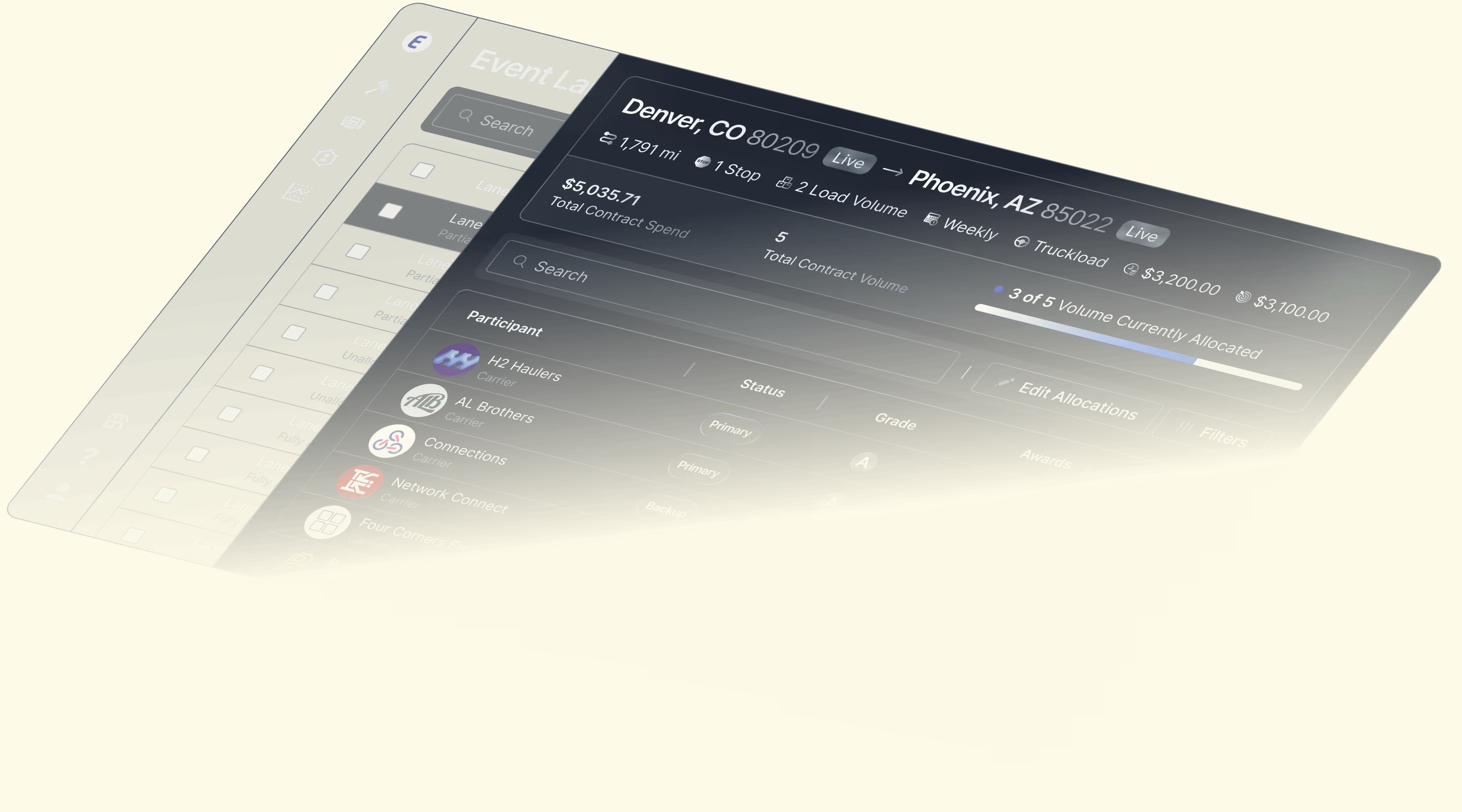
ProcureOS lets a customer invite existing carriers to an annual bid or a smaller mini bid covering selected lanes. Alongside that private network sits Emerge Marketplace, which advertises more than 45,000 vetted carriers. The customer can add capacity where it makes sense. There is also a software-only option for companies that want to keep procurement within their own network.
In the daily spot market, the workflow moves from requesting quotes to comparing, awarding and booking. Dynamic Book It Now adds starting and ceiling rates and immediate carrier booking. Contract tools tackle a different calculation: how to distribute freight among providers while considering price, capacity and service. The shared workspace is the attraction. Another collection of disconnected quotes would merely relocate the mess.
“what are we trying to solve for shippers?”Mark McEntire / CEO, September 2026
03The cheap bid has homework
This puts Emerge between procurement software and a freight capacity marketplace. Buyers can also consider specialist tools such as GoodShip, broader transportation platforms such as Shipwell, or a managed transportation relationship such as Uber Freight. These are different buying decisions. Emerge’s particular proposition combines bid management, market comparisons and an optional carrier network, rather than requiring a shipper to assemble that combination separately.
Its data partnerships make that proposition more concrete. FreightWaves SONAR supplies market intelligence; project44 provides tracking connectivity. Carrier scorecards bring safety and compliance information together with custom grading. The implication for a buyer is practical: compare the rate with the market, then compare the provider with the work. A low quote deserves questions about the service behind it.
Consider Ace Hardware. In August 2026, Emerge reported an award from the retailer after nearly 3,800 shipments that year, with 98 percent on-time delivery and less than 1 percent tender rejections. Those are company-reported results from one relationship. Still, they make a more useful test than a savings slogan: did the freight get accepted, and did it arrive?
04First, Emerge had to see its own bill
Building the system took outside capital. A $20 million Series A announced in February 2020 was led by NewRoad Capital Partners. A $130 million Series B followed in September 2021, led by 9Yards Capital, Tiger Global Management and The Spruce House Partnership. The company earmarked that later round for product development, research and enterprise sales.
Then the market slowed. A Mosaic customer case study describes Emerge’s finance team trying to understand its own expenses while working through manual Excel reports. Migrating from QuickBooks to NetSuite had not, by itself, solved the visibility problem. Payroll and operating costs still needed to be brought into a view people could use.
Emerge adopted Mosaic, connected financial and workforce data, and introduced monthly budget reviews. The case study reports more than $1.2 million in expense reductions, including identification of $100,000 in monthly technology savings. This is an unusually useful wrinkle in the company story. The seller of better purchasing visibility had to confront the same management problem internally: information was present, but acting on it took too much work.

05The next bid starts sooner
Mark McEntire became CEO effective September 2, 2026, returning after an earlier Emerge operating role and a stint leading Princeton TMX. Michael Leto remains president; Andrew Leto holds the founder role. McEntire’s September argument was that procurement must become a continuing process. His starting point was plain: “what are we trying to solve for shippers?”
Emerge introduced the ProcureOS name in August 2024, building on existing procurement tools and freight relationships. That makes adoption a practical question: which buying routine needs to move first, and who must participate for it to work?
The product is also widening. On September 22, Emerge announced air, ocean and LTL contract bidding for enabled ProcureOS Pro customers. Custom lane templates accommodate units such as containers and kilograms. That matters because a truckload-shaped form can force other modes back into spreadsheets. The release covers bidding and awards; it does not add air or ocean execution and tracking.
Commercially, customers can buy a ProcureOS license or use a Marketplace arrangement with platform access included. Pricing is tailored to capabilities and the freight program. For a prospective customer, the sensible calculation is the quoted bill against time saved, buying outcomes and the effort of onboarding carriers.
There is a habit here any procurement team can copy: revisit the lanes that drift, compare equivalent bids, and keep service performance beside price. The approach depends on carriers participating and on usable shipment information. A quiet marketplace or poorly specified bid gives software little to work with. The payoff comes when the next quote arrives and the buyer has enough context to ask a better question.