The first clue that Ecentria is not a conventional retailer is that its name is missing from the shopping bag. A customer looking for a rifle scope may land on OpticsPlanet. A climber comparing tents may open CampSaver. A bargain hunter enters Dvor; a government buyer talks to USIQ. The brands face the public. Ecentria sits underneath them, quietly maintaining the software, catalog, marketing, supply chain and distribution machinery that makes each store run.
That structure is the company’s most interesting idea. General marketplaces make almost everything available, but technical products punish shallow catalogs. A telescope, thermal imager, tent or replacement component arrives with specifications, compatibility questions and use cases that are difficult to flatten into a generic product tile. Legacy specialty stores have expertise but not always digital scale. Ecentria’s answer is to combine the two: a very large shelf, a library of guidance and a platform built specifically to connect them.
A retailer disguised as infrastructure
Mark Levitin and Pavel Shvartsman founded the company in 2000 and launched OpticsPlanet at the first crest of internet retail. The original opportunity was optics, where buyers needed enough detail to tell one highly specific object from another. From there the catalog widened into hunting, shooting, outdoor recreation, public safety, apparel, footwear and hundreds of smaller categories. The company says it now offers more than one million products and has served more than seven million customers.
Scale alone would make Ecentria another large merchant. The differentiator is CORE, its proprietary technology, and the larger “eBusiness Platform” wrapped around it. Ecentria describes modules for dynamic pricing, fulfillment and customer retention. Those modules do not live in isolation. Merchandising, marketing, forecasting, supply chain and operations feed the same system. More than 100 engineers, according to the company, maintain and extend it across several time zones.
No solution could meet our standards. So we built our own.Ecentria, describing its eBusiness Platform
This is not software sold by subscription. Ecentria uses the platform to operate its own commerce portfolio. That makes it closer to an internal operating system than a SaaS company. The payoff is leverage: a new category or acquired retailer can draw on existing catalog architecture, customer-acquisition systems, content operations, supplier relationships and fulfillment instead of rebuilding each function.
The portfolio is a set of different questions
OpticsPlanet is the broad flagship, serving enthusiasts and professionals across optics, outdoor, tactical and public-safety categories. CampSaver, acquired in 2015, narrows the lens to camping, climbing, running, paddling and winter sports. Dvor, launched in 2010, is a members-only flash-sale business built for shoppers who enjoy the hunt for a deal as much as the gear itself. USIQ, launched in 2018, turns toward military, government and institutional procurement.
Then come the products that improve Ecentria’s economics. OPMOD works with manufacturers on curated or exclusive equipment. TRYBE is the company’s own line of technical gear. Retailing another brand earns a merchant margin; creating an exclusive or private-label item can add differentiation and more control over the margin. The portfolio therefore spans ordinary resale, discounted inventory, institutional commerce, manufacturer collaboration and owned product.
Specialist storefronts collect focused customer demand.
1Guides and reviews make difficult products easier to compare.
2Browsing and orders sharpen pricing, buying and forecasts.
3Shared operations move inventory and close the loop.
4The customer problem is not merely finding an item. It is deciding which item will work. Ecentria’s how-to guides, reviews and product specialists reduce that uncertainty. The resulting content has a second job: it attracts shoppers through search and turns category expertise into a customer-acquisition channel. Marketing chief Yelena Cina has led those content efforts for years, and Ecentria openly describes the accumulated library as a barrier to entry.
Where the screen meets the warehouse floor
The digital story ends in Aurora, Illinois. Ecentria’s 300,000-square-foot distribution center uses picking robots and conveyor systems to move orders from receiving through storage and shipping. The facility became possible after the company acquired Rockpoint Logistics in 2014 and later launched Ecentria DC as an integrated part of the platform.
Warehouse automation is easy to treat as corporate theater - a robot always photographs well. Here it is more consequential. A sprawling technical catalog creates long-tail inventory and uneven demand. Forecasting has to decide what to hold, the website has to communicate availability, and the warehouse has to find a small, specific object without wasting the margin on labor and error. Ecentria’s advantage, if the system works as intended, comes from connecting those decisions rather than optimizing each in a separate spreadsheet.
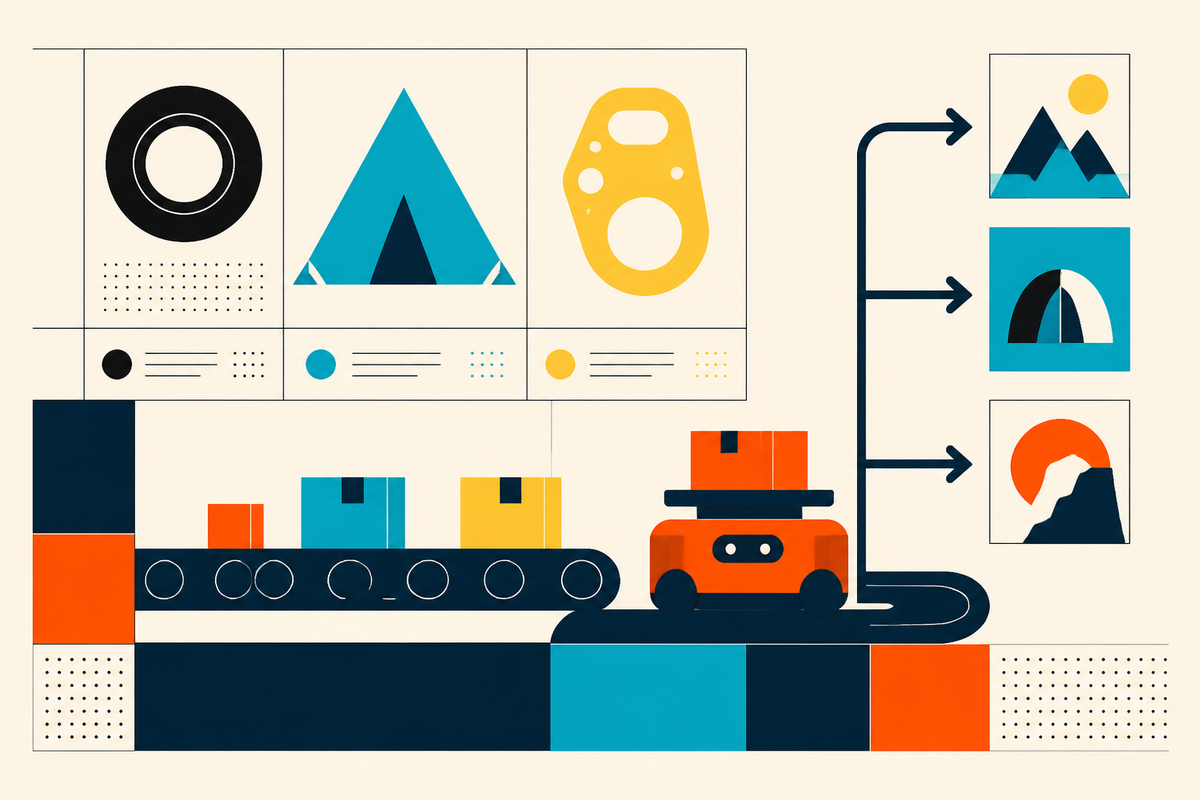
This editorial diagram shows how prominently each capability features in Ecentria’s published operating model. It does not represent revenue, market share or performance.
A position between expertise and abundance
Ecentria competes in several directions at once. Amazon offers unmatched convenience and breadth. Bass Pro Shops, Cabela’s, REI and Sportsman’s Warehouse combine known brands with physical stores. Brownells and MidwayUSA bring deep specialist credibility in overlapping categories. Manufacturers increasingly sell direct, controlling their own story and customer data.
Ecentria’s defense is the accumulated system: product data, original content, supplier relationships, buying history, pricing tools, customer behavior and fulfillment capacity. No single piece is impossible to copy. Together they make a new category less expensive to launch and a difficult purchase easier to complete. The company can also segment customers without forcing them through a single, muddled storefront. A CampSaver shopper need not feel as if she has wandered into an optics warehouse, even when both orders touch the same underlying infrastructure.
The model carries familiar retail risks. Inventory consumes cash. Search algorithms change. Shipping is expensive. A broad assortment can produce a frustrating gap between an item appearing available and actually leaving the building. Private labels improve margin but demand product judgment. And several focused brands sharing a platform still need distinct reasons to exist. Technology can coordinate the work; it cannot make customers forgive a poor delivery.
The portfolio can change; the platform remains
Armasight offers a revealing recent example. Ecentria acquired the thermal- and night-vision brand’s assets and intellectual property in 2020, relaunched it in 2022, and sold it to American Holoptics in April 2026. Levitin described the five-year rebuild as an “amazing journey” and said the buyer could give Armasight the resources and expertise to thrive. The arc shows that Ecentria is willing to make, rebuild and divest a brand rather than simply accumulate logos.
The company remains private, so its economics are mostly out of view. A 2014 debt financing tied to Morgan Stanley Expansion Capital is public; valuation and current revenue are not. LinkedIn places Ecentria in the 501-to-1,000 employee band, though the number of visible profiles is much lower and changes over time. What can be observed is the architecture: specialist demand on the front end, shared intelligence and operations in the middle, and automated fulfillment at the back.
There is also a streak of humor in the machinery. Ecentria calls its employees “Ecentrians.” Its culture pages include testimonials from Robbie the Robot and Norman the Hunter, a mannequin who regrets that his modeling career led to technical gear instead of high fashion. Weekly leadership minutes are shared internally as The Ecentria Express; the monthly newsletter is The Ecentrian. The jokes keep an otherwise dense story of modules, SKUs and conveyor systems from becoming entirely beige.
Behind the jokes is a deliberately communicative workplace. Ecentria says new hires periodically have lunch with the founders, employees can read notes from weekly leadership meetings, and teams receive formal training through Ecentria University. Its careers materials list remote-work possibilities, an on-site gym, gear discounts and professional-development programs. The company also points to Chicago Tribune workplace awards in 2018 and 2019 and Best and Brightest recognition through 2021. Those details are not proof that every employee has the same experience, but they reveal what management wants the culture to reward: initiative, cross-functional work, stamina and enough personality to challenge a process that has become routine.
The commercial logic is similarly practical. Ecentria makes money primarily from merchandise margin. Dvor gives it a timed, members-only outlet for deals. USIQ adapts the assortment to institutional purchasing. OPMOD exclusives and TRYBE products add items that cannot be compared line for line on every competing marketplace. Meanwhile, shared technology and fulfillment spread fixed costs across the group. It is a portfolio strategy, but not the kind that stops at financial ownership. The brands are valuable because they can reuse operational capabilities; the platform is valuable because it has focused brands feeding it demand.
The clever part is everything the shopper never sees: the guide that answers the question, the forecast that places the box, and the robot that finds it.
That invisible sequence explains where Ecentria fits. It is not trying to be the internet’s only store. It is trying to be the most useful store for a collection of complicated purchases, then reuse the expensive parts of that usefulness across brands. Twenty-five years after OpticsPlanet opened, the original wager still holds: when a product requires judgment, abundance needs an editor - and the editor needs very good plumbing.