A red carpet is a peculiar place to make the news. The people walking it are often promoting something. The people watching may care more about a dress than the thing being promoted. Somewhere between those two interests stands a reporter with a microphone, trying to turn a few available seconds into something worth passing along.
E! News has made a business in that narrow space: close enough to celebrity to get the interview, familiar enough to give the audience a reason to watch. Its territory includes relationships, premieres, fashion and the small public moments that become large conversations. The underlying service is selection. Hollywood produces an abundance of material; the reader wants to know which part everyone is talking about.
That job once came with a television appointment. In July 2025, E! announced that its nightly news program would finish in September. The digital brand would continue. A recognizable name had become less dependent on the particular product that made it recognizable. The interesting question is what the audience had been hiring E! News to do all along.
01 / The inconvenient clockBy bedtime, the conversation had moved on
The 2025 version of E! News occupied an 11 p.m. slot. Variety’s reporting identified the tension between that schedule and the demand for immediate digital coverage. The final original broadcast was scheduled for September 25. Justin Sylvester and Keltie Knight were its hosts.
Think about the practical difference between a premiere interview arriving in your feed and the same subject appearing in a late-night bulletin. The first can join a conversation while it is happening. The second needs to offer something that makes waiting worthwhile: better reporting, a particularly good guest, a personality you want to spend time with. The clock imposes an editorial burden.
Television had already been interrupted once. In August 2020, E! canceled E! News alongside Pop of the Morning and In the Room during a broader NBCUniversal restructuring. The news program had moved to New York and mornings; production was being centralized back in Los Angeles. A November 2022 revival returned E! News to the evening with Sylvester and Adrienne Bailon-Houghton.
Those are different episodes with different circumstances. The first belongs to the pandemic-era production reset. The second arrived after the revival had tested the nightly format again. Neither cancellation, by itself, establishes that people had stopped caring about celebrity news. They establish that a particular way of packaging it had lost its place on the schedule.
02 / The audience had already votedThe phone was the front door
Five years before the second cancellation, there was a revealing number inside a website redesign. In June 2020, E! Online publishing executive Jaime Freedman told TheWrap that mobile devices accounted for 80-90% of visits. The team put trending subjects prominently on the site and made photo galleries viewable within the page.
The changes were modest in the way useful product changes often are. Fewer interruptions between a reader and a photograph. A clearer route to the story people were discussing. A homepage organized around what was happening. Asked what a returning visitor might notice, Freedman replied: “It depends what’s happening in the world!”
“It depends what’s happening in the world!”
Jaime Freedman on E! Online’s redesign, 2020
The transferable idea is straightforward: start with observed behavior. If most readers arrive holding a phone, their small screen is the main edition. An elegant desktop experience cannot compensate for a frustrating gallery on the device people actually use. This is a product decision that a much smaller publisher can copy without buying celebrity access.
The scale later became substantial. Versant’s registration materials report that E! News Digital generated 11 billion video views across digital platforms in 2024, with significant millennial and Gen Z audiences. Views measure activity. They do not count 11 billion separate people, and they do not reveal how much money each viewing generated.
Video views across digital platforms.
Repeated viewing is included; this is not a unique audience count.
03 / Same beat, different roomHollywood gossip goes to the sauna
Hot Goss offers a cheerfully literal version of a format experiment. Eyal Booker and Lonnie Marts discuss entertainment from a sauna. The E! Digital Studios series began in 2024 and expanded from short Instagram installments into longer YouTube interviews in January 2026.
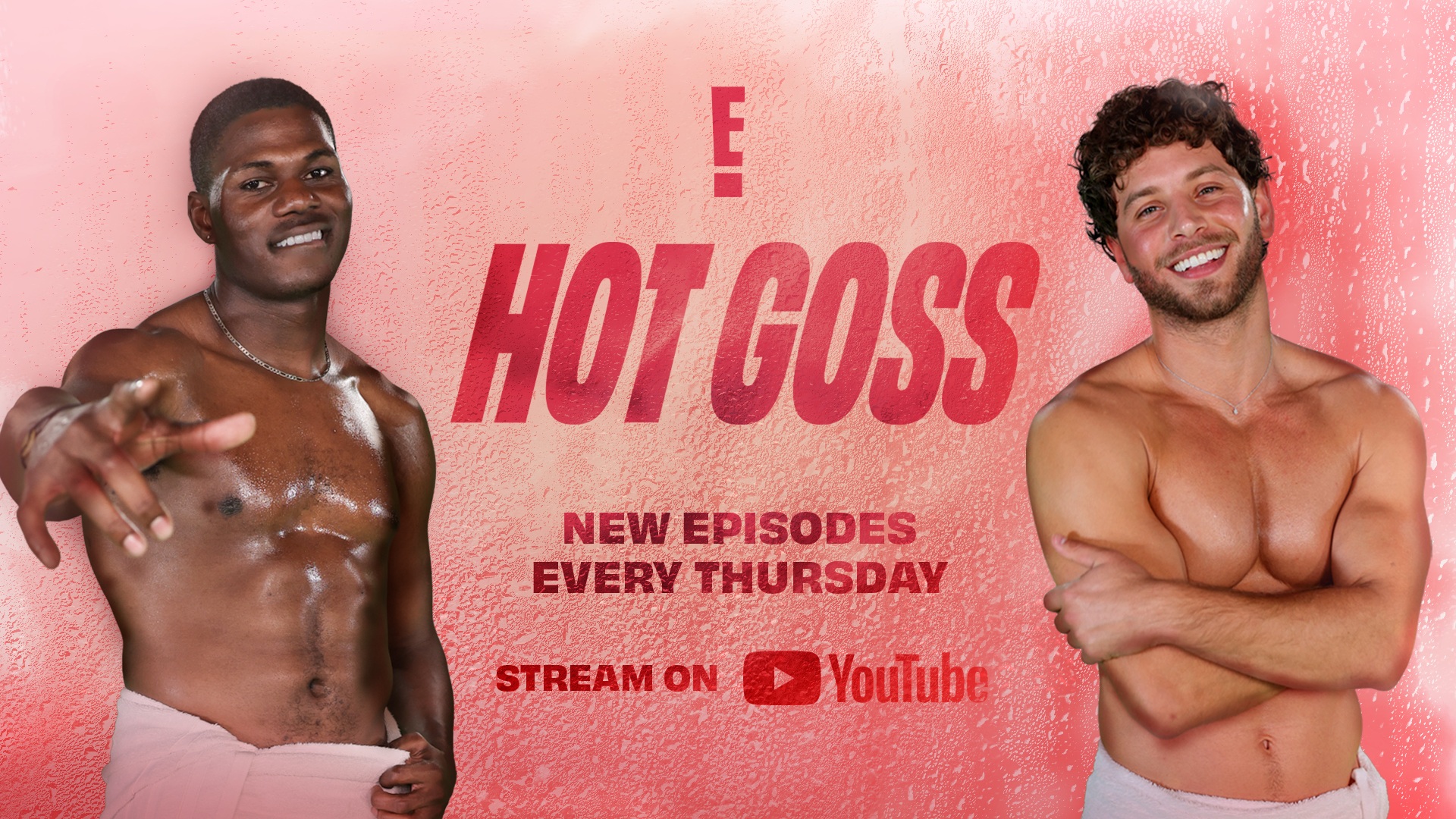
The location supplies an immediate visual identity. A viewer can understand the joke before recognizing a guest. As an editorial reading, the experiment suggests a useful distinction: preserve a recognizable subject and give each format its own reason to exist. A longer interview needs room for a conversation; a short social installment needs an immediately legible premise.
This is also where E! News sits in a crowded market. People, Entertainment Tonight and TMZ offer overlapping routes into celebrity coverage. Stars themselves can speak directly to followers. E!’s particular combination is reporting, presenter familiarity, fashion and event access, distributed through an established entertainment brand. A reader can follow a developing story or simply watch an interview. An advertiser can reach the audience gathered around it.
04 / Follow the attention, then the moneyThe fan and the advertiser want different things
A media brand has to satisfy at least two constituencies. The fan wants an entertaining or useful story. The advertiser wants that fan’s attention. E!’s commercial materials sell access to pop-culture audiences across entertainment news, programs and red-carpet coverage. The newsroom supplies part of that wider offering.
There is a transaction business alongside the attention business: E! Insider Shop can earn commissions when readers purchase through its links.
The appeal is easy to understand. Celebrity coverage creates questions about clothes, beauty and everyday purchases. A shopping recommendation can answer one of them. The editorial challenge is equally clear: the recommendation must remain useful when the reader is uninterested in the business arrangement behind it. Attention is an introduction, not an obligation to buy.
Shopping coverage also creates a route to affiliate purchases. This diagram describes the model, not the size of each revenue stream.
Ownership needs precision here. E! News belongs to the wider E! business, now part of Versant. Comcast completed Versant’s separation on January 2, 2026. A financial result for that parent would encompass other networks and digital properties; treating it as E! News revenue would tell the wrong story.
The origin has a similar wrinkle. Alan Mruvka and Larry Namer created the parent network’s predecessor. Mruvka later recalled an initial requirement of $6.9 million to get that network going. E! News itself began in 1991, and E! Online followed in 1996. The early network figure describes the cost of an earlier undertaking. It is no price tag for the newsroom’s digital evolution.
05 / Keep the eventSome appointments still earn their place
The wider E! network provides an interesting counterpoint to the canceled bulletin. Versant reported that Live from the Red Carpet doubled its year-over-year viewership across key events in the first quarter of 2026. In May, the company’s coming-season announcement included continued Live from E! coverage.
A live arrival has a clock of its own. Viewers can watch the outfit, the greeting and the interview unfold before knowing which moment will circulate afterward. That gives the live product a different purpose from a late summary of information already available elsewhere. It also gives subsequent clips something to draw upon.
The lesson is conditional. Following audiences across platforms works best when a publisher brings something distinctive: access, reporting, a host or a format worth recognizing. Reposting the same readily available announcement supplies a weaker reason to return. A crowded feed can distribute an interview, but distribution alone cannot make it interesting.
For readers, E! News remains a way to keep up with entertainment without following every celebrity account individually. For people building a media business, its history poses a sharper question: which part of your product is the audience attached to? The microphone, the person holding it, the story being told, or the time it arrives? At E! News, the answer has had room to change.
Keep up with the conversation
Read the latest E! News stories, browse shopping coverage, or visit the E! press room.