Before Dwarkesh Patel had a media business, he had a question about whether to keep going. After graduation, a listener, Anil Varanasi, asked what six months of podcasting and writing would cost. Patel’s answer was $10,000. He was living with his parents in Texas. The money bought something quite specific: another stretch of time in which an unlikely career could become less unlikely.
He repeatedly considered quitting to build a startup. Encouragement, including praise from Jeff Bezos for a blog post, postponed the exit. An early backer who had questioned the project changed his mind as it grew. Confidence arrived in installments; the audience kept giving Patel reasons to continue.
- Long interviews about AI, science, history, and economics, available as video, audio, and text.
- A business selling sponsors access to a technical audience, with paid membership and related publishing.
- A useful habit to borrow: learn enough to test an explanation before asking someone to defend it.
He started in 2020, when college classes went online and he was bored. By September 2024, he was advertising for a chief operating officer. The division of labor in the job posting was wonderfully blunt: “My role: Read, write, record.” Someone else would handle sponsorships, editors, hiring, logistics, and the expanding business around those three verbs.
The homework is the product
A microphone is easy to buy. The harder purchase is the week before anyone speaks into it. Patel’s preparation has included reading papers, talking to researchers, and implementing a transformer before interviewing Ilya Sutskever. That last detail matters. You can nod along to an explanation of a machine without knowing how it works. Trying to build one makes nodding considerably harder.
That work produces the distinction a listener can hear. A guest offers a general claim; the next question asks about its machinery. In the February 2026 conversation with Anthropic’s Dario Amodei, Patel pressed the relationship between forecasts of powerful AI and commitments to computing capacity. The question becomes practical: if you believe your own forecast, what should you buy, and when?

The show occupies a useful space between the specialist paper and the broad technology interview. Alternatives include Lex Fridman’s conversations and Conversations with Tyler. Dwarkesh Podcast’s appeal is the amount of prior work brought into the room. For listeners, the payoff is hearing an expert’s reasoning unfold, including the steps that a polished keynote tends to skip.
A history professor walks into an AI feed
The name on the door can make this sound like a personality business. Its history programming suggests a more interesting possibility: the audience can follow the subject. In October 2024, Patel announced a three-part live series with Sarah Paine, a professor of history and strategy at the Naval War College. Substack helped bring it to an audience in San Francisco.
Each event paired an hour-long lecture with a 90-minute discussion. Paid subscribers received an initial ticket window. By December 2025, the publication was releasing the final episode of a later Paine lecture series, examining why Russia lost the Cold War. An interview had become a format that could sustain repeated visits.
There is a lesson here for anyone commissioning content. Recognition gets someone to click; an unfamiliar expert can give them a reason to stay. The wager requires judgment. A distinguished researcher is not automatically a compelling conversationalist. Patel’s January 2026 scout advertisement explicitly sought experts able to connect their discipline to broader questions.
The audience has a purchasing department
Listeners are one customer group. Sponsors are another. The sponsor page reports an average of 1.8 million views and listens per episode. Treat that as the publication’s combined distribution measure, rather than a count of distinct people. The more revealing numbers come from its June 2024 audience survey.
The offer fits that audience: quarterly partnerships, mid-roll advertisements, newsletter mentions, category exclusivity, and an event component. Recent episode descriptions name Jane Street, Antithesis, and Grok Bot as sponsors. This is a media company whose advertising inventory is valuable partly because some listeners choose tools, hire engineers, and approve spending.
Advertising also consumes the resource the show depends on. In his 2024 progress report, Patel described roughly a day or more of work per advertisement, including negotiation, scripting, revisions, recording, and graphics. He considered paid subscriptions as another route. The uncomfortable business question is whether monetizing attention leaves enough time to earn it again.
“My role: Read, write, record.”Dwarkesh Patel, 2024 COO posting
Reading is not the same as remembering
Patel’s March 2026 account of preparation is useful because it admits a failure that a reading list conceals. He could spend days studying and still discover a basic hole in his understanding. He could also forget much of what he once knew. More pages were not a complete answer.
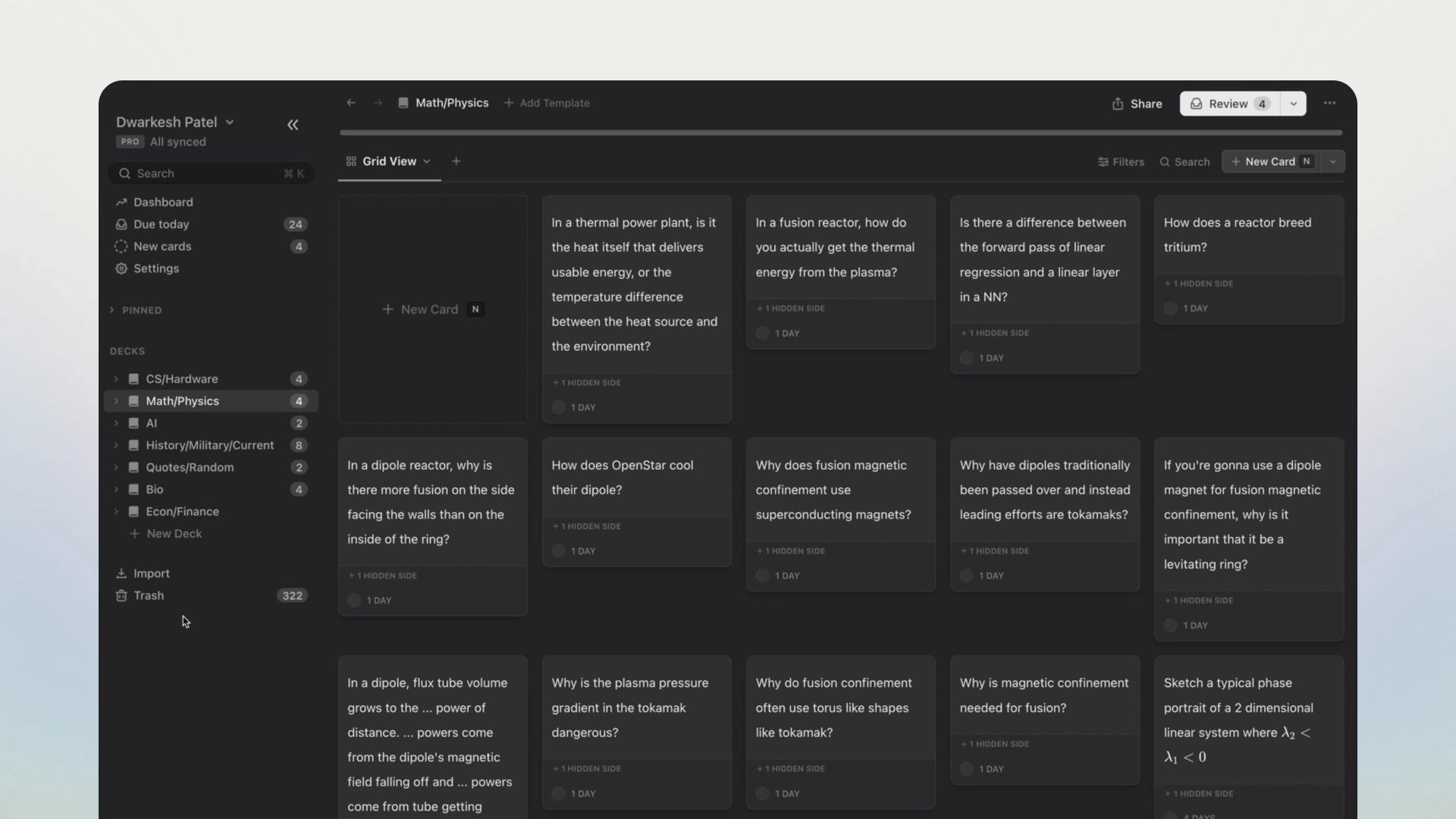
His remedies include spaced repetition, writing a provisional view, and implementing ideas from scratch. Flashcards revisit concepts after the interview has passed. A written argument forces scattered evidence into a shape that can be challenged. Code and spreadsheet models expose dependencies. These are tasks a reader can copy without acquiring a famous guest or a studio.
The method has limits. If you need a quick introduction before lunch, a dense conversation may be an expensive use of your attention. Experts also have interests, incomplete information, and predictions that can fail. A transcript gives you a way to inspect their claims; it does not turn those claims into established facts.
Buying better questions
The business keeps finding new containers for the work. In March 2025, Patel announced the digital release of The Scaling Era through Stripe Press, organizing AI interviews into an oral history. The book gives readers a route through an archive that otherwise arrives one conversation at a time.
By January 2026, another constraint had become explicit: finding guests. Patel offered scouts $100 an hour, typically for five to ten hours a week, to identify people and assemble curricula. That is $500 to $1,000 weekly per scout at the advertised workload. The company was putting a price on the search that happens before the search.
For a reader, the useful move is small: pick a subject, make something that tests your understanding, and write down the point where you get stuck. Then listen for whether the guest answers it. Dwarkesh Podcast is most useful when the conversation gives your own questions somewhere better to go.