Doug Evans once built a kitchen appliance that could exert four tons of force. Today, a handful of sprouts is enough to occupy him. In a photograph from the desert, he holds a tangled green clump towards the camera, smiling beneath a blue cap. Behind him is a landscape with considerably more room than groceries. The plant life in his hand looks almost impertinent.
For anyone who remembers Juicero, the picture invites a double take. Evans founded the company behind the $699 connected juice press, a product that became a shorthand for Silicon Valley's expensive enthusiasms. Its undoing included a demonstration so easy to understand that the explanation fitted into a pair of hands: the company's produce packets could be squeezed without the machine.
That happened in 2017. Evans had already handed over the chief executive's job. Years later, he is still building things for kitchen counters, writing about food and turning up to explain his ideas. The continuity is more interesting than a tidy redemption story. His products have changed; his appetite for persuading people remains conspicuously intact.

The apprenticeship before the appliance
Evans's route to food passed through the New York art world, military service and graphic design. He has described painting graffiti on subway trains and leaving high school before joining the Army's 82nd Airborne Division. His old personal biography dates his Army chapter to 1984. The next entry is Computer Impressions, in 1986. For someone who later became associated with a countertop gadget, he had already tried a remarkably broad range of surfaces.
After the Army came an apprenticeship with Paul Rand. Evans says he tracked down the designer, arrived at his doorstep and worked with him for seven years without pay. There is an audacity to that approach which makes an online application seem a rather timid instrument. Evans was prepared to make himself available before he could make himself indispensable.
The relationship also left a physical record. Rand created a logo for Doug Evans + Partners, Evans's consulting firm. Years later, Evans and designer David Weinberger searched a Lower Manhattan storage locker for Rand's original work. Among boxes, lamps and assorted collectibles, they found sketches, correspondence and files documenting their collaboration.
Rand drew; Evans produced the work on a computer. Design historian Steven Heller authenticated material they recovered, and Rand's widow subsequently passed the work to the Yale archives. The logo for Evans's firm was identified as Rand's final logo. Before Evans had a place in the history of failed gadgets, he had a quieter place in the history of graphic design.
There is something pleasing about the storage locker episode. The evidence of a creative relationship survived in ordinary boxes, waiting for somebody to open them. Years of work had left behind more than a polished mark. They had left a record of decisions, corrections and attention. That is a useful prelude to a career in which the finished product would sometimes overwhelm everything that preceded it.
From a New York shop to a California button
In 2002, Evans co-founded Organic Avenue with Denise Mari. The New York business sold organic plant-based food and cold-pressed juice. Mari brought the food vision; Evans helped finance it. He served as chairman and CEO. Retail meant translating an enthusiasm into something people could walk into, order and carry away.
The ambition was concrete: put fresh food within reach. But a shop has an address, and its customer eventually goes home. Evans became interested in taking the experience into the kitchen. He knew the industrial presses used to make juice and wanted their results without the preparation and clearing up that a home user inherited.
Juicero, founded in 2013, put that desire inside a machine. Organic produce arrived in proprietary packs; the customer inserted one and pressed a button. The appliance connected to Wi-Fi. The company's system tracked the packets, while the press supplied the force. A glass of juice was the visible output of a business that also had to manage agriculture, packing and delivery.
The industrial designer Yves Béhar worked on its design. Backers included Google Ventures and Kleiner Perkins. Around $120 million in financing helped give the venture the scale and visibility that made its eventual collapse so memorable. That figure belonged to the company. It was never a measure of Evans's personal fortune.
There was an appealing proposition buried inside the machinery. Somebody else would do the fiddly work. The customer would get the final act, the satisfying button, and the glass. Consumer businesses have sold versions of that arrangement for decades. Juicero's difficulty was the price and infrastructure attached to making it happen every morning.
A founder's chair is a moving target
On October 31, 2016, Jeff Dunn succeeded Evans as CEO. Dunn had led Coca-Cola North America and Bolthouse Farms. Evans remained chairman, with responsibility for the company's vision and strategic relationships. The announcement positioned the change as a partnership for the next stage, including opportunities in offices, hotels and other commercial settings.
That date deserves to survive the retelling. The hand-squeezing controversy came the following April; the shutdown came in September 2017. Evans was the founder, and his name stayed attached to the product, but he was no longer the chief executive when those events occurred. A memorable corporate failure can flatten a complicated sequence into a single face.
At the time of the handover, he compared managing the two roles to trying to swim and run simultaneously. His next responsibilities included product development, recruiting, partnerships and investor relations. Dunn would take on the operating demands of the business. Between the two of them sat a supply chain that needed to work as smoothly as the button.
“It's hard to swim and run at the same time.”
Doug Evans, on the 2016 CEO handover
By December, Evans was onstage at BevNET Live in Santa Monica, explaining that building the hardware had been only part of the challenge. Supplying fresh produce in sealed packages was harder. He talked about future versions for consumers and corporations, as well as software. The product on sale was, in his telling, an opening chapter.
From the kitchen, a customer saw an appliance. From the founder's chair, Evans saw a procession of further inventions. Those two views do not always arrive at the same valuation. Engineers can spend years removing friction from an experience while a customer spends a few seconds deciding whether the remaining task is worth paying to avoid.
The demonstration nobody ordered
In April 2017, Bloomberg showed that the produce packs could yield juice when squeezed by hand. The machine's price had already fallen to $399. Now a simple demonstration gave critics an image with which to question the entire arrangement. A connected appliance had acquired an unconnected competitor, available at the end of each customer's arms.
The comparison travelled because it required so little explanation. Juicero could discuss its wider system, but the public could see a packet being squeezed. A demonstration can be a brutal editor: it cuts away everything outside the frame. In this case, the frame contained a bag, some juice and a question about necessity.
On September 1, the company announced it was suspending sales, offering refunds and looking for a buyer. Its stated problem was the infrastructure needed to manufacture and distribute to a nationwide customer base. The business had to make a complicated operation support a simple consumer experience, and it could no longer carry that ambition alone.
A failed business leaves several stories behind. Customers remember the purchase. Employees remember the work. Investors remember the numbers. The founder has to live with all of those versions while finding something to do next. Evans's subsequent career offers a particularly literal answer to that last problem: he went back to growing things.
A smaller operation, visible through glass
Evans settled in Wonder Valley, in California's Mojave Desert. He had been sprouting for years, and the setting made producing food at home an immediate practical interest. In April 2020, St. Martin's Essentials published The Sprout Book. The publisher lists the paperback at 288 pages and describes it as a national bestseller.
The format changed the relationship with the audience. A book can explain a practice before somebody buys equipment. It leaves room for curiosity, for reading a few pages and deciding whether to try. For a founder previously associated with a substantial purchase and a proprietary supply system, an instruction book offered another way into the kitchen.
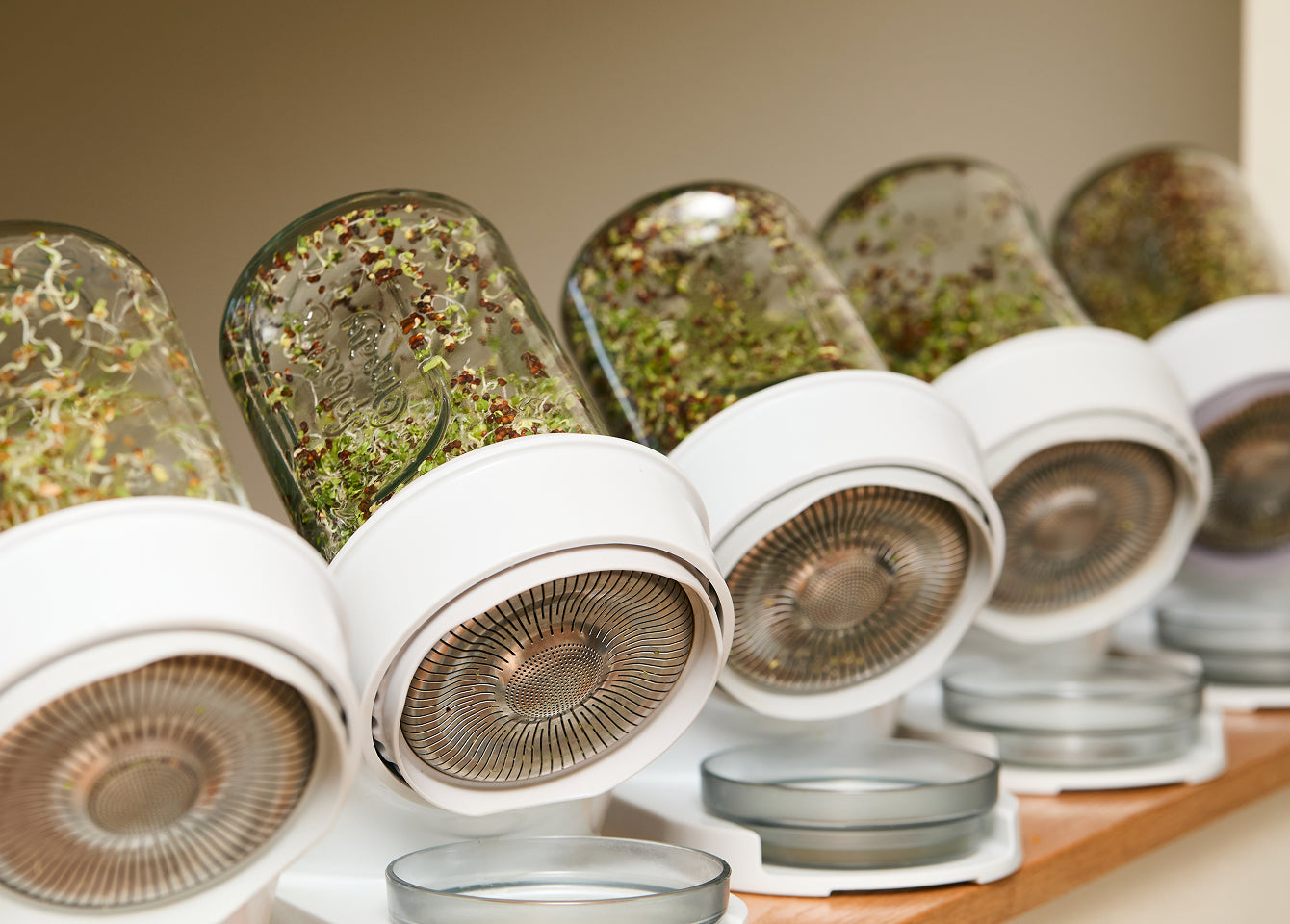
He went on to co-found The Sprouting Company, where he is now CEO. The venture sells sprouting equipment and seeds. Its account of product development centres on familiar frustrations: awkward drainage, broken jars and makeshift setups. The concern with design survived. The object being designed became easier to inspect.
That visibility is part of the appeal. A jar gives the owner a view of the work as it happens. The customer has a recurring task and a changing object to look at. It makes an unusual sales pitch in a world of instant results: return tomorrow, and notice what happened while you were away.
Still willing to make the pitch
Evans brought The Sprouting Company to Shark Tank in its seventeenth season in 2025. In February 2026, he discussed his business career on Travis Makes Money. In March, a conversation with Sammi Cohen returned to Juicero, the Mojave move and his later venture. He continues to explain his work in public, including the chapter that made him easiest to mock.
His circle has changed with the work. It has included a graphic design mentor, a retail partner, a beverage executive, industrial designers and podcast hosts. Each connection belongs to a different version of the same recurring activity: making an idea tangible enough that another person can consider it. Sometimes the object is a logo. Sometimes it is a glass of juice. Sometimes it is a jar.
Evans's life resists a clean moral about ambition. Juicero's failure does not make every earlier decision foolish, and a later business cannot erase the collapse. What the sequence does show is a founder continuing to put his ideas where other people can examine them. The desert photograph makes that habit almost comic in its directness. Here is Doug Evans. Here are the sprouts. He would like you to take a look.
More from Evans’s world
Read, follow & watch