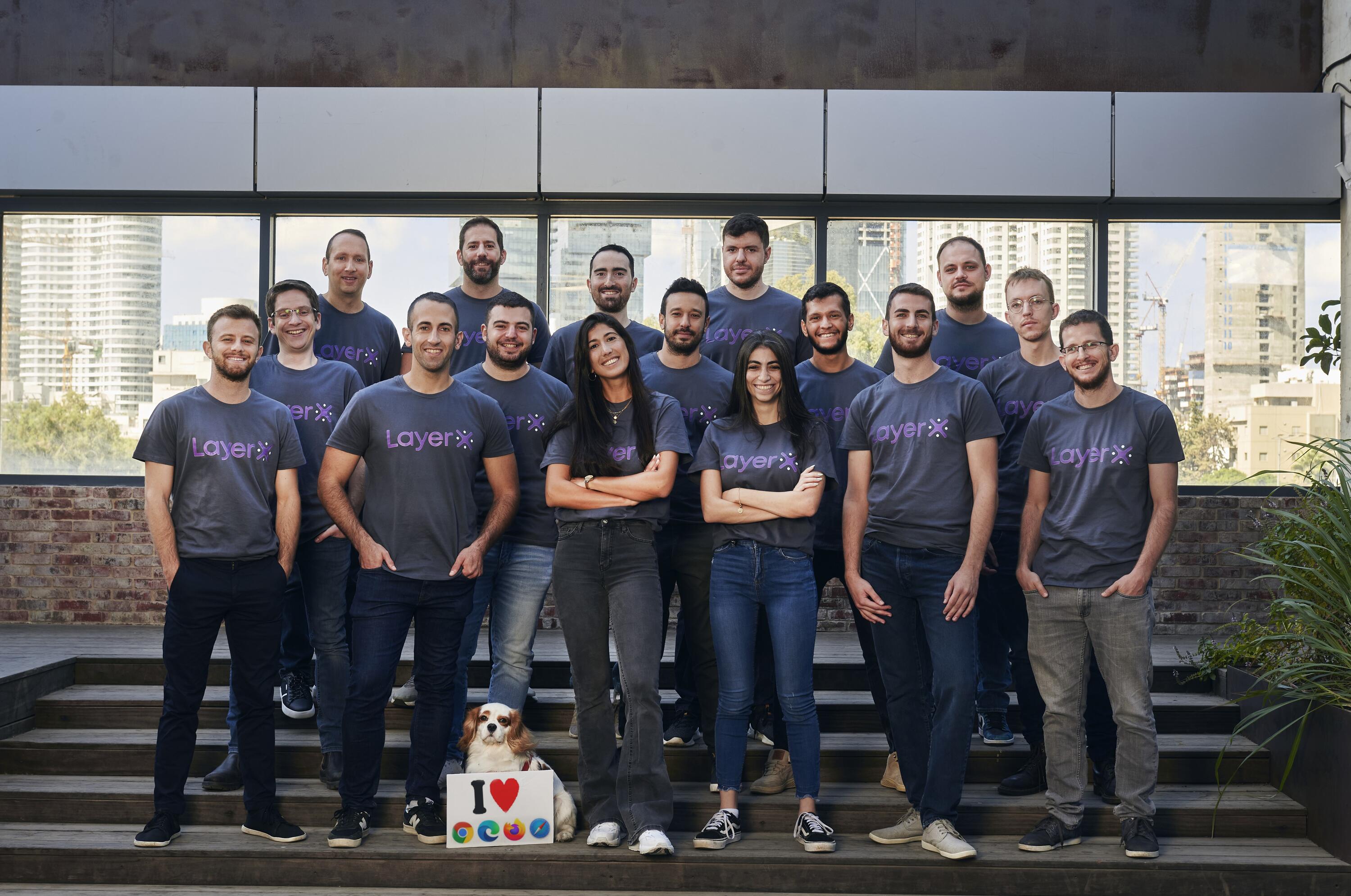
On October 3, 2022, Dori Harpaz posted a photograph of a young startup team in matching charcoal T-shirts. They stood on a terrace in Tel Aviv, the skyline hazy behind them. At their feet sat a small dog holding a handmade declaration of loyalty to Chrome, Edge, Firefox, and Safari. Harpaz, newly arrived as chief marketing officer, offered three reasons for joining: deep technology, a dream team, and a growing market. The timing was tidy. That same day, LayerX Security emerged from stealth with $7.5 million in seed funding and a proposition that sounded almost suspiciously convenient: companies could secure the browsers their employees already used.
Convenience is a difficult thing to sell in cybersecurity. Fear is easier. Fear has villains, clocks, and red warning triangles. Convenience asks a more adult question: can a security product work without making ordinary people resent it? LayerX placed that question at the heart of its pitch. The browser had become the office, but the office door had an unruly collection of extensions, personal logins, pasted text, uploads, and newly talkative AI tools. LayerX wanted to watch the door without replacing the building.
For Harpaz, this was not a first encounter with an invisible product. His public résumé begins in consumer branding at Unilever, moves through brand management at social-trading platform eToro, and then settles into a long run through Israeli cybersecurity. Each stop changed the object being marketed. The central labor did not: taking something technical, distant, or easily ignored and giving it a reason to matter now.
A marketer learns the cloud
The cyber chapter took shape at Incapsula, the cloud web-security company backed and later fully acquired by Imperva. Harpaz served as director of marketing. Marc Gaffan, a former colleague, later credited him with building the marketing group from one person into a broader team and generating millions in sales pipeline. The detail is revealing because it joins the two halves of an operating marketer’s job: build the apparatus, then make it produce.
Incapsula dealt in web application protection and distributed-denial-of-service defense, services whose success often resembles nothing happening. That is awkward material for a storyteller. It rewards proof, precision, and the patient construction of trust. Harpaz also reviewed an early draft of The SaaS Marketing Handbook, a small credit that places him inside the practical conversation about how recurring-revenue software gets explained and sold.
He next became vice president of marketing at Secdo, which built endpoint detection and response technology for security-operations teams. In April 2018, Palo Alto Networks bought Secdo for $82.7 million. Secdo CEO Shai Morag later described Harpaz as a key member of management through the deal, praising a mix of creative thinking, planning, execution, and an ability to connect with people. Morag’s three-word personal summary was plainer: “reliable, accountable, creative.” It sounds less like a campaign and more like the equipment list for surviving one.
At Cynet, Harpaz moved from vice president of marketing to CMO. The company’s audience included smaller security teams that lacked the staff of a Fortune 1000 operation. In a 2021 announcement, Harpaz framed the problem around organizations large enough to attract attackers but too small to maintain abundant security resources. The language is direct because the buyer’s constraint is direct. A product is never autonomous if its explanation requires a committee.
The ordinary tab becomes a perimeter
LayerX arrived with a different map of the enterprise. Networks and endpoints still mattered, but employees spent their days inside web applications. The browser was not merely a window onto work. It was where work happened. A pasted customer list, an upload to an unapproved service, a personal account used for company business, or an overprivileged extension could all slip through controls designed for another era.
The company’s answer was a browser extension of its own, managed by the enterprise and designed to inspect activity at the point of interaction. Its commercial distinction was as behavioral as it was technical: users could keep Chrome, Edge, Firefox, Safari, or another supported browser. Security teams got visibility and controls; employees did not receive a new browser and a new reason to complain. The product’s desired effect was conspicuous to administrators and nearly uneventful to everyone else.
This is the part of the story where marketing could easily become grandiose. Harpaz’s more interesting public instinct is narrower. In a Hebrew LinkedIn post about Lefties, an Inditex chain that outgrew its origin as a Zara outlet, he wrote that a name should not describe a company’s current activity too perfectly. If the business is fortunate, today’s activity may not be tomorrow’s. A good name, in his formulation, should help the brand grow - or at least avoid getting in the way when success takes an unexpected form.
LayerX proved the point almost literally. “Browser security” was specific enough to create a category, yet the arrival of generative AI enlarged the category around it. Prompts contained confidential data. AI applications mixed corporate and personal identities. Agentic browsers began to act rather than merely display. The browser became the place where human intention met machine action. What had looked like extension management now touched data-loss prevention, identity governance, SaaS control, and AI policy.
From seed to acquisition
Announced transaction valuesProof arrives in stages
The market supplied a sequence of increasingly expensive votes. In May 2024, LayerX announced a $26 million Series A led by Glilot Capital Partners. In April 2025, Jump Capital led an $11 million extension, taking the Series A to $37 million and total funding to $45 million. The company said the money would support growth across protection for AI tools, SaaS applications, browser extensions, and web data leakage.
Three months later came a more practical kind of validation. Google integrated LayerX’s extension-risk scoring into the Chrome Enterprise management console. The arrangement let administrators see risk information for installed extensions and restrict dangerous ones without introducing another console into the daily life of the user. LayerX had made “works with the browser you have” central to its identity; now a browser with a broad enterprise footprint had made LayerX data part of its own management experience.
Harpaz’s public work around the company shows the habits of a business-to-business operator rather than a celebrity CMO. He promoted research on malicious extensions, shadow AI, unmanaged identities, and leakage through copy-and-paste. He worked the less glamorous machinery too: demand generation, partner marketing, press preparation, websites, and the repeated conversion of technical findings into reasons for a security leader to act. One advisory partner quoted him celebrating “real pipeline” created quickly without large event or advertising budgets. The noun is prosaic. The discipline is not.
The category gets a larger name
On May 14, 2026, Akamai announced that it would acquire LayerX for approximately $205 million. The buyer described the logic in the vocabulary LayerX had spent years sharpening: browser-based AI usage control, workforce security, real-time visibility, and protection without forcing employees into unfamiliar software. The transaction closed on July 2. LayerX employees joined Akamai’s Zero Trust organization in a deal that added another Tel Aviv cybersecurity team to Akamai’s portfolio.
A month later, the product received its larger name: Akamai Workforce Protector. The original LayerX technology was now presented as an interaction-security layer spanning browsers, SaaS tools, desktop applications, people, and AI agents. Harpaz’s brand observation had acquired a corporate footnote. The company’s first label had helped make an overlooked surface visible. Its second described the broader job that surface had come to perform.
None of this makes a marketer the author of the technology, or an acquisition the work of one executive. LayerX was founded by Or Eshed and David Vaisbrud, built by a growing team, and backed by investors who saw the browser thesis early. Harpaz’s contribution belongs to a different craft: category translation. Technical founders can see a future before customers have words for it. Marketing gives that future a sentence, a shape, and enough evidence to survive the procurement meeting.
The sentence LayerX carried was unusually durable: secure work where it already happens. It could explain a lightweight extension in 2022, a Chrome Enterprise integration in 2025, and AI workforce controls inside Akamai in 2026. Harpaz’s career helps explain why. Unilever taught brands at human scale. eToro joined software to behavior. Incapsula turned cloud infrastructure into a service. Secdo and Cynet made invisible defensive work legible. By the time the browser needed its own security story, he had spent years practicing on things people mostly notice only when they fail.
In the old LayerX team photograph, the joke sits at the bottom: a dog professing love for four browsers. The serious proposition sits just above it: a team betting that people should be allowed to keep the tools they like. Four years later, a public company paid roughly $205 million for that wager. The browser did not become less ordinary. The rest of the market finally noticed how much was happening inside it.