There is a peculiar moment in every public campaign when the client discovers that being correct is not the same as being believed. The architect has a rendering. The retailer has a traffic study. The hospital has a new model of care. Then somebody puts out folding chairs in a municipal room, the neighbors arrive, and the polished certainty begins to leak out of the plan.
Dolphin Group has made a business of that moment. The California firm is small - LinkedIn puts it at two to ten employees - but the problems it accepts are generally too large for a tidy slogan. A museum needs city approval. A housing proposal meets rumors, a lawsuit, and homeowners who will not sit down. A Walmart becomes a proxy fight over labor, traffic, and change. An old medical group needs to sound human again. Dolphin does not sell one answer to these problems. It sells the sequence in which an answer can become acceptable.
The firm began with the campaign, not the brand book
Bill Roberts founded Dolphin in 1974. He had already helped invent the modern California campaign business with Stu Spencer, including Ronald Reagan's successful 1966 run for governor. Roberts understood politics as a full-time profession: research, media, timing, field organization, and the relentless management of what voters saw and heard. His later campaigns included George Deukmejian's first run for governor and the 1986 effort that removed three California Supreme Court justices.
This is useful history because it explains the firm's reflexes. Dolphin still treats a corporate or civic problem like a campaign. Who can be persuaded? What do they fear? Which messenger do they trust? Where will the decision be made? What visible proof of support will matter on that day? A logo, a mailer, a press interview, and a neighbor at a council microphone are not separate products. They are pieces on the same board.
The political inheritance was not a string of clean victories. In 1994, Dolphin executive Lee Stitzenberger ran the campaign for Proposition 188, a tobacco-industry-backed smoking measure. Tobacco companies spent more than $18 million. The measure received just 29.3 percent of the vote. Opponents made the industry's sponsorship the story, and no quantity of paid communication could make that fact feel incidental.
More than $18 million in tobacco-industry spending met a 70.7 percent rejection. Credibility was the scarce resource.
That loss offers a sharper lesson than most agency case studies. A campaign can buy frequency but not a trusted identity. If the audience doubts the sponsor, the sponsor's money may simply make the doubt more visible. Dolphin's present-day service list - stakeholder engagement, coalition building, audience research, brand identity, crisis planning, analytics - reads like a set of answers to that old constraint.
Listening became part of the deliverable

Kathy Kenney, Dolphin's principal and CEO, has led more than two dozen state and local ballot campaigns. The approach highlighted in her biography is almost stubbornly analog: person to person, neighbor to neighbor. Christine Aghassi brings three decades of policy, entitlement, real-estate, and integrated campaign experience. Creative director Doug Fitzsimmons adds brand systems, web, video, direct marketing, and data visualization. Chairman emeritus Lee Stitzenberger supplies continuity with the firm's long political past.
Together they have moved Dolphin away from the narrow identity of a political consultancy without discarding campaign logic. The firm now develops names and websites, buys advertising, trains spokespeople, handles litigation communications, runs social channels, and measures performance. The business model is bespoke professional service: a client retains a compact senior team to diagnose the audience problem and assemble the right mix of field, media, and creative work. There is no menu price because there is no standard unit called “public permission.”
A door hanger can be infrastructure
Royal Vista is the most revealing modern case. Developers wanted to replace a struggling, closed golf course in Rowland Heights with homes, townhomes, and open space. Opposition came immediately. Rumors circulated. A group filed a legal challenge. Some homeowner organizations refused meetings. Then COVID removed the ordinary tools of community engagement.
Dolphin changed the channel, not the objective. It built a project-information website, mailed residents, briefed business groups, and moved meetings to livestreams. Every public-facing item appeared in English, Spanish, Korean, and Chinese. The important unit of progress was not reach. It was a line of communication reopening. Over time, the campaign assembled support from businesses, the school district, elected officials, housing advocates, and more than 200 individuals. The county approved the project.
When a meeting becomes impossible, preserve the two-way exchange. A livestream is not a digital flyer; it is a room with different doors.
The tactic works under particular conditions. The facts must withstand inspection. The client must be willing to adjust, answer, and remain present. Local supporters must have reasons of their own to participate. Translation must mean more than swapping words; it must make the process legible. If those conditions are absent, “community engagement” becomes a decorative name for broadcasting, and audiences recognize it quickly.
The scoreboards are deliberately concrete
For Walmart's proposed store in Eagle Mountain, Utah, Dolphin began with a political landscape analysis and a targeted message framework. It then recruited and activated more than 800 residents. The project passed the City Council 4-1 in late 2023 and opened in late summer 2025. These are pleasingly unromantic numbers. Supporters raised a hand. Councilmembers cast a vote. A store opened.
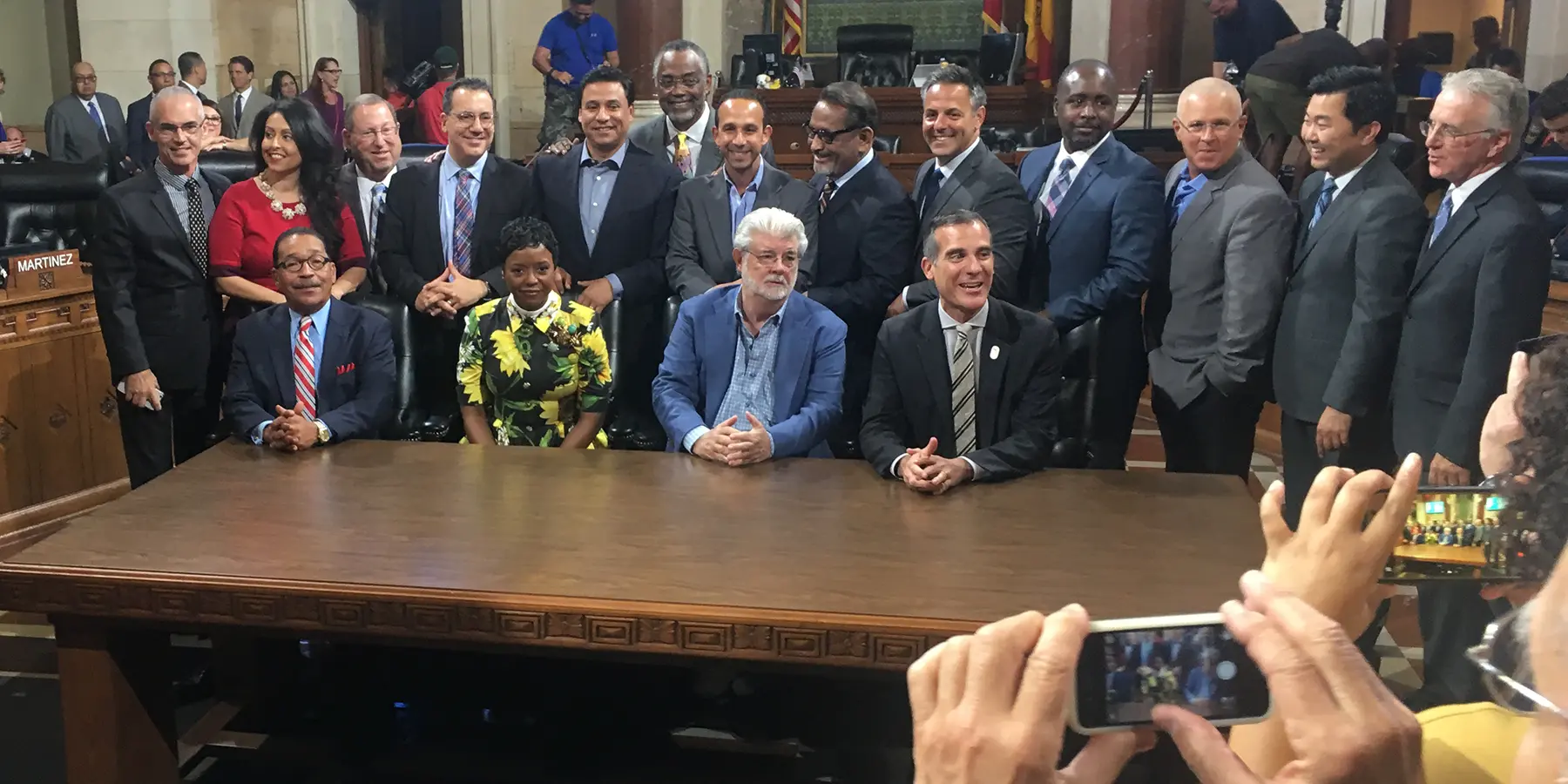
The Lucas Museum of Narrative Art required a different coalition. Dolphin coordinated public and thought-leader outreach while Los Angeles and San Francisco competed for the museum. After Exposition Park was selected, the firm worked with museum leadership, lawyers, and strategic partners to build support. The Los Angeles City Council unanimously approved the entitlements on June 27, 2017.
Then there is healthcare, where the object is less an approval than a feeling. Dolphin modernized Beaver Medical Group's identity while keeping enough of the old mark to remain recognizable. It carried a message about humane doctor-patient relationships through outdoor ads, clinic screens, brochures, recruitment materials, and a 75th-anniversary system. One tiny artifact stands out: custom adhesive bandages for vaccination events, designed to be photographed and shared. A piece of medical waste became a media placement.
For Maren Medical Group, the firm started even earlier. The founders had a clinical idea but no name, visual identity, or patient-facing presence. Dolphin developed the name and brand, then extended them through a website, search optimization, collateral, social media, print, outdoor advertising, and even exam-room graphics. The work shows where the firm now fits in the market: between a public-affairs consultancy that shapes permission and a creative agency that shapes recognition.
What Dolphin actually sells
The answer is not persuasion in the cartoon sense - a clever person whispering the perfect phrase into the public's ear. Dolphin sells coordination. Research has to agree with the message. The message has to suit the messenger. The creative work has to survive across a billboard, a website, a council presentation, and a difficult television interview. Field activity has to produce something decision-makers can see. When conditions change, as they did during the pandemic, the channels have to move without the strategy dissolving.
That makes the firm most useful to organizations with a real operational plan and a complicated human obstacle: a proposal that needs entitlement, an institution with a stale identity, an executive facing scrutiny, or a policy campaign whose natural supporters have not yet become a coalition. It is less useful when leadership wants the appearance of listening but has already decided not to hear the answer. The method depends on feedback entering the plan.
Fifty years after its founding, Dolphin still behaves like a campaign shop. It counts votes, identifies constituencies, rehearses hard questions, and worries about who is speaking. The difference is that a campaign may now end with a medical practice opening, a museum rising in Exposition Park, or a skeptical neighborhood deciding that a new plan is worth considering. The ballot box has become many boxes. The discipline remains the same.