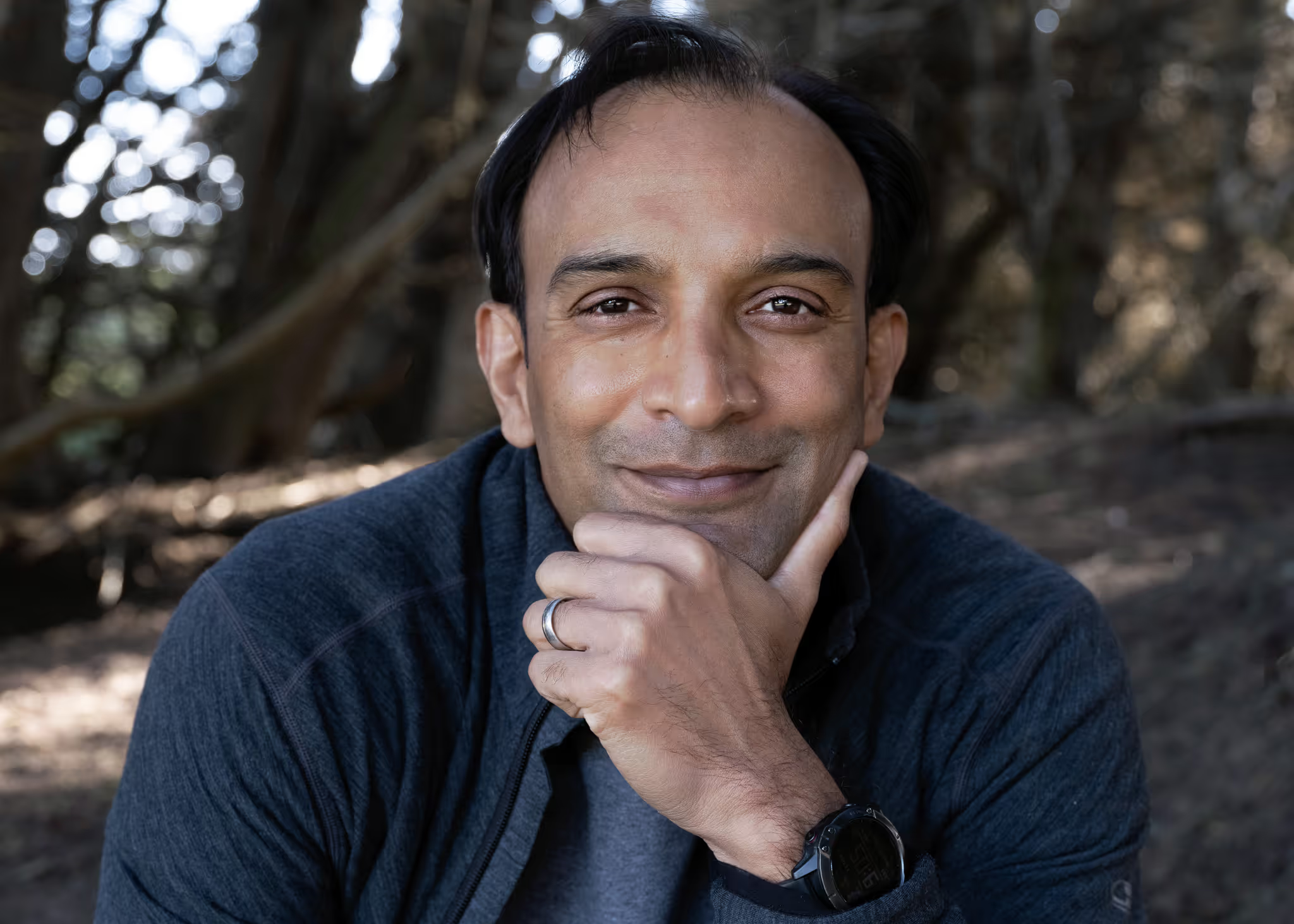
Dhanurjay Patil - the D and the J - is in San Francisco today, where his calendar is the kind that bends light. Mornings on Montgomery Street, afternoons with founders, evenings in a group chat with people who used to run the country's data. February 2023 was the inflection: he took the General Partner seat at GreatPoint Ventures, a 20-person Bay Area firm with a tight focus on healthcare, enterprise technology, and national security. The shorthand for his thesis is the same shorthand for his life: ship software that matters.
What Patil brings to a term sheet is not the swagger of a career operator or the polish of a finance veteran. It is the muscle memory of someone who has built data teams, regulated data policy, run national initiatives, and sat with founders through three a.m. crises. He talks like an engineer and listens like a counsellor. He hands out his cell number too easily. He answers.
Most investors lead with their portfolio. Patil leads with the work. Figma. Confluent. Monte Carlo. Chronosphere. Sumo Logic. RelateIQ. Peoplehood. Rebellion Defense. The names land like a syllabus on what the last decade of enterprise software actually was. He was early on most of them, not because of a thesis deck, but because he had spent years inside the messy bits of data - and could spot the founders who were not afraid of the mess.
He arrived at venture from a path no one would design on purpose. A PhD in applied mathematics, working on chaos theory and weather prediction at the University of Maryland. A jump to the Department of Defense, where he ran a project on threat anticipation. A stint at eBay, then a Greylock fellowship, then LinkedIn - where he and Jeff Hammerbacher coined the modern job title 'data scientist' in 2008. They needed a label that would appeal to physicists and mathematicians. The label stuck. So did the discipline.
In 2012, Patil and Thomas H. Davenport published an essay in the Harvard Business Review with a line that became inescapable: data scientist, the sexiest job of the 21st century. Patil has spent the years since gently rolling his eyes at his own headline. The point, he has said, was never the sex appeal. It was the recruitment. The label was a fishing lure. The catch was a generation of people who decided to build with data instead of stare at it.
Then 2015 happened. The Obama White House called. Patil became the first U.S. Chief Data Scientist - Deputy Chief Technology Officer for Data Policy and Chief Data Scientist - working out of the Office of Science and Technology Policy. The job title was new because the job was new. He stood it up from a sketch.
What followed was the most consequential two years of his public life. The Precision Medicine Initiative, a long-term bet on genomic-scale research that could tailor treatment to a patient's biology. The Police Data Initiative, which by the end of the administration had recruited more than 130 jurisdictions to publish their data publicly. The Data-Driven Justice Initiative, which spanned counties covering 91 million people, all trying to break the cycle of jail-to-streets-to-jail by sharing data smarter. None of these efforts were photogenic. All of them were the point.
When his term ended in January 2017, Patil did not float into a think tank. He went straight back into product - first as Head of Technology at Devoted Health, a Medicare Advantage company built by the Goldman brothers; then as an advisor at Venrock; then as the Chief Technology Officer of the Biden-Harris presidential transition in late 2020, helping the incoming administration absorb the technical reality of a government during a pandemic. He is on the Defense Science Board, the kind of body whose work the public rarely sees but whose recommendations end up shaping budgets.
The GreatPoint move was, by his own description, a homecoming. The firm, founded by Ashley Dombkowski and Andrew Perlman, invests in revolutionary ideas with long-term commitment - the kind of patient capital that takes a research breakthrough and gives it a decade to find its market. Patil's job is to find the founders and back them past the awkward years. He likes companies that are unglamorous but indispensable. He distrusts pitches that talk about disruption without mentioning the customer.
Two Michael Lewis books mention him. He helped invent the discipline that runs your phone. He grew up in Cupertino - Monta Vista High School, De Anza College for a year, then UCSD for the math degree - in the house of Suhas Patil, who founded Cirrus Logic. Dinner conversation was chips and supply chains. The kid did not become a chip designer. He became the person who decided what to do with the data the chips produced.
What is striking about Patil up close is how little of him is performance. He is funny without being clever. Direct without being short. He has lived enough lives to know which questions matter and which are noise. Ask him about a portfolio company and he will pivot to the founder's last hire. Ask him about Washington and he will pivot to a coder in a county records office. The throughline is people - the ones who do the work, the ones who use the product, the ones the policy affects.
This is the part of Patil that the resume misses. The chaos theory PhD, the LinkedIn coining, the White House badge, the GP card - these are the spine. The muscle is something else. It is a habit of treating data as a means, not an end. It is the discipline of a mathematician who refuses to lose the human at the bottom of the spreadsheet. It is the reason founders take his call.
He is 51 now. His firm is small by Sand Hill standards. His latest investments are quieter than his early ones. He likes it that way. The headlines belong to the work, not to him.