A rock band can stretch a chorus. A video file cannot take the hint. At U2’s Sphere residency in Las Vegas, the pictures had to follow the musicians across an enormous, continuous screen. Disguise supplied the software and media servers that helped make that possible. Its less visible contribution came earlier: letting the production team see the show before the show existed.
That is the useful way into this London company. Disguise sells tools for planning, mapping and running images across physical spaces. The canvas might be an LED wall, a building, a television studio or fabric behind a singer. Its customers have a picture in their heads and a collection of equipment on the floor. Disguise helps connect the two.
The business sits in an unusually exposed corner of enterprise technology. Its work appears in public, often live, frequently beside somebody famous. The product has to satisfy both the person asking whether the image feels right and the person asking whether every machine will deliver the next frame together.
The arena was once a file
For U2’s 2023 Sphere production, Disguise Designer and 23 GX 3 media servers formed part of a system delivered with Fuse Technical Group and Treatment Studio. The software divided the vast visual canvas across machines while keeping their contributions synchronised. To the audience, the separate pieces needed to read as one image.
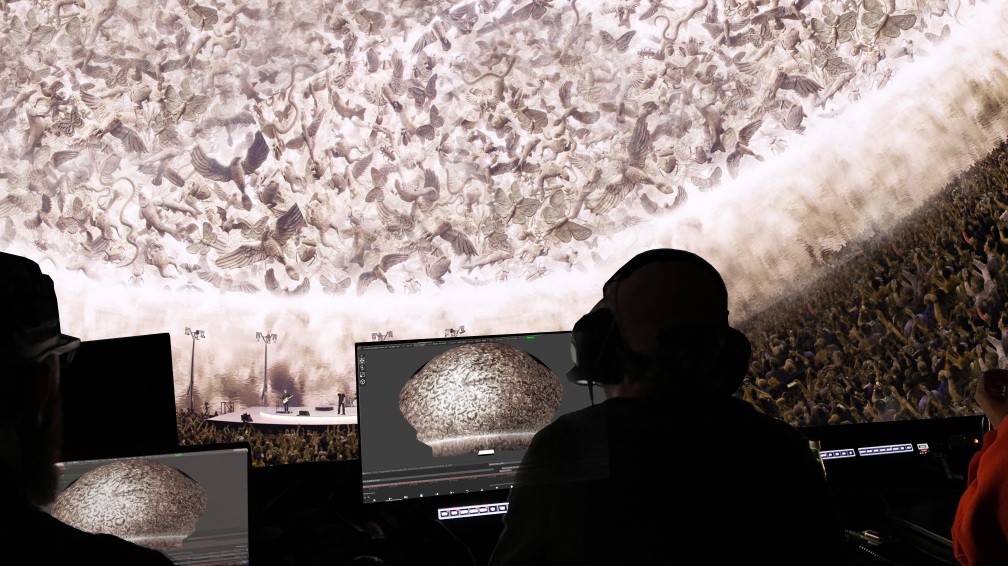
Designer supplied a digital replica in which the creative team could preview the production. Disguise’s Single Large Canvas technology addressed the harder deployment problem: assigning sections of one continuous surface to different machines without making the division visible. Real-time graphics also gave operators room to respond when the music departed from a rigid schedule.
“Our software works in beats and bars”
Peter Kirkup, Disguise, describing the musical logic of its software
The division of labour matters. Disguise was one member of a production involving artists, content makers, screen specialists and a venue. Its contribution was the connection between the planned picture and the delivered picture. For a buyer, that is a more useful distinction than a list of celebrity names.
in U2’s Sphere system
Divide the image. Keep the timing together.
A founder who wanted to see it first
Ashraf Nehru’s route into this business passed through United Visual Artists, the London art practice he co-founded in 2003. Disguise’s account of its beginnings includes work with Massive Attack and U2. Stage design and software were growing up together: the spectacle created the need for a tool that could explain it.
The company’s biography dates the d3 Technologies venture to May 2010. The present UK legal entity was incorporated in February 2012, then changed its name from D3 Technologies Limited to Disguise in November 2017. Those dates describe different steps in the same development, from creative practice to a separately constituted business.

Previsualisation sounds like an extra preparation stage. Disguise’s user guide makes the economic argument plainly: move decisions forward, before production rehearsals start consuming money. A team can assess a proposed image against the stage, identify an unhelpful direction and revise it while the work is still relatively easy to change.
That is a practice a reader can copy without booking an arena. Build a shared representation of the thing you intend to deliver. Let the people responsible for its appearance and its operation argue over the same version. Discovering that a picture does not fit is much more useful before the projector is hanging overhead.
There is more here than a play button
Designer is the centre of the system. It combines a 3D representation of the environment with content mapping, a timeline and controls. Designers can place screens and projectors, examine how imagery falls on surfaces and sequence the production. When the environment is complicated, the relationship between those jobs becomes part of the product’s value.
RenderStream connects Disguise with external graphics engines, exchanging images and control information and supporting distributed rendering. Unreal Engine, Notch, Unity and TouchDesigner appear in its ecosystem. They can supply the worlds or effects; Disguise helps integrate them into a production. Calling every graphics package a competitor would miss how the work gets made.
The surrounding products address different parts of that work. Mapping Matter supports projector and LED planning. Porta gives broadcasters and venue operators browser-based graphics control. GX, VX and EX media servers handle different playback and graphics requirements, with RX hardware used for rendering. Creative and technical services add people who can design content, build workflows and help deliver installations.
- 01PreviewPut the content in a model of the space.
- 02Map & sequenceAssign surfaces, timings and controls.
- 03DeliverSend the picture to the physical screens.
This places Disguise between content creation and audiovisual delivery. Dataton’s WATCHOUT overlaps in synchronised playback across multiple displays. Resolume Arena offers live visuals, projection mapping and edge blending. Disguise’s case rests on the combination of visualisation, graphics integration, hardware and support. Whether that combination earns its place depends on what a production actually needs.
When the concert workflow met television
The expansion into extended reality, or xR, gave the company another market for its coordination skills. During Katy Perry’s “Daisies” performance on American Idol in 2020, XR Studios brought together Disguise technology, Notch graphics and a production team including Silent Partners Studio, Silent House Productions and PRG. The performer appeared to move through a changing virtual world.
The distinction from a conventional background is practical. Real-time imagery can respond during production, and a physical stage can be extended digitally. In its 2022 technical Emmy announcement, Disguise described the ability to capture lighting, reflections and visual effects in-camera. The company received an Engineering, Science and Technology Emmy Award for its xR technology that year.
Livingbridge, its investor, described the xR launch as accelerated during the 2020 lockdown. The adjacent market was already there; the pandemic sharpened the need. Television also supplied a different problem to solve. For NBC News and MSNBC’s 2022 midterm coverage, Disguise helped implement a virtual Washington setting with real-time election graphics on a three-month timetable.
The price on the software is only the beginning
Disguise earns money from software licences and subscriptions, hardware, and services. The model reaches end productions through rental houses and specialist partners as well as direct relationships. A touring team can therefore encounter Disguise as part of a larger production package, rather than as a standalone purchase from a software website.
Its published Designer licensing FAQ puts a number on one part of the bill. The model introduced on April 1, 2025 lists Pro at US$159 a month or US$1,500 a year. Starter is free for learning, with restrictions including limits on joining professional sessions. The Pro price covers a programming tool; it does not buy the screens, content, crew or complete playback installation.
US dollars. Annual billing is $408 less than twelve monthly payments. Software only; based on the model introduced April 2025.
Support is another concrete part of the proposition. Core support includes round-the-clock coverage for urgent issues affecting an active show. An enhanced package adds priority access, service commitments and 15 flexible onsite days annually. In a business with fixed opening times, access to someone who understands the system has an obvious use.
Capital has helped broaden the operation. Livingbridge backed a management buyout in 2017. In March 2021, Carlyle took a majority stake, Epic Games took a minority stake and Livingbridge reinvested. The following year brought acquisitions including immersive production studio Meptik and broadcast graphics specialist Polygon Labs, adding expertise beyond the equipment itself.
Now put it in a laptop bag
X1, introduced in 2025, addresses a different constraint: carrying a familiar production workflow into a smaller job. The licence lets customers run shows on suitable Windows laptops or other hardware of their choosing, with a single 4K output. It is a deliberate expansion beyond deployments built around Disguise’s own media servers.
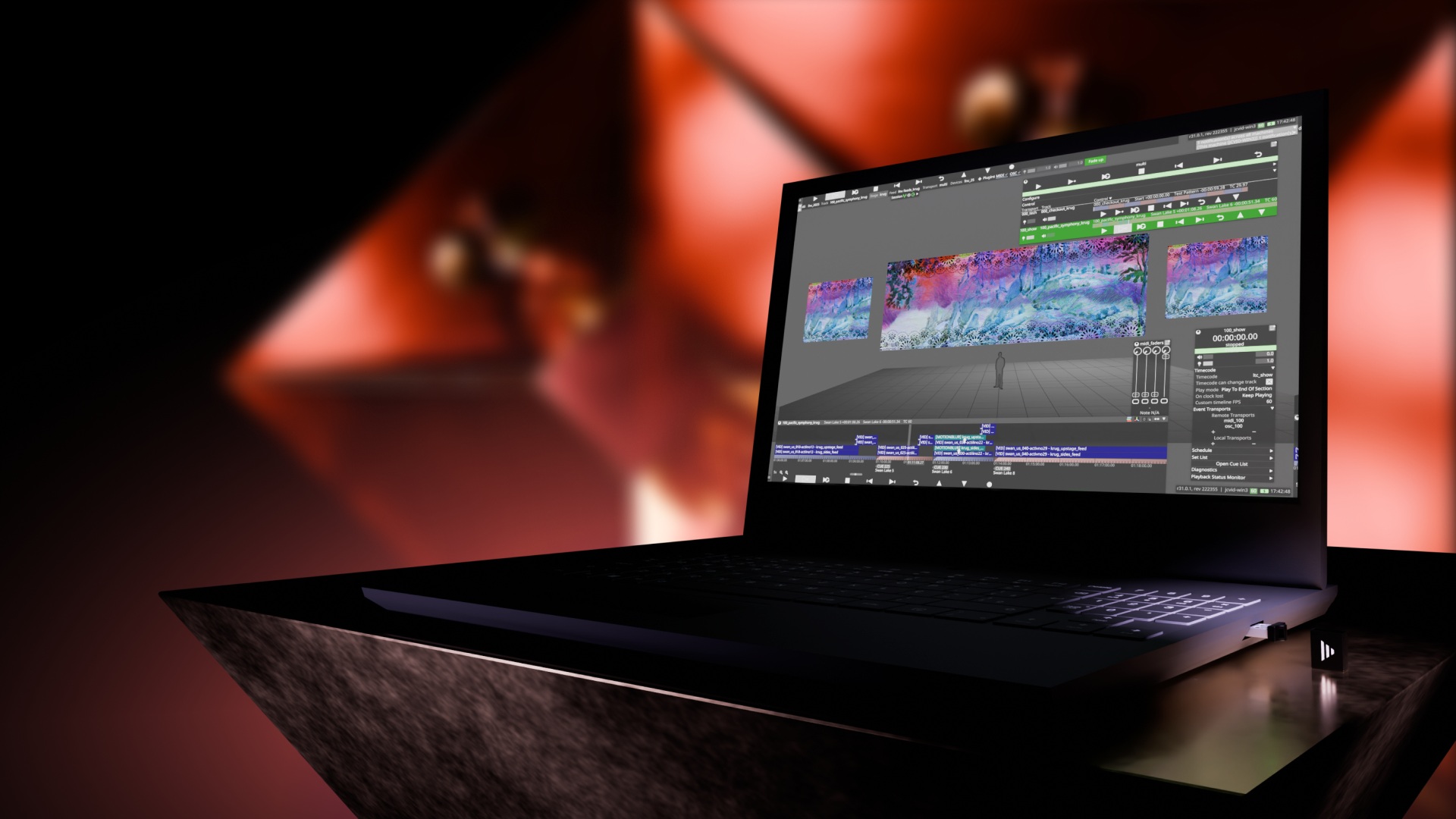
The company presents continuity as a selling point. A show file can travel between planning, rehearsal and performance without being rebuilt in another package. Smaller productions get a route into that workflow, while the output limit and the chosen computer’s capabilities remain real constraints. A portable licence does not make a laptop equivalent to an arena’s server system.
The same commercial direction appears in Disguise’s July 2026 account of 4Wall Entertainment expanding its EX 3+ fleet. The rental company wanted to carry a familiar workflow across different project sizes. Disguise reported deployments on Saturday Night Live and a car-process virtual production stage. The purchasing logic was matching capacity to the job while preserving the tools operators knew.
The useful lesson is hiding in the curtains
A September 2026 case study brings the company’s pitch down to a wonderfully tangible surface: Olivia Dean’s drapes. FRAY Studio and 1826 Studio used live camera projection to keep the audience close to the performers while preserving the set’s soft appearance. Three GX 3 servers drove eight projectors, with real-time grading in Notch.
Curved fabric and changing projection distances required fresh alignment at each venue. The team developed a browser-based tool so operators could adjust image warps while standing nearer the surface. That is the detail to borrow: put the controls where the result can be judged. The software helped, but the production still required people to look, compare and correct.
That example also sets sensible limits on the sales pitch. Simulation supports preparation; it does not remove the physical room. Portable playback helps transport; it does not remove capacity limits. Disguise’s value is clearest when those practical problems belong to the same production. A picture needs to survive the trip from somebody’s imagination to the audience, including every awkward curve along the way.
Go backstage
Explore the tools, watch a demonstration, or follow the people putting them to work.