In October 2012, Brad Griffith and his brother had tickets to a San Francisco Giants playoff game. What they lacked was a printer. The solution involved a sports bar, a basement and a computer. By Griffith’s account, rendering those barcodes on paper took 45 minutes. They missed the first inning. Somewhere between buying admission and entering the ballpark, a supposedly finished transaction had acquired a second job.
- Gametime brings sports, concerts, theater and comedy tickets to your phone.
- Its specialty is helping people choose quickly, often close to showtime.
- Zone Deals exchange exact seat selection for potential savings. Waiting carries its own risks.
Griffith’s response became Gametime, launched in 2013. The interesting part of the founding story is how ordinary the obstacle was. Nobody needed to invent baseball, or even the resale ticket. Someone needed to notice that the customer was still outside. A better checkout meant little if the next step sent you hunting for office equipment.
The clock is part of the inventory
A seat at tonight’s game is an unusual product. Tomorrow, the same plastic chair will still exist, but tonight’s admission will be worthless. That deadline can make an unsold ticket a negotiation between two impatient people: a seller who wants some return and a buyer who has only just decided to go.
Gametime built its identity around that meeting. In its account of 2016, the company said 75% of tickets sold through its app were purchased within seven days of the event. It reported revenue growth above 220% that year. These are historical company figures, but they explain the early attraction: late buyers were a market worth designing around.
In 2019, LastCall pushed the idea past the opening whistle, allowing purchases up to 90 minutes after an event began. Availability depends on the event. The bargain contains a visible cost: arrive late and you surrender part of the performance. For a nearby fan who cares more about being there than seeing every minute, that may be acceptable.
LastCall’s advertised limit after the start.
Availability varies. This is a time window, not a price forecast.
A little less choice, please
Today, Gametime serves millions of fans across sports, concerts, theater and comedy. Its own company page describes more than 60 cities in the United States and Canada. The audience includes spontaneous sports fans, but the app also handles advance purchases. Favoriting teams and artists can trigger notifications about price drops or fresh inventory.
Against alternatives such as StubHub, SeatGeek and TickPick, Gametime emphasizes the work it removes. Seat views help explain what a location feels like. Gametime Picks surfaces recommendations. Its value scoring considers seat quality, current pricing and comparable options. The proposition is editorial as much as transactional: somebody has already narrowed the pile.
There is a revealing detail in its seller terms. A listed ticket may never appear in the marketplace because Gametime curates what buyers see. More supply does not automatically mean more visible choice. For sellers, that is a constraint. For buyers confronted with a stadium map full of dots, it can be a relief.
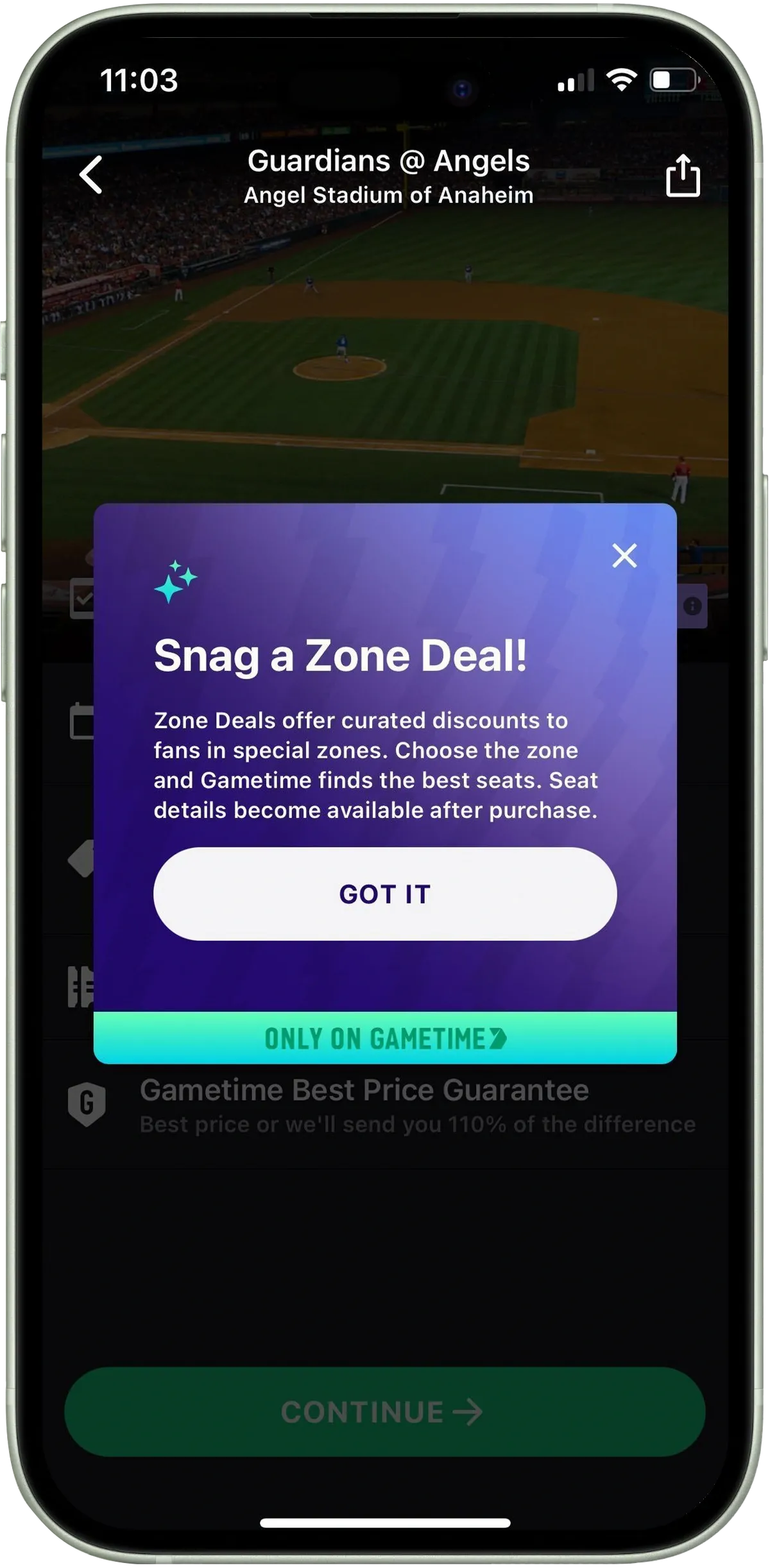
Zone Deals makes the trade explicit. Buyers select a designated area; Gametime selects the exact seats. Its March 2025 release introduced Zone Deals 2.0. Someone who wants a particular row should read carefully. Someone who mainly wants to get friends inside may value the discount more than the privilege of choosing every coordinate.
The price of getting inside
Gametime operates a transaction-based marketplace with fees, rather than a recurring app subscription. Its terms say it does not own the tickets sold through the service, and prices can exceed face value. All-in pricing makes comparison easier; it does not make the transaction fee-free. Buyers still need to compare the full checkout total with other available offers.
The company announced $30 million in financing in May 2022, with investors including Nimble Partners, Maven Ventures, Accel and GV. That capital was intended to support product and platform development and reach younger fans. Funding explains some of the resources behind the experience; it says little about whether your particular ticket is a bargain.
The guarantee also deserves a close reading. An eligible lower-price claim must be submitted within two hours. The benefit is 110% of the qualifying difference in Gametime credit, capped at $200. That is a reason to check comparable listings promptly. It is also different from getting the cheaper ticket price back in cash.
Ordinary sales are generally final. An event cancelled without rescheduling qualifies for a refund under the guarantee; other specific protections have conditions. Ticket delivery is guaranteed in time for the event, which should not be confused with every ticket arriving immediately. These details matter most when an impulsive purchase becomes a complicated evening.

The next bottleneck was search
Gametime has also had to solve problems buyers never see. In 2017, it explained that resale inventory alone sometimes failed to provide enough selection. A Ticketmaster partnership added primary inventory through API tools. A purchasing alternative could also be a distribution partner. The useful boundary was the customer’s experience, not a tidy diagram of competitors.
Search created another constraint. Algolia’s customer account describes an Elasticsearch system that required too much maintenance from generalist engineers. In a March 2026 announcement, Gametime product manager Turk Anwar said:
“Our previous search infrastructure required constant manual tuning and specialized expertise.”Turk Anwar · Lead Product Manager
Algolia reported that Gametime exceeded its targeted 2% conversion lift within three months of implementation. That is a vendor-reported result, not an independent audit. Its practical lesson is still useful: when maintaining infrastructure consumes the people meant to improve the product, buying a service can return their attention to customers.
A December 2025 Yahoo Sports agreement takes the same thinking into distribution, placing ticket offers near games, teams and schedules fans already follow. The distance between wanting to go and arranging to go gets shorter again.
Copy the method by following a purchase beyond payment. Watch where the customer stalls, then fix that step. For fans, flexibility helps: compare total prices, inspect the seating terms and decide how much lateness is worth. Scarce inventory, a must-see opening act or a precise seating requirement can erase the advantage of waiting. The first inning still happens only once.