Clients kept asking Diane McIntyre a question that sounds almost comically modest for someone whose work concerns CEOs and boards: “Are you still doing executive search?” Her answer was emphatic. Absolutely. The question captures a small puzzle in her career. As her responsibilities expanded, the activity that had built her reputation became harder to see inside the larger job.
Finding the right executive is a satisfying assignment to describe. There is a vacancy, a search and, eventually, a name. Advising on culture, succession and the relationship between a CEO and a board is less accommodating. The work continues after the announcement. A person can arrive with the right experience and still encounter an organization whose habits make the job difficult.
McIntyre’s career follows that widening field of attention. She leads Teneo’s People Advisory business in the United States, with a remit that reaches from executive and board search to strategic alignment and leadership development. Recruitment remains part of the work. So does the question of what the organization will do with the talent it recruits.
A recruiter gets recruited
In December 2015, Calibre One announced McIntyre’s appointment as a partner for its New York and Connecticut offices. She came from Accelent. The appointment itself had been handled by Rochelle Schumer of R&L Associates, a pleasing reminder that even the people who find people sometimes need finding.
Calibre One wanted someone to drive its East Coast search activity and contribute to a growing partnership. McIntyre’s own explanation emphasized a shared appetite for the work. She welcomed the team’s “sense of urgency & hustle.” There is little leisure in that phrase. A search has its own clock, and a client has a reason for watching it.
She had already spent nine years as a managing director at Ramsey/Beirne Associates, working closely with David Beirne. Her assignments included senior searches for technology businesses. Microsoft, eBay and E-Trade appear among the companies connected to searches she managed. The names make a useful point without needing to turn a recruiter into the inventor of the internet: building a technology business also requires building its leadership.
“sense of urgency & hustle”
Diane McIntyre, on joining Calibre One
When the job grew around the search
Teneo announced McIntyre’s arrival as Head of U.S. Talent Advisory on April 7, 2021. By then, she had become Calibre One’s U.S. Managing Partner. Her move placed executive recruiting within a firm advising leaders across a wider set of business questions.
The next organizational marker came in June 2022, when Teneo launched its global People Advisory brand. It brought together Ridgeway, Anna Whitlam People and the U.S. Talent businesses. McIntyre led the U.S. alongside Sue O’Brien in the UK and Anna Whitlam in Asia Pacific. At launch, the combined group counted more than 70 professionals working on more than 110 projects.
Those are launch figures, rather than a claim about the team today. They show the scale of the undertaking at that moment: executive search, board advisory, culture and organizational transformation under one name. McIntyre welcomed the opportunity to build a global team and broaden the support available to CEOs.
June 2022 launch snapshot · global People Advisory
The expansion helps explain why a client might ask whether search was still on the menu. It also explains her quick reply. Recruiting remained a direct way to change a business. The larger practice added attention to the relationships and working conditions surrounding the appointment.
The CEO has company
“No CEO succeeds alone.” McIntyre opened her January 2023 writing on board collaboration with that sentence. It is brief enough to survive a board pack, and direct enough to puncture the idea that leadership is a solo performance.
Her argument placed the CEO and board in a relationship of mutual dependence. Directors offer oversight and judgment; the CEO carries responsibility for leading the business. Both need clarity about strategy, goals and their respective roles. Experience does not remove the need to listen.
Succession featured in that discussion, including succession for the board itself. The chair and committee chairs need a future plan, too. The table has a next generation on both sides of it.
That emphasis shifts attention from the résumé to the room. Hiring a capable CEO does not decide how directors will challenge that person, how disagreements will be handled or how everyone will stay informed. A meeting can be perfectly scheduled and still contain people working from different understandings of the same business. Collaboration needs maintenance. Calendar invitations are the easy part.
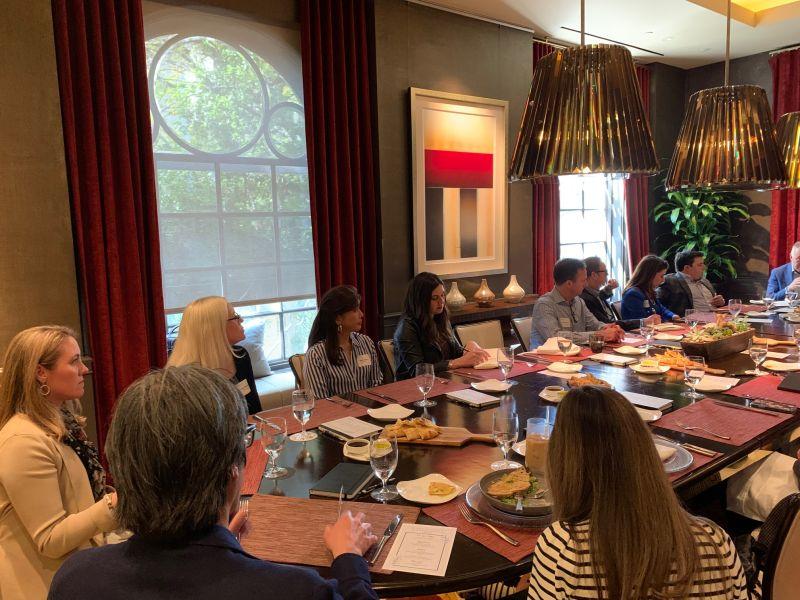
McIntyre’s work has also crossed into conversations with communications leaders. In Los Angeles in 2023, she joined Tim Burt and Sally Drexler in leading a lunch discussion on corporate crises. It is a concrete example of the subjects meeting around one table: leadership, communication and the demands placed on an organization when circumstances change.
The people between the boxes
A merger offers a particularly sharp version of the problem. Two companies can be combined on paper before their employees understand what the combination means for their work. The transaction supplies a date. Belonging is harder to put in a diary.
In February 2024, McIntyre and Micah Alpern wrote about talent in M&A integration. Their approach distinguished future leaders, people holding essential institutional knowledge and employees who connect and influence their colleagues. Each group matters for a different reason. The familiar organization chart is only one view of the business.
Their recommendations included listening to employees and involving them in the combined culture. The implication is practical: telling people that change has occurred leaves unanswered the question of where they fit. Integration has to make that future intelligible.
A conceptual map, based on their 2024 talent framework.
For a recruiter, that is an interesting extension of the original assignment. The conspicuous role still deserves attention. So do people whose influence comes from what they know or whom others trust. A business may depend on someone who has never appeared in the announcement. The appointment and the integration belong to the same story, viewed from different distances.
New tools, familiar leadership questions
By September 2025, McIntyre was coauthoring work on leadership in the age of AI with Alpern, Scott Thomas and Cali Goldberg. They identified five capabilities: coaching, creativity, agility, connectivity and sense-making. Their research included benchmarking 15 global organizations across seven sectors.
The list gives leaders work to do even when technology can perform more tasks. Coaching helps others develop. Creativity asks which problems deserve attention. Agility concerns responding to change. Connectivity and sense-making attend to the relationships and explanations that hold work together.
The significance for McIntyre’s career is the continuity. Technology changes the requirements of the job; choosing and developing leaders still matters. A company can obtain new tools faster than it can establish shared expectations about their use.
The authors also described a practical speaking exercise in which leaders receive peer feedback and revise a short message. That small example is revealing. Leadership development has to enter the work itself. An impressive vocabulary about transformation is of limited use if colleagues leave a conversation unsure what to do on Monday.
Building a team to match the questions
McIntyre also leads a business that recruits expertise for itself. In July 2025, Teneo added Keith McAllister and Jamie Waldron as senior managing directors in U.S. People Advisory, based in New York and Los Angeles respectively. Their backgrounds extended into media, sports and entertainment.
McAllister brought executive search experience and a career that included senior media roles. Waldron brought entertainment and recruiting experience. Welcoming them, McIntyre pointed to the importance of their networks and industry understanding as clients faced change.
It is an ordinary managerial action with a useful connection to her wider career: people advisory also requires choices about people. A practice cannot advise across changing industries through a job title alone. It needs colleagues who understand the businesses and the leaders within them.
The business it is becoming
In September 2026, McIntyre returned to a question that gathers the earlier work together. When a business changes its strategy, has it also changed what leadership requires? Her essay examined the gap between a new direction and established patterns of decision-making, authority and accountability.
The issue gives the search question a longer life. A company can recruit someone for its future while asking that person to operate through arrangements inherited from its past. The mismatch deserves attention before another appointment becomes the proposed solution.
Seen across her career, McIntyre’s work keeps widening the view around a leadership decision. There is the person selected, the board that works with them, the employees who interpret change and the colleagues who make daily decisions. Each belongs in the picture.
Executive search supplies the name. The continuing assignment is to make the job, the relationships and the business fit together well enough for people to act.