Before Derek Chang had Formula 1 and MotoGP in his working life, he occupied a rather different seat in competitive sport. At Yale, he was the coxswain of the varsity men’s heavyweight crew. The rowers supplied the propulsion. His place was in the boat with them, helping a collection of individual efforts travel in the same direction. It is an appealing detail for a future chief executive, though a rowing seat should probably be spared the burden of explaining an entire career.
There is a more useful way to follow Chang: follow the spectator. His work has moved through the businesses that carry entertainment from its makers to the people who want it. Cable systems. Satellite television. International channels. A basketball league’s operation in China. A company built to put premium sport on commercial screens. The job titles change; the distance between an event and its audience keeps needing attention.
In February 2025, he became president and chief executive of Liberty Media. The role brought together a long acquaintance with the company and years spent on both the operating and financial sides of media. By the end of that year, Liberty had completed its acquisition of MotoGP’s rights holder and separated Liberty Live. Chang’s next chapter would have considerably more engines in it.
A history degree, then the machinery of television
Chang graduated from Yale in 1989 with a degree in history and earned his Stanford MBA in 1994. The combination offers a pleasing range of reading material: how institutions develop, followed by what it costs to run them. His subsequent career would require familiarity with both the audience-facing attractions of media and the arrangements supporting them.
His early executive experience included TCI Communications and the YES Network. He was executive vice president of development at YES from its inception in 2001 through January 2003, helping launch a network built around sports. A fan sees a game; a new network also needs distribution, partners, and a business that can survive between games. The beginning of a channel is therefore a useful education in how many things must happen before the screen lights up.
At Charter Communications, from 2003 to 2005, Chang’s work shifted toward finance and strategy. He also served as interim co-chief financial officer. His responsibilities included the balance sheet, mergers and acquisitions, corporate strategy, and communication with Wall Street. These are quieter activities than a televised contest, but they determine how much room a company has to make its next move.
DIRECTV put content at the center of his brief. From 2006 to 2013, he was executive vice president of content strategy and development, overseeing acquisition and production. His sports responsibilities included relationships with the NBA around NBA TV and League Pass. He was working at the point where a distributor’s commercial decisions become a viewer’s available choices.
- 2001Build a networkYES
- 2006Acquire the contentDIRECTV
- 2013Cross bordersScripps
- 2018Run a league’s marketNBA China
- 2023Reach the sports barEverPass
- 2025Lead the ownerLiberty Media
The audience has a postcode
In 2013, Chang joined Scripps Networks Interactive as managing director for Asia-Pacific. Three years later, a promotion made him head of international lifestyle channels, and he relocated from Singapore to London. His responsibilities extended across television brands concerned with food, homes, and travel: ordinary interests with considerable appeal, provided the programming finds its audience.
His tenure included the international expansion of HGTV and Food Network. HGTV launched outside North America for the first time; Food Network expanded in Latin America and arrived as a free-to-air channel in Australia and Italy. Moving a brand into another country sounds tidy in a presentation. In practice, the words “another country” conceal a new set of viewing habits, distributors, advertisers, and expectations.
Chang’s international work matters to the sports career that followed. A recognizable brand provides a starting point, but its presence in a market is something people have to build. A television executive can admire the reach of a network and still have to answer a much smaller question: who will actually watch this program here?
China, before the corner office
For Chang, China had an earlier, personal place in the story. Both his parents were born there. He was born and raised in the United States, visited China while in college, and returned after graduating to teach English. When the opportunity to lead NBA China arrived, the geography carried memories as well as a business proposition.
He began the NBA job in June 2018. Explaining its attraction that year, he described the combination plainly: “It’s sports, it’s media, it’s technology and it’s China.” The league had assembled an operation of roughly 200 people, with offices across Beijing, Shanghai, Taipei, and Hong Kong. The audience was large, but so was the organization required to serve it.
During his tenure, the NBA expanded its relationship with Alibaba to bring content onto the company’s platforms and enhance its shopping offering. A five-year Tencent partnership expansion followed in 2019. These were different routes into the same fan’s day: watching, following, buying, and returning. A league abroad needs more than a visiting team and a date on the calendar.
Chang left NBA China in May 2020. The experience remains relevant to his later work: he had led a sports business within a market rather than simply negotiated a channel into it. He had also returned, as an executive, to a country he first encountered as a student. That is a more interesting journey than the straight line suggested by a résumé.
“It’s sports, it’s media, it’s technology and it’s China.”Derek Chang, reflecting on the NBA China role, 2018
The Sunday afternoon business
EverPass Media introduced another audience: people watching sport somewhere other than home. Chang and Alex Kaplan cofounded the company in partnership with the NFL and RedBird Capital Partners. Announced in March 2023, the venture held commercial distribution rights to NFL Sunday Ticket, serving bars, restaurants, hotels, and other venues. Chang became executive chairman; Kaplan became CEO.
The distinction between a household and a business is consequential. A restaurant owner is buying part of the customer experience. The game must be available in the right setting, on equipment that works, through an arrangement appropriate to the venue. A thrilling fourth quarter loses something when the person holding the remote is negotiating with a login screen.
In July 2024, EverPass acquired UPshow, bringing streaming and on-premise technology into the business. TKO also invested, and its president and chief operating officer, Mark Shapiro, joined the board. The acquisition meant EverPass could pair its content library with more of the infrastructure needed to deliver it. On LinkedIn, Chang finished his announcement with five economical words: “Now the real work begins!”
His own description of the venture emphasized building a streaming platform for commercial establishments. It fits the longer career remarkably well. Content rights supply the attraction; distribution makes the attraction usable. EverPass placed that relationship somewhere pleasantly familiar: the room where people have gathered to watch their team.
A familiar company, a different brief
Chang had been a Liberty Media director since March 2021 when the company announced his appointment as CEO in January 2025. The formal start date was February 1. He stepped down as EverPass executive chairman while remaining on its board. At Liberty, this was an insider’s move into the operating job, backed by experience elsewhere.
John Malone had worked with Chang for more than 25 years and publicly praised his leadership style and global perspective. Their connections included TCI, DIRECTV, and board service. Chang’s familiarity with Liberty therefore extended beyond the latest corporate presentation. He had seen parts of its world from several seats.
The first year delivered two visible structural changes. Liberty completed the purchase of approximately 84% of MotoGP rights holder Dorna on July 3, 2025, with management retaining 16%. Then, on December 15, the Liberty Live split-off created a separate publicly traded company. Liberty Media’s former tracking stock structure ended. Formula 1 and MotoGP became the central operating businesses in the remaining company.
Approximately the stake acquired by Liberty Media.
Liberty Media ≈84%
MotoGP management 16%
The race, and everything around it
At the Autosport Business Exchange in Monaco in May 2025, Chang discussed Formula 1’s move into broader entertainment. He pointed to screen storytelling, the film then approaching release, and consumer partnerships including Lego and Disney. The underlying idea was an audience that can encounter the sport through several doors. A racing series has people, personalities, and stories alongside its results.
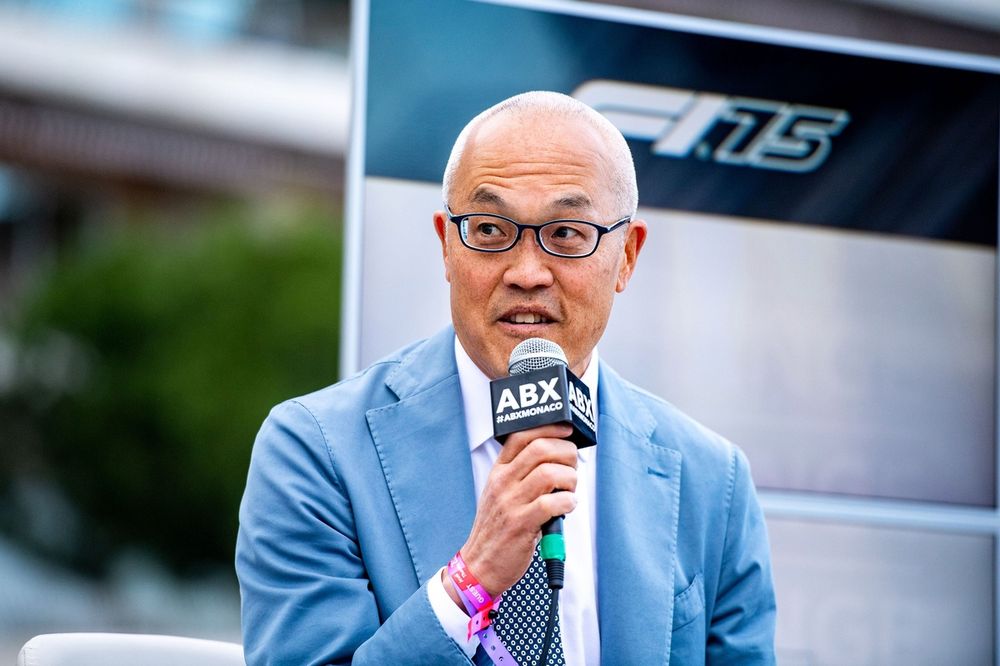
He also identified China as a market where Formula 1 had more work to do. His NBA experience supplied a direct acquaintance with the country’s enthusiasm for sport. The observation was practical: existing interest and existing distribution do not exhaust an opportunity. Building an audience requires continued investment and attention, even when the brand is already internationally recognizable.
MotoGP adds another version of that task. Liberty’s purchase brought an established championship and its management into the portfolio. The ambition Chang has expressed is to deepen the connection with existing fans while reaching a wider global audience. Keeping those two groups interested at once is a substantial assignment. Longtime followers bring expectations; newcomers bring questions.
Back to the boat, briefly
In 2026, Chang joined Yale’s board as a successor trustee. He had already volunteered on three reunion committees. His public commitments also include the Committee of 100, whose membership connects Chinese American leaders, and the Paley Center for Media’s trustees. These activities add institutional continuity to a career marked by changes in employer, country, and medium.
By August 2026, his Liberty brief paired global sports growth with disciplined capital allocation. There is still room for the financier’s questions alongside the operator’s: what deserves investment, what can expand, and what should the organization concentrate on? Racing supplies an unusually vivid setting for decisions that are often expressed in considerably less vivid spreadsheets.
The coxswain detail remains a good place to end, provided the metaphor stays modest. Chang’s documented career is full of jobs coordinating people, rights, money, and distribution. His contribution is easiest to see by looking beyond the finish line, toward everyone trying to watch it. Somewhere between the event and that audience sits a business. He keeps finding work there.