Start with a week. Three visits to a dialysis center, roughly four hours apiece. Twelve hours before counting the journey, the waiting, the rearranged working day. DaVita describes this as a typical in-center treatment schedule. It is also a useful way to understand the company: an enormous organization built around a small, recurring appointment that a person cannot casually skip.
- DaVita delivers dialysis in centers and at home, alongside education and care coordination.
- Its late-1990s growth overwhelmed its operating infrastructure.
- Its expanding insurance partnerships put more attention on preventing crises between visits.
By June 2026, DaVita served approximately 298,500 dialysis patients across 3,266 outpatient centers. The footprint covered the United States and 14 other countries. Yet size alone explains surprisingly little about the work. A treatment network must get a long sequence of ordinary things right, repeatedly, for people whose health leaves little room for administrative improvisation.
Twelve hours, before the journey
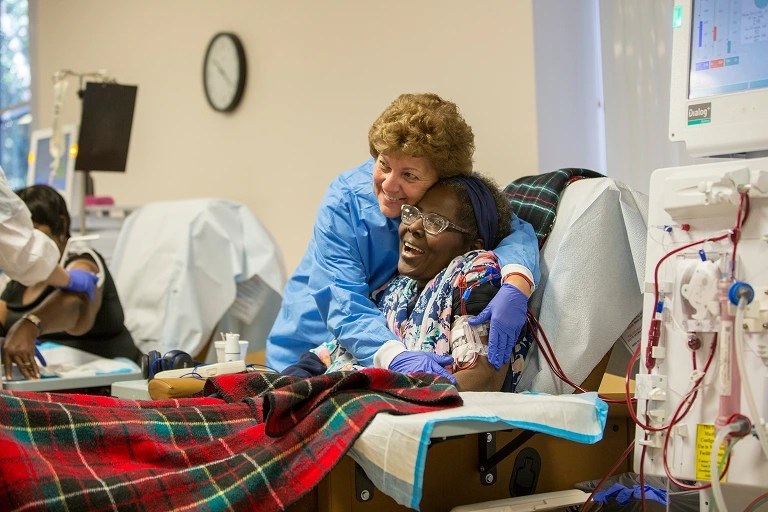
Hemodialysis removes waste and excess fluid from blood when the kidneys can no longer do enough of that work. At a center, the appointment includes weighing, checking vital signs, connecting the patient and monitoring treatment. The machine is conspicuous. The system around it makes the appointment possible.
DaVita’s expertise sits in that system: clinical teams, treatment protocols, patient education and coordination with kidney specialists. Its offerings extend to hospital dialysis, home treatment, clinical research and Integrated Kidney Care. For patients, the useful question is practical: which setting and support can fit their medical needs and daily lives?
The machinery that failed first
DaVita’s predecessor discovered the price of neglecting ordinary operations. Before mid-1999, Total Renal Care pursued acquisitions aggressively. Its own subsequent securities filing says growth strained administrative functions and operating efficiency. Buying clinics was easier than building the organization required to run them together.
The repair was concrete. Under new leadership, the company sold most operations outside the continental United States, improved billing and collections, reduced debt and restructured credit facilities. Later came investment in systems and processes. The sequence matters. A business delivering essential care still has to collect its bills and finance tomorrow’s work.
Kent Thiry became chairman and CEO in October 1999. The following May, more than 600 leaders voted on a new name and core values. DaVita called itself a “Village.” That cultural language accompanied a financial and operational reconstruction. For another operator, the copyable lesson is to make growth answerable to the capacity of the organization serving it.
Illustrative typical in-center schedule. Individual prescriptions vary; travel and waiting are additional.
A household becomes a treatment room
Home dialysis changes the geography of that commitment. DaVita offers peritoneal dialysis and home hemodialysis, with training and continuing clinical support. Peritoneal dialysis uses the lining of the abdomen to help filter waste. Home hemodialysis uses a machine. Neither turns a serious treatment into a household appliance you simply switch on.
There must be room for supplies, a suitable treatment space and someone able to learn the tasks. Most home hemodialysis patients need a care partner. Some homes require electrical or plumbing changes. The patient and clinician must consider medical suitability alongside these practical conditions. Greater control over a schedule can arrive with greater responsibility for the household.
Education is therefore part of the service. Kidney Smart classes cover treatment options, diet, insurance and transplantation, online or in person, at no cost. A person can begin by learning the vocabulary before making decisions with a care team. That is a useful service even before a dialysis chair enters the picture.
Who pays for the time between visits?
DaVita’s conventional business earns reimbursement for treatment from government programs and commercial insurers. Its largest named competitor, Fresenius Medical Care, also manufactures equipment and supplies. DaVita’s distinction centers on delivering and organizing care. It is a provider network whose performance depends on people and processes as much as technology.
In the second quarter of 2026, DaVita reported U.S. dialysis revenue of $415.87 per treatment and patient care costs of $277.40 per treatment. Those are company averages, not a patient price list. Nor is the difference pure profit: administration, depreciation and other expenses still matter. Consolidated 2025 revenue reached approximately $13.64 billion.
What happens between appointments becomes part of the business.
Integrated Kidney Care widens the assignment. It coordinates care with nephrologists, uses risk information and supports planning intended to reduce unplanned dialysis starts and avoidable hospital stays. In risk-based arrangements, the financial stakes extend to broader medical spending. That gives prevention a place in a company associated with recurring treatments.
A Humana agreement launched in July 2026 makes the shift tangible. It extends coordinated care to more than 10,000 Medicare Advantage members with chronic kidney disease stages 3B-5. The stated aims include delaying or preventing dialysis and reducing hospitalizations. These are the partnership’s goals; announcing an agreement does not establish that it has achieved them.
Read the village and the balance sheet
The culture deserves scrutiny alongside the economics. In 2014, DaVita agreed to a $350 million civil settlement over alleged referral kickbacks, plus $39 million in forfeiture. A corporate integrity agreement required changes to business arrangements and independent monitoring. The settled claims were allegations, with no determination of liability. The episode shows why physician relationships require more than warm language.
Continuity has another price. An April 2025 cyber incident disrupted operations and exposed data. DaVita reported approximately $25 million in annual remediation and system-restoration charges, excluding business interruption effects. It said patient care continued. For a service organized around repeated essential appointments, backup procedures are part of delivering the product.
DaVita’s next chapter depends on whether coordination can make that recurring week less precarious. Its October 2026 research announcement includes studies of home treatment and why patients miss dialysis. Those questions bring the company back to the person with a calendar: how to keep treatment dependable, and how to make more room for everything else.