The interview was going well enough until somebody asked for the benchmarks. Davit Buniatyan and his fellow Princeton doctoral students had come to Y Combinator with an idea about spare computing power. During the conversation, his co-founder Jason Ge offered a more precise proposition: perhaps cryptocurrency mining and neural-network inference could share a GPU efficiently. The trouble was that the team had yet to test the proposition.
In Buniatyan’s later telling, they hurried back to their accommodation and ran the experiments. The numbers supported the hunch. An email from YC then arrived, requesting a call. They were ready to discuss their results; the investors were ready to let them in. A research question had acquired a deadline, an audience and a company.
It is a useful opening to Buniatyan’s story because it contains so much of what followed: technical curiosity, an uncomfortable gap between an idea and its proof, and the willingness to keep working through that gap. The company would change its name and its product. The practical question would survive: how do you make expensive intelligence spend less time waiting?
A detour through the movies
Buniatyan grew up in Yerevan, Armenia, and completed the International Baccalaureate at Quantum College in 2013. London came next. At University College London, he studied computer science, with Lourdes Agapito and Adrián Peñate Sánchez supervising his final-year project. His route toward the subject had begun somewhere considerably more colourful than a database diagram.
He had been drawn to animation by Pixar films. Learning about graphics, rendering and three-dimensional models seemed like a way into that world. When he discovered there was no dedicated animation curriculum for him, computer science became the route forward. A film can conceal an extraordinary amount of computation behind a few seconds of apparent ease. His later work would concern the machinery behind another convincing performance.
In 2014, Buniatyan helped build Newsly, a UCL hackathon project using swipes to personalise news recommendations.
Teaching a machine to stay for a conversation
In 2016, Buniatyan entered Princeton’s doctoral program with a Gordon Wu Fellowship. His research adviser was Sebastian Seung. Computer vision and large-scale computing became working problems rather than subjects to admire from a lecture theatre. A dataset could be scientifically valuable and still be thoroughly inconvenient to use.
Another Princeton project offered a different sort of inconvenience: conversation. Buniatyan was part of the team behind Pixie, the university’s entry in the 2017 Alexa Prize. Its ambition was to sustain an engaging conversation across open-ended subjects. Answering a factual question was only the beginning. Keeping somebody interested required coherence, timing and some sense of where the exchange might go next.
The team drew members from several research backgrounds, including computer vision, machine learning and distributed systems. Its weekly meetings with adviser Sanjeev Arora brought those disciplines into the same room. The technical paper described a modular system and examined the limitations of its largely template-based approach. Long before conversational AI became an everyday browser tab, Buniatyan was helping examine why a machine could speak and still be poor company.
“If we win or if we don’t win is not the point.”
Davit Buniatyan, on Princeton’s Pixie team, 2017
The remark gives a glimpse of his priorities at the time. He valued what the research contributed beyond the competition. It also complicates the familiar dropout biography, in which university appears mainly as a place the protagonist had the good sense to escape. Princeton supplied collaborators, questions and experience that travelled with him.
Spare GPUs, then a harder question
The first business was called Snark AI. It joined Y Combinator’s summer 2018 batch, and Buniatyan moved to the Bay Area. An early proposition involved using idle GPUs. By December, investor SmartGateVC described a broader deep-learning platform and announced its participation in a $1.7 million seed round alongside YC, Baidu Ventures and other investors.
The contemporary account names Jason Ge as CEO and Buniatyan as CTO. That matters to the shape of the story: the current founding CEO began this chapter working alongside fellow researchers, with responsibilities that changed as the enterprise evolved. Building a company involved more than taking a research idea and adding a sales address.
Buniatyan’s 2019 paper on Hyper shows the engineering questions occupying him. It describes a distributed framework for workloads spanning cloud and on-premise resources, with task scheduling, a distributed file system and tolerance for computing-node failures. The experiments used 10,000 CPU cores and 300 GPU instances. Keeping all those resources useful requires attention to what happens between the machines.
Reported experimental resources, not a measure of Activeloop’s current infrastructure.
A processor has little use for the elegance of an algorithm while it waits for the next piece of data. Files must arrive, jobs must run, failures must be handled. In this corner of computing, logistics gets its revenge on glamour. Buniatyan was developing a career around the details that a demonstration can conveniently leave offscreen.
The lake, and the unfortunate merchandise
Customer work helped narrow the problem. Activeloop worked on language-model applications for patents and data pipelines for agricultural imagery. Different customers brought different material, yet images, text and sensor data repeatedly created difficulties for the systems expected to feed machine learning. Hundreds of company conversations helped turn those experiences into a product direction.
In 2020, the company released Hub as an open-source dataset format. It stored complex data as chunked arrays in object storage and connected that data to deep-learning frameworks. Version control, streaming and querying expanded its responsibilities. By September 2022, Buniatyan was introducing Deep Lake, a name with rather more specificity than “Hub.”
The naming explanation included a pleasingly ordinary casualty: recently ordered merchandise bearing the old branding. Software could change overnight; the swag was less cooperative. For a business dealing in abstract infrastructure, it was a small encounter with the stubborn material world.
Deep Lake’s documentation made the proposition concrete. Developers could keep images and their annotations together, track dataset changes and stream data into PyTorch or TensorFlow. Data could live locally or in cloud storage. These are practical provisions for people who need an experiment to work again tomorrow, with a clear account of what changed.
That concern helps explain why the business is about data infrastructure at all. A model depends on the material available to it and the process that delivers that material. Improving that process can make an existing model more useful, while giving its human operators less housekeeping to perform.
A founder who corrects the introduction
In a 2023 conversation with Shane Hastie, Buniatyan corrected an introduction that credited him with a completed doctorate. He had left Princeton to start the company. His own website is equally direct about the unfinished qualification. It is a small correction with a useful effect: the reader can put the credential aside and look at the work.
The same conversation shows an engineer considering how other engineers meet AI. He discussed experienced colleagues’ reluctance to use coding assistants and his own experience of making mistakes after hours of programming. He saw practical assistance in unfamiliar tasks, alongside the need to understand models, data and the edge cases an application would encounter.
By March 2024, Activeloop announced an $11 million Series A from investors including Streamlined Ventures, Y Combinator and Samsung Next. The announcement put total funding at about $20 million. That money belonged to the company’s financing story, with an enterprise product to develop and customers to serve.
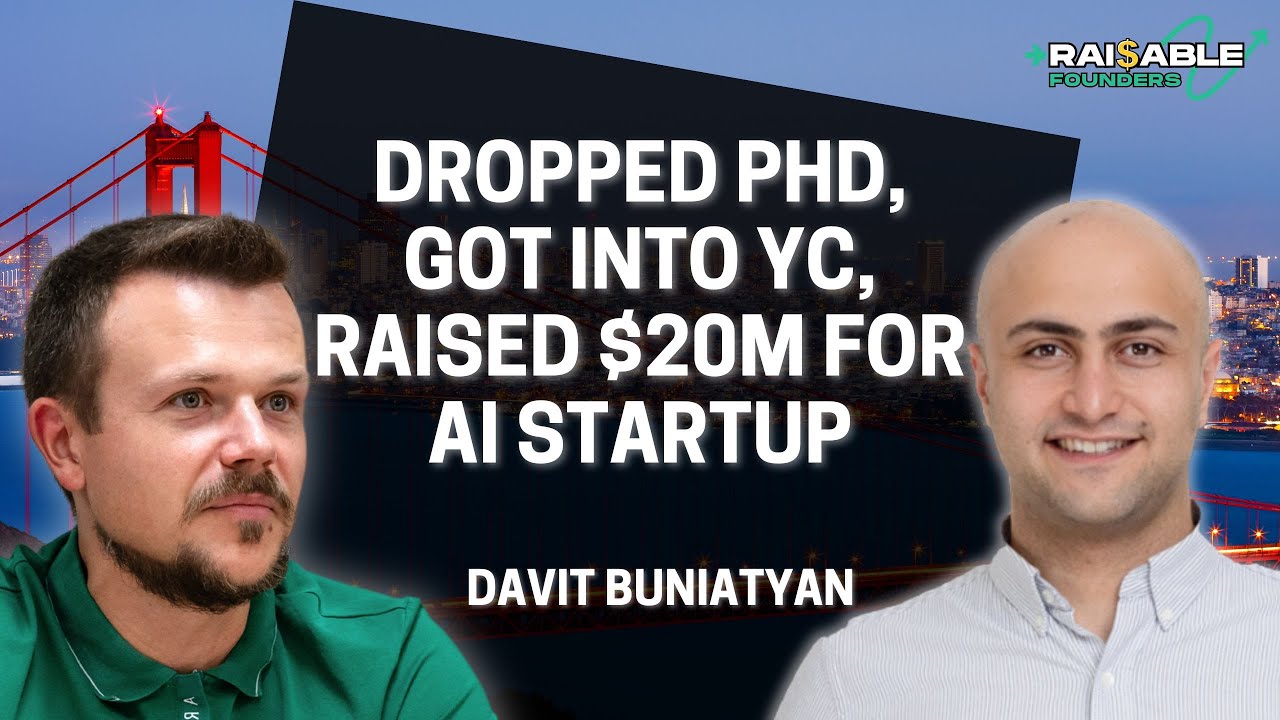 Watch the founder interview ↗
Outside work, the details are more pleasantly analogue. He has described swimming, tennis and shotokan karate among his interests. Chess has been part of his life since childhood, and he enjoyed The Queen’s Gambit. None of those details needs to become a theory of entrepreneurship. A founder is allowed to like a game without every move explaining his business.
The next thing that forgets
His public writing in 2026 follows a newer frustration. In February, he described an autonomous software-development experiment running for fifteen hours. In March, he wrote about data environments for agents. In April, his subject was Hivemind and the loss of useful context when coding-agent sessions end. These are his published experiments and proposals, rather than settled promises about what every user will achieve.
Hivemind’s public repository describes turning agent traces into reusable skills. It works across coding tools and uses Deep Lake for shared memory. The connection to his earlier work is straightforward: useful activity produces information, and the next task benefits if that information remains available in a usable form.
There is a long distance between a young student attracted by Pixar and a founder occupied with what software remembers. Yet both involve looking behind an apparently effortless result. Buniatyan has spent the intervening years among the files, experiments and awkward handoffs that make such results possible. His next chapter is taking shape in that same busy middle, where an idea still has to meet its benchmark.