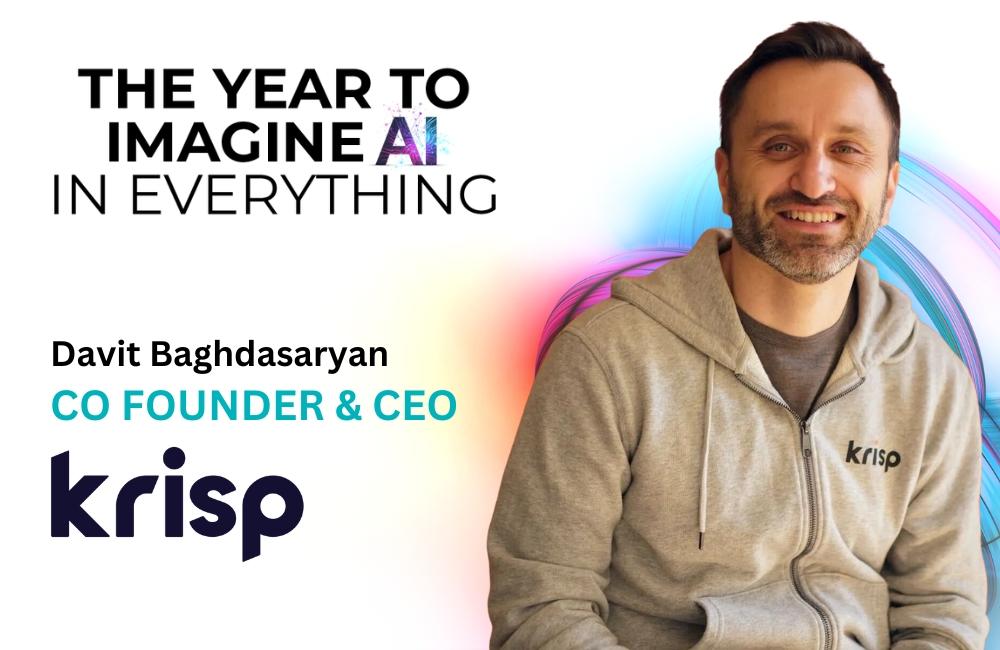
Davit Baghdasaryan wanted to go out. His calendar had other ideas. He was working for Twilio in San Francisco and returning regularly to Armenia, where friends and family were waiting. The American working morning landed in the Armenian evening. A call could follow him into a café or a car. His colleagues needed his attention; they did not necessarily need the soundtrack.
That is an unusually ordinary beginning for an artificial intelligence company. There is no grand declaration in it, just a person trying to be in two places at once. Baghdasaryan wanted his voice to travel across the world without taking the whole room along. The wish eventually became Krisp, which he co-founded with Artavazd “Arto” Minasyan in 2017.
The smallness of that original wish matters. A product has to earn its place in somebody’s day. In this case, its founder already knew the interruption it needed to remove. The ambitious part would be persuading a computer to distinguish the conversation from everything trying to join it.
The question over coffee
Minasyan remembers asking his friend which problem he would solve with machine learning if he could choose one. Baghdasaryan answered immediately: noise reduction. The two spent time drinking coffee together, and the question found a receptive audience. Minasyan began working on the idea with Stepan Sargsyan, who became Krisp’s chief scientist.
Baghdasaryan initially thought the proposal was a joke. A prototype changed the terms of the conversation. Minasyan puts the development period at eight months; the result helped persuade Baghdasaryan to leave Twilio and build the company. Coffee has financed many implausible conversations. This one acquired an engineering team.
The partnership divided the early challenge usefully. One founder had a recurring problem from his working life. The others could investigate whether machine learning could solve it. Neither the irritation nor the research was sufficient alone. Their combination gave the project a reason to exist and a way to proceed.
From a personal inconvenience to a problem a team could work on.
Before the microphone, the lock
Baghdasaryan arrived at voice software through security. Before Krisp, he led Twilio’s product security program. Earlier, at Nok Nok Labs, he worked on authentication technology. His background includes co-authoring the FIDO UAF security protocol, and his professional biography records more than eighteen US patent applications.
That career puts a different emphasis on the story. He had spent years dealing with what software should permit, protect, and authenticate. The new company asked what a microphone should admit. The analogy is imperfect, but the recurring design problem is recognizable: a useful system needs to make distinctions reliably, while the person using it gets on with something else.
He also brought experience on both sides of the geography. His early professional biography describes years of technology work in Silicon Valley alongside development work rooted in Armenia. The company he was building would draw on that combination. Armenia supplied a research base; the market extended well beyond it.
Three milliseconds to behave yourself
One of Baghdasaryan’s more revealing pieces of writing concerns a browser extension. In April 2020, he described how Krisp’s team had made its neural network thirty times faster for Chrome. The account begins with dinner with friends at Discord. Its CTO suggested that changes to Chrome might allow an external audio filter.
Baghdasaryan was skeptical enough to commission an outside proof of concept before committing the core team. Research then supplied a smaller model. Even so, video calls could push processing beyond Chrome’s three-millisecond window, producing broken audio. The solution divided the work into smaller parts.
His punchline concerns an engineer who took ten days to produce the algorithm, seven of them on vacation. There is affection in the arithmetic. There is also a useful measure of the CEO’s attention: he remembers who solved the problem, the constraint they faced, and the joke that made the account worth reading.
The processing window in Baghdasaryan’s Chrome account. Miss it, and the call could break up.
A timing constraint, not a current product performance claim.This is where the attractive idea encounters the customer’s laptop. A demonstration can take its time. A live conversation keeps going. The team had to fit its work around the other demands of the browser, including the video call it was supposed to improve. The practical problem was wonderfully unforgiving: make the software quiet without making the speaker disappear.
The founder who says AI is a tool
By October 2023, Baghdasaryan described Krisp’s technology as deployed across more than 200 million desktop and mobile platforms. He named Discord, RingCentral, Twilio, Vonage, and Zoho among the services it powered. Those are company-reported deployment figures, rather than a count of people paying for the Krisp app. The distinction helps explain how a relatively discreet technology can travel widely.
His advice to AI startups was less theatrical than those numbers. As development tools spread, he argued, AI itself would become less distinctive. Founders would still need to choose a useful problem and solve it well. The novelty of the machinery would offer diminishing shelter from a familiar question: why should anyone use this?
“AI is just another technology under your belt”
Davit Baghdasaryan · 2023
That is an interesting position for someone whose business depends on it. It asks the founder to surrender an easy sales pitch. An AI label can describe the ingredients; the customer still has to like dinner. Baghdasaryan’s original evening call supplies a more concrete test than any fashionable vocabulary could.
A second business in other people’s beginnings
In November 2021, Baghdasaryan announced BigStory VC with Minasyan and Podcastle founder Arto Yeritsyan. The stated plan was to invest ten million dollars in about twenty-four Armenian startups over two years. Those were intentions at launch, and they make the purpose clear: turn experience gained building companies into support for the next set of founders.
The fund’s current description puts operational help alongside capital. It offers access to experienced people and international investors, focusing on Armenian founders targeting global markets. It lists checks from $100,000 to $400,000. Baghdasaryan’s route between Armenia and California had become part of what he could offer someone else.
There is a practical generosity in making introductions, asking awkward questions, and helping a young company find its market. A founder can have a workable product and still be inexperienced at selling it, hiring for it, or explaining it to investors. BigStory makes those gaps part of its stated work.
The company over coffee and the fund share a recognizable pattern: a local relationship opens onto a larger market. In one case it produced software. In the other, it offers founders access to people who have already made some of the mistakes awaiting them. Experience is expensive; occasionally it can be bought secondhand.
Armenia is part of the work
Baghdasaryan has spoken publicly about returning to Armenia with his family and about contributing through science, technology, and education. In a 2021 conversation, he connected those choices to family influence and the question of what makes a meaningful life. The country appears in his account as a place where he wanted to do things.
That commitment has specific institutional forms. Physmath Friends lists him on its board of trustees and identifies him as a 2000 graduate of the PhysMath School. Its biography also names him as a co-founder of DeepSat, a company developing satellites for very low Earth orbit. Audio software, venture investment, education, and spacecraft make an eclectic set of responsibilities.
They also widen the usual portrait of a technology CEO. The work extends from helping an individual speak clearly to helping other people build, study, and experiment. The school connection supplies a particularly tangible return journey: an alumnus reappearing in the institution’s governance.
He has started asking the questions
Baghdasaryan now also hosts The Future of Voice AI and maintains a Voice AI newsletter. The interview format revolves around three questions: what problems guests see, how their companies address them, and what solutions they expect over the next five years. It gives a working founder a recurring reason to listen to other working founders.
The conversations range across speech technology and customer service. His newsletter has featured people from companies including Fixie, Teleperformance, and Flip. That activity puts him in a different seat from the familiar interview subject explaining his own success. Here, he is gathering other people’s descriptions of where the work becomes difficult.
His July 2026 reflections on Customer Contact Week return to a demanding customer. He described buyers wanting evidence of shorter calls, faster resolutions, lower costs, and less work for agents. Krisp had received the event’s Disruptive Technology of the Year award, but his argument concentrated on operational results.
The distance from that first noisy evening is considerable. The standard remains surprisingly close to it. A person is trying to have a conversation while the surrounding world makes demands. Baghdasaryan has built a company, an investment role, and a running public discussion around making some of those demands easier to manage. The evening still belongs on the calendar. Perhaps it can finally keep its own soundtrack.
Keep the conversation going
Writing, interviews, and the organizations in Davit’s story.