In May 2026, David Hoffman told the audience he had spent years helping to gather that he had sold all his ETH. Ryan Sean Adams opened their Bankless podcast with the obvious point: this was the first episode they had recorded without Hoffman holding Ether. For a show whose arguments had helped make Ethereum legible to listeners around the world, the disclosure was more than a portfolio update. It invited a question about what happens when a public advocate changes a private conviction.
Hoffman answered in an essay. He still expected Ethereum’s network and the applications built around it to succeed. He had become less persuaded that ETH, the asset, would capture enough of that success to justify his own investment. A person can dispute that conclusion. The notable thing is that he made the distinction in front of the people who knew his older arguments best.
His career has often consisted of doing just that: taking an argument that lives inside a technical community and putting it into words for someone outside the room. Long before the microphone, however, there was a Seattle bedroom, an eMac, and a child who liked being at the computer so much that his mother limited his time on it.
The computer came before the microphone
Hoffman says he was born in Seattle in 1992 and grew up there. His mother was a psychologist; his father, an urban planner. He played baseball and soccer, and the family soundtrack leaned toward Bruce Springsteen and Tom Petty. He remembers saving about $400 for an eMac and discovering how much he enjoyed tinkering with Photoshop and GarageBand. Those tools taught him photo, music, and video editing years before he had any professional use for them.
There is an appealing untidiness to that origin. He was a computer enthusiast who never learned to code. At Chapman University in Orange County, he studied psychology. He later described his early interests as pieces of a puzzle: the computer, the way people behave, and the way groups find rules without always writing them down. Watching the social life of a college fraternity, he said, gave him a language for thinking about the decentralized communities he would encounter later.
After college he returned to Seattle. He did social-services work, then considered another professional path. In 2017, he began mining Ethereum partly as a way to earn money. But the equipment raised a more interesting question than the income: what, exactly, was he mining? He read white papers, watched talks, and followed the people building on the network. By the time he was supposed to be preparing for graduate school, he was spending far more attention on Ethereum.
At ETHDenver in February 2018, he found an industry full of people willing to discuss that question at length. Hoffman took his first crypto job the same month. The market’s enthusiasm soon collapsed, but his route through the industry continued: an advisory business, security tokens, and then tokenized real estate. He became chief operating officer at RealT. The chronology has none of the clean upward line that founders’ bios like to draw. It has false starts, the kind that make a person learn the adjacent territory.
A bank made of software
One application helped Hoffman explain the larger idea to himself: MakerDAO. He could deposit Ether as collateral, create Dai against it, and see that value enter a familiar bank account. In his telling, it felt like a tutorial for a game. The abstraction of decentralized finance acquired a task a person could understand. A financial arrangement that normally required a company could be expressed in software and used directly.
“How can you not say this is real?”David Hoffman, recalling his early use of MakerDAO
He began writing about such experiments because writing forced him to work out what he thought. In 2019, Bankless published his essay on “The Two Faces of Ethereum,” identifying him then as RealT’s COO and host of POV Crypto. The latter was his first podcast, made with a college friend who preferred Bitcoin. Hoffman took the Ethereum side. Their familiarity let them argue vigorously and remain friends, a useful rehearsal for public conversation in an industry where allegiance can become a substitute for explanation.
The difficult market of 2018 and 2019 also gave him a community. He has said some of his closest friendships formed among people who stayed engaged after the excitement faded. Those relationships matter to the Bankless story. Hoffman was not simply broadcasting a belief to strangers; he was learning alongside people who had similar questions, then putting the answers into articles that could travel further.
The offer was to do the editing
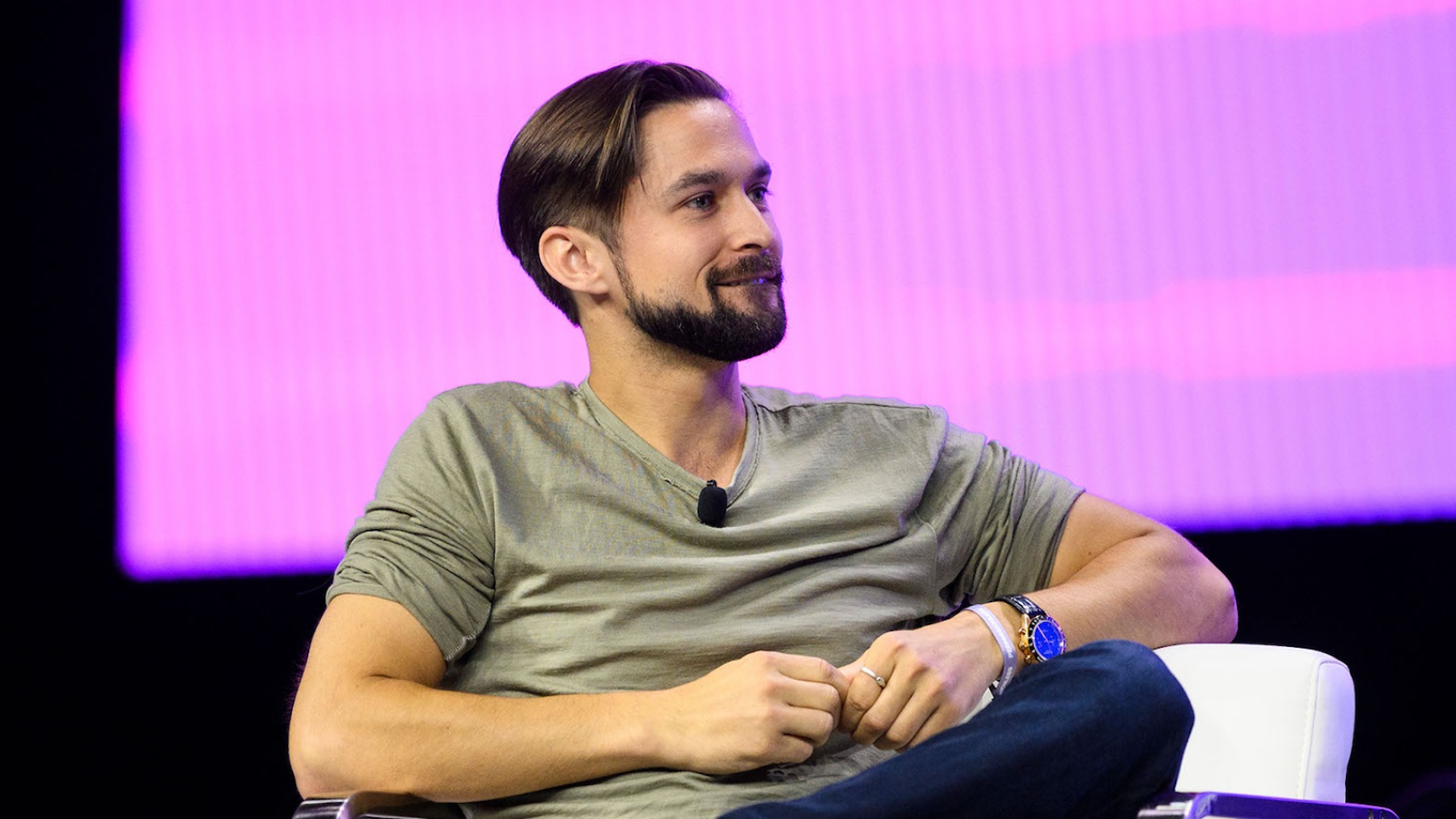
Hoffman and Ryan Sean Adams met through their writing and conversations on Twitter. Adams had started the Bankless newsletter. Hoffman thought it needed a podcast and told him so repeatedly. Adams was reluctant. After several attempts, Hoffman changed the offer: Adams could turn up and talk; Hoffman would handle the editing and release. It is a small production detail with large consequences. The show that would make both men familiar voices in crypto began because one of them was willing to do the work after the recording stopped.
Bankless launched its podcast in early 2020. The two hosts developed a conversational format that could stretch from beginner questions to debates with builders and researchers. Hoffman’s childhood hours with editing software suddenly looked less like a diversion. A psychology graduate who liked explaining systems had found a medium that required listening, framing, cutting, and occasionally letting a guest finish a sentence.
As the audience grew, people wrote to the hosts offering to help. Hoffman and Adams had to decide what sort of organization Bankless should become. Hoffman had already worked in a startup leadership role at RealT; he said neither of them wanted to become a conventional chief executive overseeing an ever larger company. They helped develop BanklessDAO as a way for a community to organize activity around the idea without turning every volunteer into an employee of the media business.
His own account of that choice has the recognizable texture of an inbox problem. Many people wanted to contribute. The founders had more energy around them than they could direct alone. Their answer reflected a long interest of Hoffman’s: how does a group set a direction when control is distributed among its members? It was the college observer of informal rules meeting the podcast host with too many direct messages.
Belief meets the balance sheet
For years, Hoffman's work was closely associated with the argument that Ethereum could become the base for a new financial system. He wrote about the network as an emergent structure, interviewed people working on it, and used the Bankless platform to ask what its applications could make possible. He also became a general partner at Bankless Ventures, joining Adams and Ben Lakoff in investing in crypto projects. The host, writer, and investor were never separate characters.
That made the May 2026 decision unusually visible. Hoffman described ETH as an investment whose monetary thesis had, in his view, largely played out. His argument was that applications and second-layer networks might gain from Ethereum’s design while retaining much of the economic value themselves. He could still be enthusiastic about the network and prefer to put his capital elsewhere. His essay did not ask the audience to forget his previous position. It set the old view beside the new one and supplied a reason for the change.
In a market built partly on conviction, changing course can look like an admission of defeat. Hoffman’s own explanation is more exacting than that. It asks listeners to distinguish what a network can accomplish from what one asset should be worth. Whether that distinction proves wise is a question for later. In the moment, the more immediate fact was that a host known for a particular thesis had chosen to put an uncomfortable revision in his own byline.
The revision has not ended his work. His Bankless author page continued to carry essays on Ethereum, privacy, artificial intelligence, prediction markets, and other crypto subjects. In September 2026 he published an analysis of attention and capital moving toward Zcash and NEAR. The same curiosity that pulled him from mining rigs to MakerDAO now ranges across a broader field. Bankless still lists him as a co-owner, and Bankless Ventures lists him as a general partner.
The useful part of a public change of mind
There is a temptation to make this story a simple before-and-after: the evangelist who sold. That account misses the more interesting continuity. Hoffman’s original move into crypto was an attempt to understand a machine he had bought, then explain it. The first podcast happened because he offered to edit. The later essay happened because a decision with public meaning demanded more than a quick social post. In each case, the task was to show the workings.
He has described himself as an optimistic storyteller of frontier technology. Optimism can be a disposition rather than a forecast for every token. The frontier, if the word is to mean anything, should contain new evidence and some altered maps. By making his own revision available for argument, Hoffman kept doing the job that brought him an audience: putting a complicated thought into ordinary words and allowing other people to answer.
The eMac in the Seattle bedroom was an instrument for making things. So is the microphone. So, in its less glamorous way, is the written explanation of a changed mind. None guarantees the conclusion will be right. They do make it possible for the rest of us to see how he reached it.