David DeMuth had an early education in the mysteries of preference. Working in a grocery store as a teenager, he watched people buy things and wondered why they chose one brand over another. Advertising would eventually make that question his livelihood. But the question came first, before the agency title, the network or the meetings about what consumers supposedly wanted.
It is a useful place to begin an advertising career. A shopper can decline an elaborate proposition without delivering a presentation in reply. The hand goes toward a different package. The purchase happens elsewhere. Anyone trying to understand that small decision has to take an interest in people whose tastes may be quite unlike his own.
DeMuth grew up in New Jersey and later made a life in the Rust Belt, with stops in Buffalo, Cleveland and Detroit. He graduated from Miami University in Ohio. In a 2019 conversation about his career, that grocery-store curiosity was still part of his account of himself. So was an interest in technology and the opportunities it creates for people prepared to learn it.
The combination would become a recurring theme: understand the person, then keep changing the means of reaching them. For someone who has spent decades in advertising, remembering the shopper is a reasonably effective defense against becoming excessively impressed by the advertisement.
A long week, followed by a new account
He joined Doner in 1989. By 2009, he was taking part in buying the agency during a recession, with the business already carrying the complications of a shareholder lawsuit and a pension scandal. The acquisition was followed by the loss of Mazda, then its largest client. Ownership had barely arrived before it acquired a very practical test.
DeMuth later recalled getting an assignment from Chrysler a week after that loss. He credited the people at Doner who helped secure it. The relationship became a lasting part of the business. The episode explains something about the way he talks about competition: there is satisfaction in winning, but an account also means work for a team and a future to organize.
In 2012, MDC Partners announced an equity investment in Doner, whose co-CEOs were DeMuth and Rob Strasberg. At the time, the agency already combined creative work with production, digital expertise and analytics. DeMuth’s stated ambition was to expand the resources available to clients and develop the business internationally.
An agency can have a long history and still face a sudden shortage of tomorrow. DeMuth’s early experience as an owner gave that proposition a concrete shape. The next assignment mattered more than any reassuring account of the previous one.
Bring the tools back into the room
Doner’s organizational changes offer a less theatrical account of reinvention. Its media department moved into Assembly in 2015. In June 2023, Doner announced a return to an integrated creative and media offering through Doner Media, led by Jennifer Villamil. Media planning and buying, creative testing, optimization and reporting were brought into the offering.
The practical aim was to connect the idea with the information about how it performed. A campaign has to survive more than a favorable reaction in a conference room. It must reach an audience, work in its chosen setting and give the client something useful to assess. Creative decisions and distribution decisions repeatedly meet, whether an organization makes that meeting convenient or awkward.
The wider Doner Partners Network also gave clients access to specialist capabilities. Its 2023 performance review reported that 43 percent of Doner clients worked with at least one other agency in the network. That figure is a snapshot from a particular period, rather than a permanent score. It nevertheless shows collaboration becoming part of the commercial relationship.
One example of the agency’s appetite for different formats was an augmented-reality campaign for The UPS Store. Users could play with a virtual moon, using animations to explore services such as packing, shipping and shredding. A familiar retail business acquired a small piece of outer space. Even the moon, apparently, had paperwork.
A Springsteen listener gets a different assignment
DeMuth’s tastes extend beyond campaigns. He collects mid-century abstract expressionist paintings and listens to Bruce Springsteen. He has also described a fondness for Italian red wine, playing tennis and coaching it, while making clear that the wine and the tennis belong on separate schedules.
The Springsteen interest gained a professional dimension with Jeep’s 2021 Super Bowl film, The Middle. DeMuth brought the script to Stellantis marketing executive Olivier François. Its setting included the U.S. Center Chapel in Lebanon, Kansas. François passed the idea along to Springsteen’s manager, Jon Landau, and Springsteen ultimately appeared in the film.
There is a pleasing collision here between private taste and public work. A musician who had mattered to an advertising executive as a listener became part of a campaign in which the executive’s agency was involved. The work remained collaborative: a script, a client, a manager, a performer and the decisions required to put a film on television.
By 2025, DeMuth was discussing another version of that collaboration at Cannes with Primo Brands marketing chief Kheri Holland Tillman. Their conversation addressed creativity, commerce, retail media and the relationship between brands and agencies. The questions were contemporary. The underlying problem was recognizable from the grocery store: what makes an idea matter when somebody is choosing?
“Stay humble and be comfortable with yourself.”David DeMuth, 2020
The coach had been there all along
Tennis occupies more space in DeMuth’s life than an occasional executive diversion. The University of Detroit Mercy recorded that he had completed his fifth season as a volunteer assistant coach in 2014-15. He also competed in USTA tournaments. Coaching was already an established commitment while he was leading an advertising agency.
The university credited him with helping the men’s team return to postseason play in 2014-15 and being part of its run to the Horizon League Championship semifinals in 2012-13. His son Alex played four years of college tennis at Bentley University. Today, Alex is listed as tournament director of the Cranbrook Tennis Classic.
A volunteer coaching job asks for something rather different from enthusiasm at a distance. It puts an experienced adult alongside players doing the repetitive work of improving. The business title does not hit the next ball. It can, however, provide another person willing to give time and attention to the people who do.
DeMuth’s public description of his own manner is succinct: “East Coast edge combined with Midwest charm and humility.” A tennis court provides plenty of opportunities for all three. It also supplies a fairly prompt opinion on how well the afternoon is going.
A venue looking for its next use
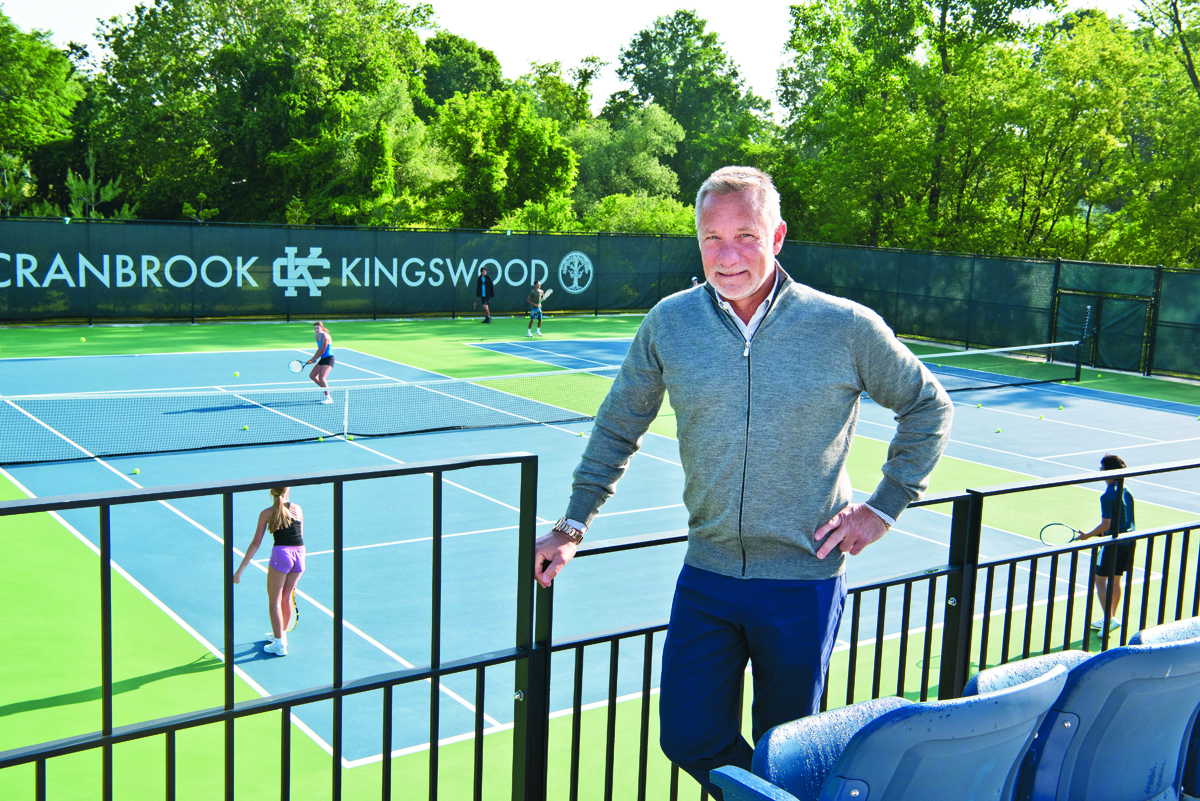
At Cranbrook Schools, DeMuth helped support a new tennis complex. A school governor and parent of graduates, he contributed an idea and an early donation; other families contributed too. Once the courts existed, he saw another use for them: a professional tournament in Bloomfield Hills.
He sent photographs and a proposal to the ATP and the USTA. The first approach did not succeed. “My first note was summarily dismissed,” he recalled. A place on the calendar eventually opened, and the inaugural Cranbrook Tennis Classic took place in July 2023. The episode has the familiar rhythm of a pitch, with an unusually literal playing field.
The tournament’s purpose includes supporting the Palmer Park Tennis Academy in Detroit. Tennis Forward, the nonprofit behind the event, directs proceeds to the academy. A professional competition thus connects visiting players and spectators with a local program. DeMuth’s interest in coaching has acquired an organizational form.
The surroundings matter too. Cranbrook offers a setting where spectators can be close to the play. The tournament has to provide the pleasures of watching tennis as well as the requirements of staging it. For an advertising executive, that is another encounter with the audience: people must have a reason to come, and a reason to return.
The players return the compliment
In December 2025, the ATP named the Cranbrook Tennis Classic its Challenger 100 Tournament of the Year. It became the first American event to receive an ATP Challenger Tournament of the Year award. The achievement belonged to a young tournament, only three editions into its existence.
The recognition carried a useful distinction. This was an award within a defined tournament category, alongside awards for other Challenger levels. It placed Bloomfield Hills on a list that also included events in France, Bahrain, Brazil and Bolivia. A local project had become visible in an international circuit.
The event continued to develop in 2026. Cranbrook announced its fourth edition as a Challenger 125, with a $230,000 prize purse and Tennis Channel coverage. It also commissioned trophies designed by Ian McDonald, the academy’s head of ceramics, working with Detroit’s Smith Shop. The campus contributed artistic expertise as well as courts.
That detail gives the project some character. A trophy can be purchased as a standard object, or it can tell visitors something about the place they have come to play. Here, the work of organizing a sporting event reached into design and local craft. Tennis, community and culture shared the same week.
The Midwest remains in the picture
DeMuth’s agency career entered another phase in January 2026, when Doner and Colle McVoy formed DonerColle Partners. Jessica Henrichs became CEO and DeMuth executive chairman. The alliance brought together more than 500 employees across Detroit, Minneapolis and Chicago, while the agencies retained their identities and client relationships.
The arrangement combines creative, media and production capabilities and makes the Midwest part of its argument to clients. For DeMuth, the region has long been more than a headquarters address. His career, coaching and community commitments have placed him in its institutions as well as its advertising business.
In January 2025, Doner had brought Brad Emmett and Rob Legato back as executive creative directors. DeMuth framed the appointments as an investment in Detroit talent. That followed the agency’s commitment of more than $1 million in additional spending to hire locally. The regional argument had a recruitment budget attached.
The grocery-store teenager and the tournament founder are separated by decades, but their projects share a practical interest in participation. Someone chooses a brand. A player needs a court. A spectator buys a ticket. A talented person needs a place to work. DeMuth has spent much of his career arranging the conditions for those decisions. The next point still has to be played.