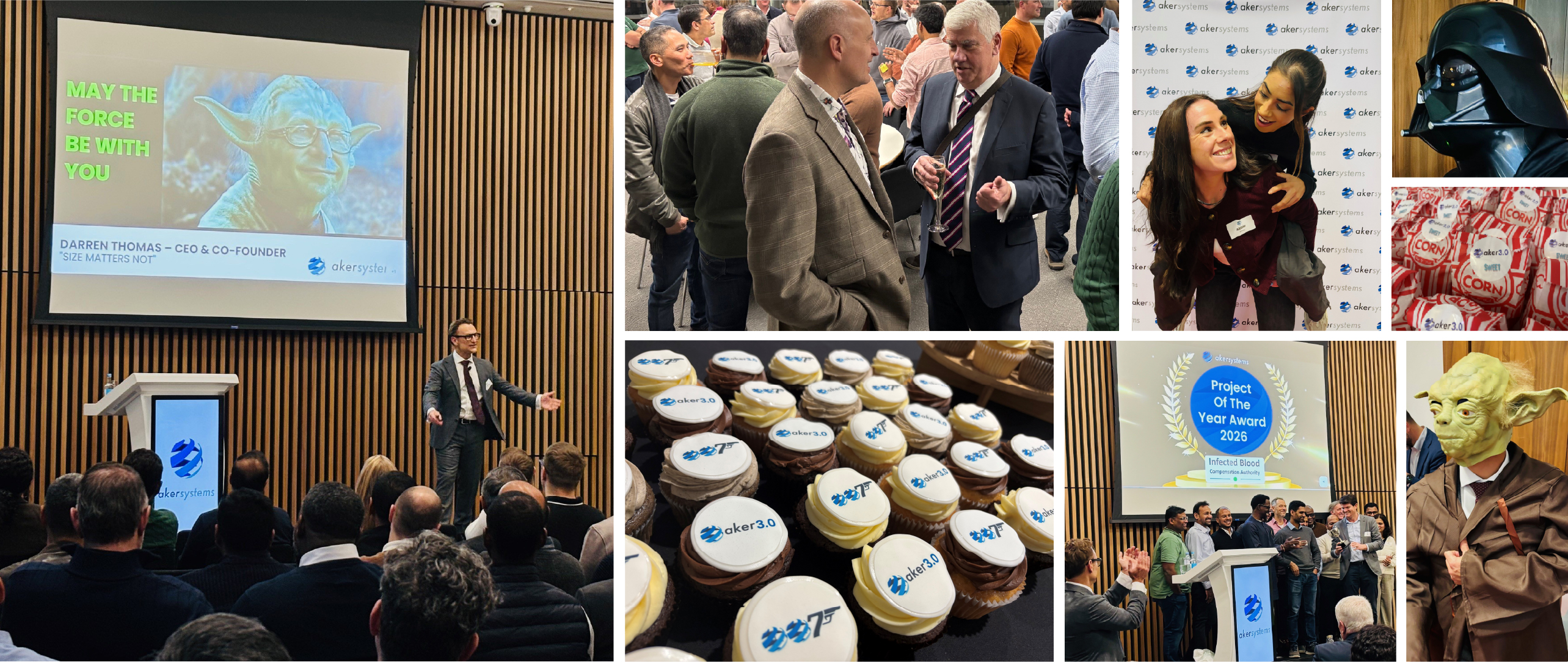
Darren Thomas had a business strategy to explain. He also had a Yoda costume. In January 2026, the chief executive and co-founder of Aker Systems arrived at his company’s staff gathering dressed as the Star Wars character. The venue was Chicago Booth Business School’s London campus, near St Paul’s. The programme concerned the next phase of a business serving government and regulated industries. Someone had clearly decided that a conventional entrance would be a missed opportunity.
The day had a film theme, so the costume was on brief. Thomas covered the political landscape and the company’s direction; colleagues addressed energy, financial services, defence and national security. Later he announced a project-team award. There were movie-themed cakes. It was a perfectly serviceable corporate agenda with an unusually well-developed costume department.
That scene offers a useful way into Thomas’s career. His work deals with organisations that need confidence in their technology and the people supplying it. The public record follows him through enterprise sales, executive leadership, company building and private equity transactions. Along the way, the work keeps returning to people: hiring them, listening to them, taking their advice and occasionally giving them something to laugh about.
Before Aker, the machinery of scale
Thomas’s route to Aker passed through Hewlett-Packard and SunGard Availability Services. He held senior European and global responsibilities across sales, marketing, general management and strategic alliances. His education included a B.S. at the University of Plymouth. The combination places him in the commercial and organisational side of the technology industry, where a promising system must also become something a large customer can buy and operate.
His published executive biography describes responsibility for a global technology division with more than 450 people and £4.3 billion in annual revenue. It also credits a team he led with securing a £640 million, seven-year contract with a global telecoms provider. Those figures belong to his earlier career. They show the scale of the environments he had worked in before Aker, rather than the size of the company he would help build.
Aker was another kind of undertaking. Thomas became a co-founder of a business designing, building and operating secure data environments in the public cloud. His biography also records an earlier startup that he co-founded, grew and exited. So the move brought together experience of established organisations and experience of starting something smaller. Both appear in the business that followed.
Fourteen months that changed the organisation
In July 2020, LDC invested in Aker. Thomas led the existing management team, alongside finance chief Richard Hodsden, commercial chief Adam Crawford and founder director Adam Fawsitt. Tom Burnet joined as non-executive chairman. The arrangement gave the company capital and additional board experience as it pursued its next stage of growth.
The investment was intended to support research and development and recruitment. Those are broad headings in a transaction announcement, but they describe tangible demands on a chief executive. Software needs time and people to develop. A growing customer base needs an organisation capable of supporting it. A management team has to decide where the next appointment will make a difference.
During LDC’s ownership period, Aker established an enterprise sales team within six months, added executive capacity and invested in product automation. It also secured two significant financial-services contracts. LDC reports that revenue grew by more than 50% and headcount doubled in little over a year. The change was organisational as well as financial: more people, more responsibilities and more customers to serve.
By September 2021, Abry Partners was investing and LDC was exiting its minority holding. Thomas remained the executive voice explaining the next phase. Fourteen months separated the two investment dates. A company can change considerably in that interval, particularly when the team responsible for delivery is expanding along with the sales effort.
The growth story also had individual names. That September, Aker announced the arrival of Lee Hendricks, Marc Cregor, Adrian Pikett and Joe Harris in its sales organisation. They brought experience in enterprise engagements, public-sector contracts and bidding. Harris was the company’s first bid manager. Thomas welcomed the group as colleagues whose experience would support further growth.
There is something revealing about that list. A specialist technology company still needs people who understand procurement, commercial relationships and the work of turning a customer’s requirements into an agreement. For a founder with Thomas’s background, these were familiar parts of the machinery. At Aker, he was helping assemble that machinery around a company of his own.
The value of another person in the room
Transactions add another layer to the CEO’s job. In an appearance in Liberty Corporate Finance’s “Working the deal; CEO’s talk” series, Thomas discussed the value of independent advisers when negotiating technical terms in a private equity sales process. The subject was specific. A sale involves terms that require close attention, alongside the continuing demands of running the business.
Grant Thornton’s account of the Abry transaction describes management tax support delivered under a tight timetable. Thomas credited the team with finding solutions in a complex transaction and responding promptly. The detail gives his comments about independent advice a practical setting: there were specialists doing work that helped management navigate the deal.
He has been similarly open about getting help with the role itself. In a public testimonial for coach Simon Roberts, Thomas described the support he received during his transition to CEO. He spoke about discovering his strengths and the value of a confidential conversation with someone who brought a broad range of experience.
“Working with Simon has helped me discover my strengths”
Darren Thomas, on coaching during his transition to CEO
There is a modest but useful distinction between holding a senior role and learning a new one. Thomas already had years of leadership experience. His testimonial still makes room for the idea that becoming chief executive required reflection and conversation. Read beside the deal discussion, it suggests a consistent practical habit: bring in expertise when the situation calls for it. That is an observation about his public choices, rather than a claim to know his private temperament.
Sixty introductions and one memorable jacket
Aker’s earlier staff gathering, organised around the theme of connection, gives another view of the work. More than 60 people had joined since the previous event. For a business using remote work as its norm, getting colleagues into the same room was a way to make introductions that everyday digital collaboration might leave unfinished.
Thomas reviewed the previous year, including its challenges and political uncertainty, then outlined plans for the year ahead. His jacket became a subject of banter. It is a small detail, but a welcome one. A chief executive’s annual update can contain the required information and still leave room for colleagues to notice what he is wearing.
The event also included a senior government customer and an industry figure who mentored members of the technology team. That brought people doing the work into contact with people who could discuss its consequences and its wider setting. For new recruits, the day offered more than an introduction to names on a screen.
The January 2026 gathering continued that pattern. Thomas shared the programme with commercial and sector leaders, outside guests and board member Sir David Capewell. Questions were invited throughout. His Yoda appearance was the conspicuous detail; the wider agenda showed a business explaining itself to its own people as it expanded into different markets.
The promise has to survive deployment
Thomas’s more recent public comments bring the story back to the customer. In January 2026, Aker announced a partnership with Prolinx focused on secure, sovereign data and cloud systems. The agreement covered coordinated design, integration, deployment and continuing operational support for organisations working within demanding security requirements.
Thomas emphasised reliability in real operating environments. The partnership’s stated purpose was to connect Aker’s data and cloud engineering with Prolinx’s integration and deployment experience. The ambition is concrete: a customer should receive a system whose different parts work together, with responsibility extending beyond the initial design.
That emphasis follows the December 2025 announcement of Aker’s appointment to the Technology Services 4 framework and four ISO certifications. Thomas credited the teams behind the work. Framework access and audit results are company milestones, but they also sit inside a CEO’s larger task of making the organisation a dependable supplier. For public-sector buyers, assurance and routes to procurement are part of getting a project underway.
Aker now presents its work across government, energy and utilities, and financial services and insurance. Thomas leads alongside executives responsible for technology, finance, people, operations and commercial activity. The structure reflects the range of work involved in growing a company that sells expertise and then has to deliver it.
The next chapter he described in London therefore comes with fairly exacting requirements. Customers need systems they can use. Colleagues need a company they can understand. Investors need a business capable of carrying its plans through. Thomas’s career has brought him into contact with each of those constituencies, and Aker puts them in the same room. Occasionally, that room also contains Yoda. Even a strategy meeting deserves a decent entrance.