The first thing to fail in healthcare compliance is rarely the policy itself. It is the memory of what happened next. A risk assessment lands as a PDF. Someone promises to fix the backup gap. A training spreadsheet drifts out of date. Six months later, the compliance officer is spelunking through email for proof that the work ever occurred. Cyber Trust Alliance built its business around that unglamorous crack between finding a risk and finishing the response.
The Austin company combines a software platform called CEBA with security risk assessments, vulnerability scans, phishing simulations, penetration testing, policy management and training support. Its customers are hospitals, clinics, physician practices and healthcare vendors - organizations that handle sensitive data but may not have a battalion of security and compliance specialists. The proposition is simple: put the evidence, gaps, owners and progress in one place, then revisit them often enough that compliance becomes ordinary work.
01 / The product
A dashboard for the work after the audit
CEBA is part evidence locker, part project tracker and part health chart for compliance. The dashboard rolls up HIPAA gaps, infrastructure findings, policy status, training scores, phishing results, vulnerability scans and remediation activity. Underneath are the less photogenic tools that matter: policy templates, workforce training records, assessment evidence and a history of corrective work.
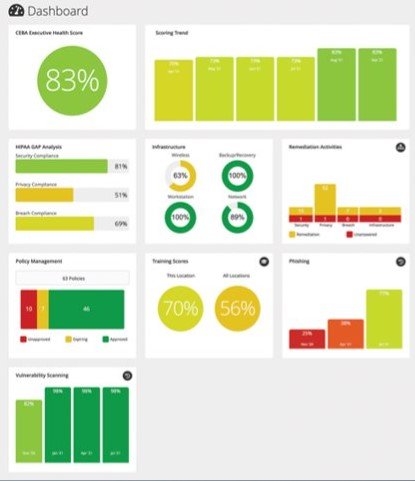
The product is based on the federal Office for Civil Rights assessment protocol and the NIST Cybersecurity Framework. That matters because CEBA is not inventing a private definition of good behavior. It is arranging familiar requirements into a workflow a smaller team can operate. The public self-assessment plan begins at $79 a month. Assisted and full-service assessments are sold by quote, with experts reviewing evidence, interviewing staff, scanning systems and presenting findings.
That quote reveals the market slot. Cyber Trust Alliance sits between the giant governance platforms that require administrators and implementation budgets, and the heroic spreadsheet maintained by one overworked employee. It also sits between pure software and pure consulting. The machine remembers; the specialists make judgment calls.
02 / The customer
Built for the team without an extra team
A national health system can divide security architecture, privacy, audit, training and vendor risk among departments. A physician group may divide them among Tuesday afternoon. Cyber Trust Alliance’s public customer trail includes US Eye, Trinity Health facilities and South Limestone Hospital District. One testimonial describes a HIPAA risk assessment across 24 hospitals and clinics. A rural Texas hospital board record is even more revealing: CEBA appears in the same operational packet as chart audits, safety training and patient falls.
That is where this product belongs - not in a futuristic command center, but inside the weekly churn of hospital administration. Security competes with staffing, patient care, insurance, building maintenance and every other issue that can become urgent before lunch. The platform’s job is to keep risk from vanishing merely because something louder entered the room.
The public price contrast
The first figure annualizes the advertised $79 monthly starting price. The second comes from a customer testimonial, not a universal market quote. Full-service CEBA pricing is not public.
The low entry price does not mean a clinic can buy a subscription and declare victory. It means the first rung is accessible. The commercial design then climbs: self-assessment for teams that can collect their own evidence, assisted assessment for outside review and testing, and full service for organizations that need interviews, analysis and reports. That ladder lets a buyer purchase judgment only where judgment is expensive and necessary.
03 / The difference
The report is not the outcome
Most security firms can identify a weak server or send a convincing phishing email. Cyber Trust Alliance’s more interesting choice is to connect those findings to a persistent compliance record. External and internal scans feed remediation. Phishing simulations become measurable workforce risk. Policies live beside the gaps they are meant to address. Training status sits on the same dashboard as technical controls.
The company calls its remote review method a Virtual Telassessment. Compliance engineers examine policies, procedures, infrastructure, software, physical security and human susceptibility, then deliver both a stakeholder-ready report and a remediation plan stored in the platform. Remote collection lowers travel and coordination costs, while the software supplies continuity after the interviews end.
Where the offer fits
| Alternative | Good at | Common catch |
|---|---|---|
| Spreadsheet + binder | Cheap, flexible, familiar | Evidence and ownership drift |
| One-off consultant | Independent judgment | Momentum can end with the report |
| Large GRC suite | Enterprise breadth and integrations | Implementation and administration load |
| CEBA + services | Healthcare focus and recurring workflow | Still requires internal owners to act |
Competitors include healthcare specialists such as Clearwater, MedStack, Compliancy Group, HIPAA One and SecurityMetrics, plus broad governance systems such as LogicGate and ServiceNow. The do-it-yourself alternative may remain the toughest rival because it looks free. Cyber Trust Alliance’s answer is not more checkboxes. It is the accumulated cost of missing proof, repeating research and letting yesterday’s finding become next year’s surprise.
04 / The company
A small team, a channel strategy, then an exit
Randy Steinle co-founded the company and serves as CEO. Public company profiles place the launch in 2018; Texas records put incorporation in 2019. The difference is ordinary for a young company, where product work and commercial use can precede paperwork. The team has remained small - public estimates range from two to 12 people - and the company openly leans on a national partner network.

That network is not decoration. TORCH, the Texas Organization of Rural & Community Hospitals, gave the company proximity to a specific buyer group. A Maryland IT provider markets CEBA alongside its own services. In January 2026, HANYS Marketplace partnered with Cyber Trust Alliance to offer risk assessments to New York hospitals and health systems. HANYS represents more than 450 member organizations, though access to that network should not be confused with 450 customers.
Reported seed financing arrived in 2022. The public numbers do not line up neatly: Dealroom reports roughly $548,000, while LinkedIn lists a $250,000 seed event. What is clear is the exit. In August 2024, Dallas-based CorePLUS Technologies acquired Cyber Trust Alliance for an undisclosed sum and said its team, tools and assessment methods would strengthen HEALTHSecure+, a broader security platform for healthcare facilities.
The acquisition makes strategic sense. CEBA organizes risk and compliance; CorePLUS brings a wider security envelope. One diagnoses and records the work, the other can surround it with more protective services. The deal did not erase the smaller company’s identity: Cyber Trust Alliance continued to appear under its own name in the 2026 HANYS announcement.
05 / What changed
From periodic expertise to productized memory
Cyber Trust Alliance says its services are user-built and user-driven. That phrase is more useful than the usual customer-first wallpaper. The architecture shows what customers likely taught the team: an expert assessment is valuable, but a report alone cannot maintain training records, remind people to revisit policies or display remediation progress. The company did not abandon consulting. It wrapped consulting in software so the relationship could continue between assessment dates.
That is the mind-change worth copying. Founders often try to automate the expert out of a service. Cyber Trust Alliance kept the expert at high-judgment points and automated the organizational memory around them. Annual risk assessments and quarterly phishing and vulnerability reviews create a cadence. The dashboard preserves context. The remediation plan gives the next meeting an agenda.
The five moves another founder can steal
- Choose a recurring obligation. A regulation, renewal or inspection creates durable demand without inventing urgency.
- Make unfinished work visible. A score matters only when users can click through to the evidence and next action.
- Productize memory before judgment. Store documents, history, owners and due dates; keep specialists for interpretation.
- Build a service ladder. Let confident buyers self-serve and let complex organizations add review, testing and interviews.
- Borrow distribution. Associations and local IT partners already have trust with the exact customer who needs the product.
06 / The limits
When this playbook does not work
Software can make a neglected process visible. It cannot make an executive fund the fix, make an employee complete training or make a vendor produce evidence. The model works when someone inside the customer owns remediation, leadership accepts that compliance is continuous and the organization can supply honest inputs. It weakens when the buyer wants a certificate more than a change in behavior.
A dashboard without a named operator becomes a brighter, more expensive binder.
Self-assessment cannot correct evidence that is missing, stale or generously interpreted.
A global enterprise may need deeper integrations, custom controls and a larger governance platform.
Compliance workflow is not a substitute for incident containment, forensics or recovery expertise.
Remote assessment also has boundaries. Interviews and scans can cover much of the environment efficiently, but physical safeguards, odd clinical workflows and shadow systems sometimes deserve eyes on site. A $79 starting plan is an invitation, not a promise that every hospital can solve risk for $948 a year. Larger assessments, penetration testing and human review cost more, even when the price is not posted.
Still, the company’s central observation holds. Healthcare security does not improve because a report uses sterner adjectives. It improves when a team can see the gap, assign it, fix it and later prove what changed. Cyber Trust Alliance made that loop its product, used services to keep it credible, and used partners to carry it into markets a tiny team could not cover alone. Boring, in this corner of cybersecurity, is the sound of the work getting finished.