The most revealing sentence CRAFT ever published was not a slogan. It was a resignation: the agency would no longer work for political candidates. The announcement came in November 2014, at the close of an election cycle, when most campaign firms were counting wins, losses, and the days until the next race. CRAFT had plenty to count. In four years, it said it had grown from five people to more than 30, served 367 clients, won 55 awards, and booked over $65 million in advertising. Then founder Brian Donahue chose to walk away from the category that had made the firm.
He did not walk away from the method. Political campaigns are temporary machines built under rude conditions: the deadline cannot move, the audience is suspicious, the message is contested, and second place is not a growth opportunity. CRAFT carried that machinery into public affairs, public relations, and corporate branding. The candidate disappeared. The campaign brain stayed.

The campaign is the product
CRAFT is easy to misfile as an advertising agency because it buys ads, or as a PR firm because it handles media, or as a production company because it makes polished video. Its actual product is the coordinated sequence. Research locates the friction. Strategy names the audience. Creative makes the issue repeatable. Media puts it in the right path. Digital gives the audience somewhere to act. Measurement tells the team whether the machine moved.
That structure solves a particular Washington problem. The customer signing the invoice is often not the audience that must be persuaded. A trade association may need to reach lawmakers. A corporate policy team may need opinion leaders to notice work the public never sees. A childcare chain may need parents in 36 separate markets to trust a local center. CRAFT sits between the client and that consequential third party.
First, find the thing that is stuck
The case studies begin with small failures of translation. Big Blue Marble Academy had stagnant enrollment. Verizon's public-policy team was doing corporate-responsibility and policy work that few people around the Capitol recognized. The National Retail Federation faced trade negotiations that were both consequential and magnificently dull. These were not production problems. They were gaps between importance and attention.
For the childcare company, CRAFT began with research into how parents actually chose care, then combined message development, video, a redesigned website, search and Facebook advertising, and location-specific landing pages. Within six months, the agency reported that leads rose 115 percent and website traffic rose 150 percent. The useful part is the order: ask, interpret, build, distribute. Copying the ad without copying the research would miss the mechanism.
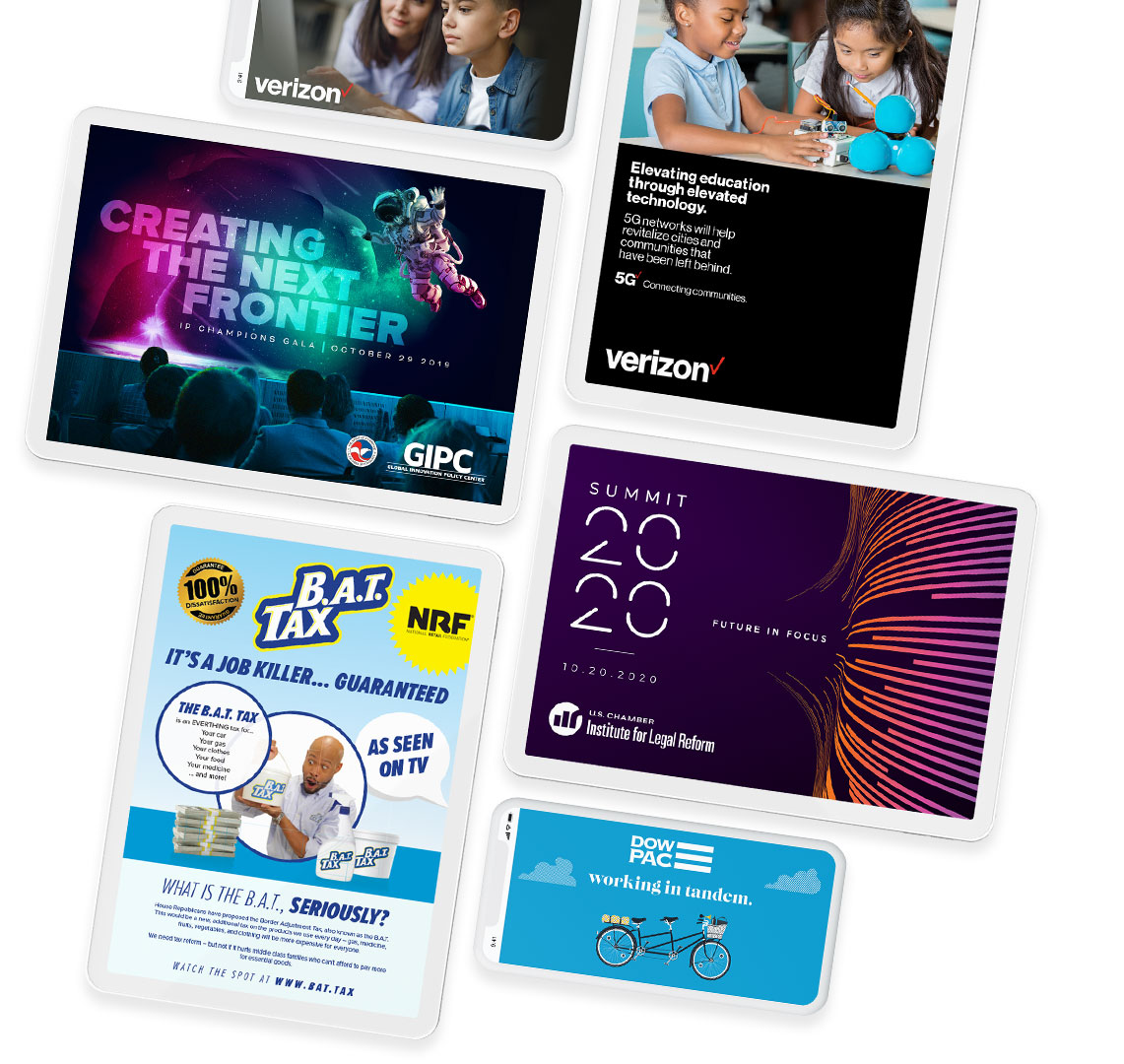
For Verizon, the agency assembled digital advertising, video, events, partnerships, and collateral around privacy, 5G, emergency preparedness, and corporate values. Its online-privacy campaign generated more than 1.8 million impressions and reached more than 16,000 policy influencers. That last number matters more than the first. In public affairs, a smaller denominator can be the whole point.
Make the argument easy to carry
CRAFT's most telling work is funny. To oppose a proposed Border Adjustment Tax, it presented the B.A.T. Tax as a terrible cleaning product in a Billy Mays-style infomercial. For a tariff campaign, it hired Ben Stein to revisit his famously monotonous classroom routine from Ferris Bueller's Day Off. A modern script turned trade policy into a cultural reference that viewers already knew how to decode.
The joke was not the strategy; it was the carrying case. CRAFT distributed multiple versions through television, social channels, YouTube, member email, media outlets, and a dedicated website. The agency reported 510,000 video views in the first week, 2.5 million digital impressions, more than 12,000 website visits, and 70 mentions in major media. Creative made the argument portable. Distribution made it difficult to miss.
“Our focus should be seamless integration that brings digital, media, and traditional channels together to multiply the effects of each.”Brian Donahue
The alternative is familiar: one firm writes the strategy, another makes the spot, a third buys media, and a fourth builds the landing page. Every handoff consumes time and sheds context. CRAFT's mixed staff of strategists, media specialists, developers, designers, writers, and producers is a bet that integration is most valuable when the issue is moving faster than the approval chain.
A glimpse at the invoice
Agency economics are usually hidden behind cheerful requests to “start a conversation.” A public federal filing provides one narrow, useful example. In 2025, CRAFT agreed to support the Embassy of Switzerland in the United States with internal strategic communications, media training, adaptive messaging, and a short video. The scope set a $50,000 retainer for two months and priced the five-minute video separately at $12,500. Approved expenses were reimbursable. Advertising placements, when used, carried a standard 15 percent agency commission unless a statement of work said otherwise.
This is one disclosed engagement, not a rate card. It is useful because it shows the pieces: advice, production, expenses, and media are distinct economic units.
That model places CRAFT between the strategic consultancy and the creative shop. Clients can buy counsel, production, distribution, or the full sequence. It also explains the customer list: national trade groups, large companies, advocacy organizations, nonprofits, and cultural institutions with complicated stories and identifiable audiences. Walmart, Expedia, JPMorgan, McDonald's, the U.S. Chamber of Commerce, API, NRF, the Washington Ballet, and Verizon appear in the agency's public roster and biographies.
The 2014 choice still explains the company
Leaving candidate work was the change of mind that made CRAFT legible. It traded an electoral niche for a method: campaign discipline applied wherever reputation, policy, or behavior is at stake. The firm could take on a preschool franchise one month and a national policy argument the next without pretending the subjects were similar. The operating system, not the industry, was the constant.
In 2024, the agency packaged some of that operating memory into CRAFT GPT, a custom internal AI model it said was informed by 14 years of communications learning and media-consumption data. The sensible interpretation is less “robot strategist” than institutional library: make past patterns easier for a 30-something-person team to retrieve and use. Its value will depend on whether judgment remains attached to the retrieval.
The copyable lesson is pleasantly low-tech. Define the audience narrowly. Find the obstacle before choosing the channel. Give the creative one argument people can repeat. Distribute it as a system, not a pile of assets. Measure the action closest to the objective. These habits work when there is a real decision, a reachable audience, and enough evidence to sharpen the message. They are less useful when the audience is “everyone,” the desired action is merely “awareness,” or a long trust problem is forced into the tempo of a news cycle.
CRAFT's name suggests handiwork, but its advantage is choreography. Research, message, joke, video, placement, landing page, press call: each part knows why the next part exists. A campaign without a candidate still has to win something. The first job is deciding exactly what.