Claudio Erba wanted somewhere to put his slides. In 2005, while teaching in Florence, he needed students to reach his presentations after they left the classroom. The problem was small enough to sound like an administrative chore. It became the starting point for Docebo, a learning software company that would eventually be listed on two North American stock exchanges. The distance between those two outcomes is the interesting part of his education.
There is a pleasing circularity to what followed. After nineteen years building the company, Erba began turning the experience into lessons for other founders. He put the videos online for free. He included the mistakes. By September 2026, a new course developed with Zick Learn was offering the material in short daily installments. The former teacher had acquired a rather expensive case study, then decided to share the notes.
A classroom problem, before the company
Before Docebo, there was already a business. In 1999, Erba founded Mailforyou.com with IEI Spa. In the early 2000s he also ran workshops at the University of Florence. His education was in economics and marketing at Milan’s Università Cattolica del Sacro Cuore. The route into learning software passed through business and teaching, with an immediate problem to solve rather than a grand theory to announce.
His account of the origin is refreshingly ordinary. Students needed access to material outside a physical room. The shared services that later made exchanging files routine were less readily available. He began considering what a useful tool could do for them, then what the same approach could do for organizations. The classroom supplied the question; corporate training supplied a larger setting in which to ask it.
Docebo was founded in 2005 in Macherio, in Italy’s Brianza area. Its name comes from Latin and carries the idea of teaching. The geography matters because this story remained connected to a particular place even as the company’s market expanded. International business can sound as though it requires a founder to dissolve into an airport lounge. Erba’s version retained a local address and a garden.
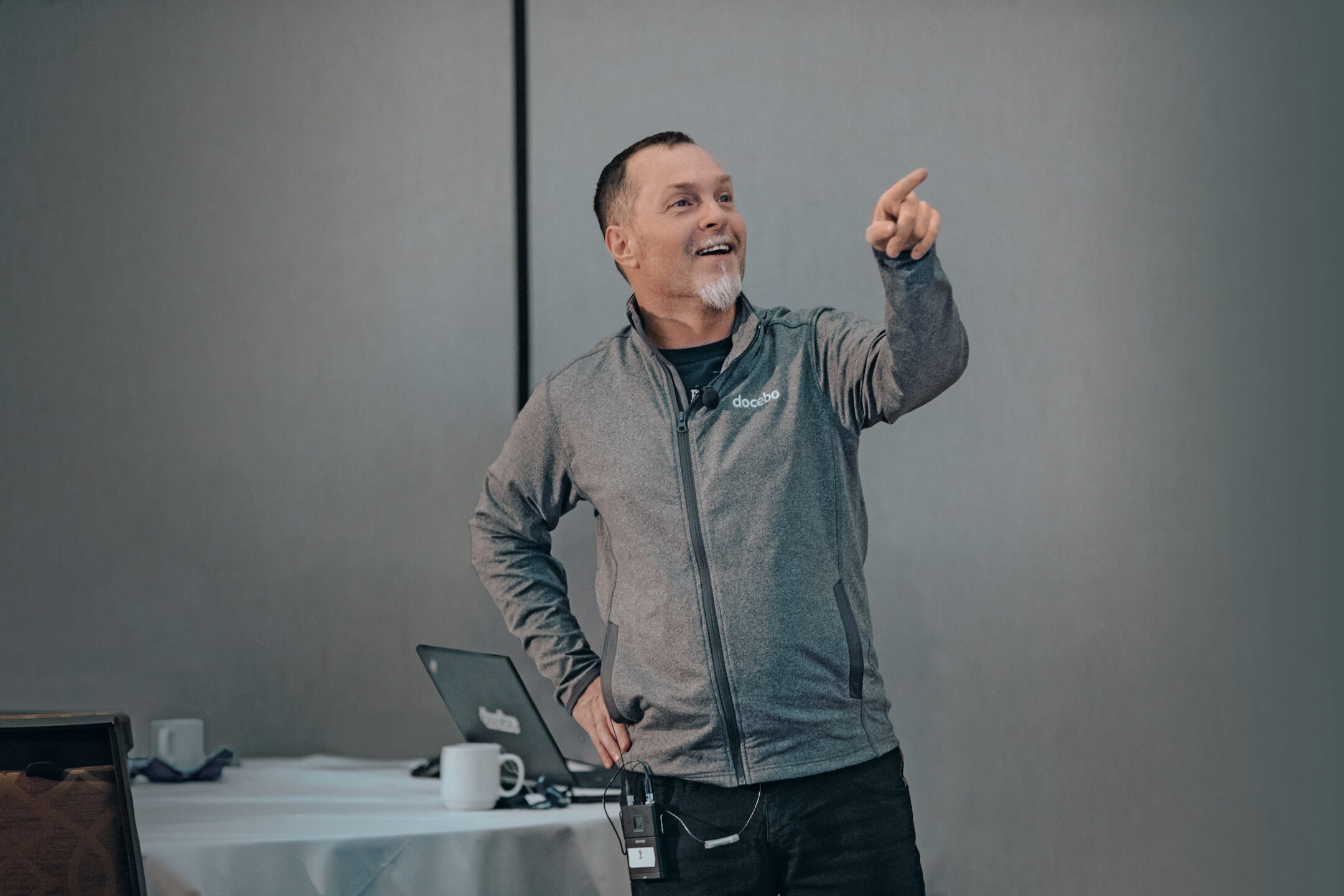
Changing the delivery, keeping the question
The early software used an open-source model and was installed on customers’ servers. In 2012, Docebo moved to a cloud-based subscription platform. That change altered the relationship with the customer: software could be delivered and maintained as an ongoing service. A teacher’s need for access had become an organization’s continuing need to train people. The delivery mechanism was now part of the business itself.
Principia invested in 2012, providing capital for the next stage. The company’s earlier backing included Seeweb. Erba’s own career began to contain several different kinds of work: building a product, deciding how to sell it, bringing in investors and managing the consequences. The product could remain recognizable while the organization around it changed. Founders who enjoy the first task do not automatically enjoy the fourth.
By 2017, Docebo was doing 82 percent of its business abroad. Erba’s advice at the time was to think internationally from the beginning, including choosing a name that could travel. Even the name on the door had a job to do. A service could be useful in another country and still make life unnecessarily difficult for the people trying to pronounce it, remember it or buy it.
- 2005Docebo begins
in Italy - 2012Cloud subscription
model - 2019Toronto Stock
Exchange - 2020Nasdaq
listing - 2024Founder moves
to innovation
In a late-2016 interview, asked to introduce himself, Erba preferred to describe the organization: more than 120 people, five offices and customers across 90 countries. He explained his remit through product, research, customers, marketing and operations. The answer is telling without needing much decoration. Offer him a personal introduction and he supplies something resembling a management report. One suspects the introductions at dinner can become unusually informative.
He also spoke about learning beyond formal instruction. Docebo used the 70/20/10 framework as a guide, encompassing experience, learning from others and structured teaching. The company was working in a field where the course itself is only part of how people improve. That leaves plenty for software to organize, and plenty that resists being reduced to a completed checkbox.
Two listings and a different job
Docebo listed on the Toronto Stock Exchange in October 2019 and on Nasdaq in December 2020. Those are convenient milestones because they have dates, symbols and public records. They also compress years of less ceremonial activity into a line on a timeline. The listing arrives after the decisions about customers, capital and distribution. The photographs tend to arrive with the listing.
Erba was still attached to Brianza. In a 2019 interview, he identified Macherio as home and described traveling to the United States about ten times a year. He also mentioned reading, mountain biking, studying French and tending his lawn. The detail brings the business back down to earth, quite literally in the case of the lawn. Global reach apparently did not excuse him from the garden.
The next significant change concerned his own responsibilities. In November 2023, Docebo announced a succession plan. Erba would step away from the CEO position and the board effective February 29, 2024, moving into the role of Chief Innovation Officer. Alessio Artuffo would become interim CEO on March 1. Artuffo, who had held senior commercial and operating roles at the company, became permanent CEO that September.
“Innovation is my passion”
Claudio Erba, November 2023
His explanation centered on having more time for innovation and fewer operational responsibilities. It was a practical acknowledgment that an organization can change what it needs from its founder. There is no reason the person most interested in discovering the next product should also want every meeting attached to the chief executive’s calendar. In a company built around learning, revising a job description seems a reasonable application of the principle.
The syllabus includes the mistakes
Erba had begun organizing his experience into teaching material before the handover was complete. In a late-2023 public invitation to university teachers, he described an evolving guide of more than 120 pages. Its subjects ranged from board dynamics and compensation to sales, marketing and innovation. He wanted to bring the material to universities and share it in person, free of charge.
In 2024 he published free founder-training videos on YouTube. He said the preparation had taken more than 500 hours, including slides, recordings and revisions. One series covered growth; another collected mistakes. The choice of subjects gives the project its character. A founder can make a course from the milestones everyone has already applauded. Erba also chose reporting lines, organizational changes and the errors behind the tidy diagram.
One day at a time.
From Zero to 1000 packages company-building experience into a free course with Zick Learn. The numbers describe the course, not a promise of results.
One of those errors concerned designing reporting relationships to make somebody feel important. A dotted line to a senior executive might please its recipient while making the business harder to run. It is the sort of observation that gives organizational charts a little of their proper drama. The boxes look innocent. The people inside them have careers, ambitions and strong views about where the lines should go.
His public investing rules show a similar impatience with the costume of leadership. He questions personal assistants at small businesses, long meeting invitations, constant fundraising and celebrations of personal awards. The list is deliberately sharp. Its value as a character detail is that it tells a prospective founder what draws his attention: whether time, money and executive importance are serving the business. An impressive calendar can still be an expensive way to avoid work.
He applies some scrutiny to himself, too. Discussing growth in 2024, he acknowledged that preserving culture had been difficult and that he could have been better prepared. The admission gives his teaching a useful boundary. The material comes from experience, including imperfect decisions. Readers can examine the judgment without having to accept the founder as an infallible guide.
The later course makes that experience easier to approach. From Zero to 1000, reported in September 2026, is an English-language collaboration with Zick Learn. It breaks the material into short daily lessons designed for a phone. A person running a company may struggle to reserve an evening for a management manual. A few minutes offers a more plausible opening in the day.
An aspiring professor, with a saxophone
There are other projects competing for his curiosity. Erba has publicly discussed his own investing and the difficulty of keeping up with portfolio companies. He wanted to bring scattered information into a weekly digest. The problem has a family resemblance to the old slides: useful material exists, but getting it into the right place requires more work than it should.
His writing now also includes fiction under the name Fatsy Pancrass. Il principio dell’osservatore is a techno-thriller concerned with artificial intelligence, electricity, geopolitics and power. The software founder has moved from thinking about what technology can deliver to imagining what its demands might do to society. Fiction gives those questions characters, stakes and room to misbehave.
His older blog describes interests in jazz and funk; his public biography says he is learning alto saxophone. It also calls him an aspiring professor. Both details suit someone whose career keeps producing new subjects to study. A saxophone, mercifully, offers no special exemption for having taken a company public. You still have to learn how to play.
The thread running through Erba’s work is access: first to classroom material, then to learning inside organizations, and now to the experience of building one. The scale changes. So does the audience. After the stock listings and the succession plan, there is still a teacher arranging what he knows so somebody else can use it. This time, the students get the mistakes along with the slides.