YesPress Profile · Climate · Hardware · Berkeley, CA
Clarity Movement Co.
The company that made the air you breathe visible - one solar-powered sensor at a time.
The company that made the air you breathe visible - one solar-powered sensor at a time.
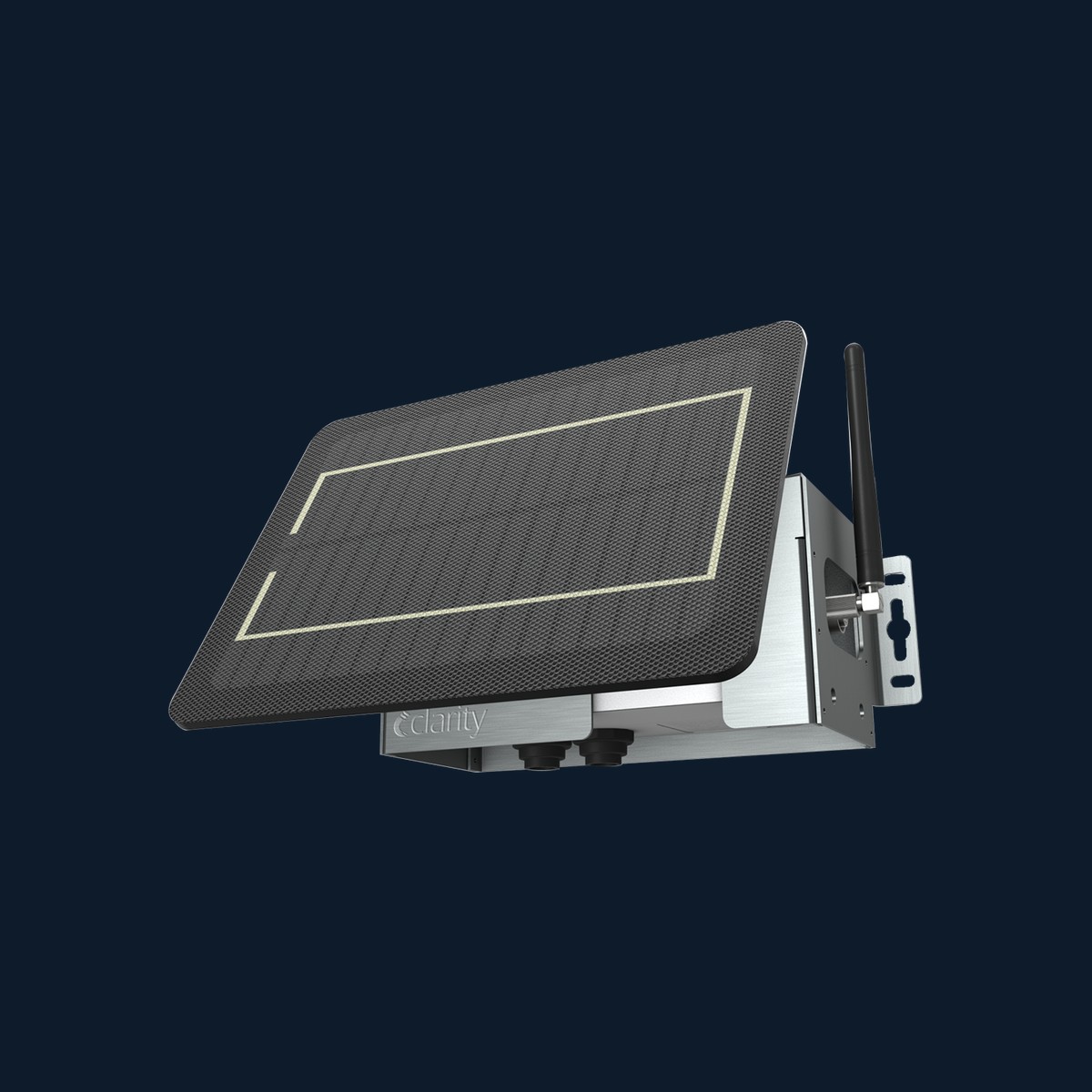
It is bolted to a pole on a Chicago side street, or a railing along the Thames, or a schoolyard fence in Los Angeles. No technician stands beside it. No power cable feeds it. It sips sunlight, breathes in the street, and every few seconds sends a number to the cloud: this is what the air is doing, here, now.
Multiply that device by ten thousand. Spread it across 250-plus cities in more than 85 countries. What you get is something governments spent decades insisting was impossible - a living, street-level map of pollution that ordinary people can actually see.
For most of modern history, air quality was measured by a handful of reference stations, each costing a small fortune, each covering enormous swaths of city with a single dot of data. If you lived between the dots, you were guessing. Clarity Movement Co. decided guessing was not good enough.
The company's logic is almost rude in its simplicity. As CEO David Lu likes to put it: "If you can't measure it, you can't fix it." Pollution that nobody counts is pollution that nobody answers for.
In 2014, David Lu was a sophomore at UC Berkeley studying atmospheric science. With co-founders Paolo Micalizzi and Baljot Singh, he joined the CITRIS and Banatao Institute cohort and started building a cheaper way to measure particulate matter. The team's qualification was less about hardware pedigree and more about refusing to accept that air data had to be scarce and expensive.
The early bet was that low-cost sensors, if you were honest about their flaws and clever about correcting them, could rival instruments costing a hundred times more. The honesty part matters. Cheap sensors drift. They get confused by humidity and heat. Clarity's answer was software - a machine-learning calibration layer that constantly tunes the cheap hardware against regulatory-grade reference data.
That combination - modest hardware, serious software - became the company's whole personality. Sell neither a gadget nor a spreadsheet, but a managed promise: trustworthy air data, delivered.
A decade later, in 2024, Clarity quietly marked its tenth birthday. A year after that, Lu landed on TIME's list of the 100 most influential climate leaders of 2025. The dorm project had grown teeth.
"Everyone has the right to breathe clean air."Clarity Movement Co. — company mission
The flagship sensor measures PM2.5 and NO2, with add-on modules for ozone, PM10, CO, black carbon, dust, and wind. Solar-powered, weatherproof, cellular-connected, MCERTS-certified. It runs where grid power and wifi don't.
A cloud platform for real-time monitoring, automated data quality control, and machine-learning calibration - plus public maps that put hyperlocal readings directly into residents' hands.
Sensors, connectivity, calibration, and expert support bundled into a single recurring subscription. Customers run a network the size of a few nodes or a few hundred, without becoming hardware companies themselves.
Who actually buys this? Regulators and city governments. School districts - including one of the largest school-based outdoor sensor networks in the US, at LA Unified. Community and environmental-justice groups who, for the first time, can put a number on the pollution they've always lived with. Ports, mines, and construction sites with something to prove or something to fix.
Atmospheric science grad, TIME 100 Climate 2025. The voice behind "if you can't measure it, you can't fix it."
Technical lead behind the platform that turns low-cost sensors into trustworthy data.
EECS background; steward of the self-sufficient, solar-harvesting Node-S device.
Founded at UC Berkeley out of the CITRIS / Banatao Institute cohort.
Breathe London deploys 400+ Node-S devices; Node-S 2 launches as a modular platform.
Closes $9.6M Series A+ co-led by Amasia and The Active Fund, with Spero Ventures, SOSV, and others.
Marks 10 years of empowering the world to reduce air pollution.
CEO David Lu named to TIME's 100 Most Influential Climate Leaders.
The co-founder and CEO on what it takes to measure the air at street level, and why it matters.
How one of the world's biggest cities built a hyperlocal pollution network on Clarity hardware.
Return to the Chicago side street. The little box is still there, still sipping sunlight, still counting. But the street around it has changed in a way that's hard to photograph and easy to feel: the air is no longer anonymous.
A parent can pull up a map and see whether the school playground sits in a pocket of traffic exhaust. A city councilor can point to a number instead of a hunch. A community that spent years being told its complaints were anecdotal now has ten thousand data points that don't blink.
Clarity didn't clean the air. No sensor does that. What it did was strip away the excuse of not knowing - and once you know, doing nothing becomes a choice somebody has to own.
That's the quiet revolution sitting on the lamppost. Not a gadget. A witness.