The most revealing thing about Clarissa Cerda's career may be that it begins with a custodian who wanted to be Pope. Her father told her the story when she was growing up in Chicago: every day, a church sweeper stopped his work to pray for the papacy. A pastor recommended a more realistic request. The sweeper replied that he had prayed for years and remained a sweeper, so imagine where he might be if he had asked for less. Cerda kept the moral in three words: dare to dream.
The phrase could sound like a fridge magnet if her life had not kept testing it. A high-school vice principal discouraged her from applying to Harvard, convinced the university would not accept Hispanic students. She applied. She became the first person from her school to attend. A scholarship earned through the Miss America pageant system helped pay the bill, the first time such an award was used toward Harvard tuition.
Dreaming, in Cerda's version, is not an excuse to float. It is permission to prepare for rooms that do not yet expect you. The pattern took her from Harvard to a Rotary fellowship in Western Australia, then to Michigan Law, a presidential campaign and the White House counsel's office. Today she is chief legal officer and corporate secretary at Pindrop Security in Atlanta, advising a company built around a question that has become oddly difficult: who is actually speaking?
“I got the slogan ‘dare to dream’ from my dad.”Clarissa Cerda
Firsts are doors, not trophies
Cerda's résumé contains a row of firsts. The first woman allowed into members-only Rotary meetings during her time in Australia. The first Latina in the White House counsel's office. The first Latina partner at Sonnenschein Nath & Rosenthal, a firm with a century of history behind it. The list says something about her nerve. Her later interpretation says more about her operating philosophy.
She once thought success meant being first and leaving the door open. Then she decided the open door was only an intermediate result. Somebody still had to walk through it. That second job - encouraging, mentoring and equipping the next person - became part of how she measured the first.
The evidence is unusually concrete. In 2018, Cerda endowed the Clarissa Cerda Legal Leaders Scholarship at Arizona State University's law school and went on to mentor seven students there. In 2025, the school named Gary Marchant the inaugural holder of the Clarissa Cerda Professorship in Law and Technology. Her stated aim was to help cultivate lawyers who could handle the intersection of technology and law with both technical proficiency and ethical clarity.
A scholarship helps a student enter the room. A professorship changes what the room can teach. Taken together, they make her theory of doors look less like metaphor and more like architecture.
Learning the useful shade of gray
After the Clinton campaign and service as Assistant Counsel to the President from 1993 to 1995, Cerda moved into corporate practice. At Sonnenschein, chairman Harold Shapiro urged her to add technology law to her corporate and securities work. The specialty was young enough to feel speculative. She attended early “First Tuesdays in Tech” sessions and kept going.
The wager paid in experience rather than fashion. Cerda moved through legal leadership at Open Port Technology and Initiate Systems, where privacy and data integrity were operating issues rather than conference slogans. At LifeLock, she ran legal and government affairs and helped take the identity-protection company public in 2012. The assignments put her near fast growth, regulators, boards, data and the fragile substance on which each depends: trust.
Cerda describes the lawyer's differentiating skill as the ability to “navigate the gray.” It is not permanent caution. Her formula is situational: push when the law is clear, protect when it is restrictive and get creative when the answer has not been written. Technical command earns the freedom to distinguish among those moments.
That habit is almost tailored for artificial intelligence. A synthetic voice can be technically convincing, operationally useful, commercially tempting and legally hazardous at once. The old categories do not disappear, but they stop arriving one at a time.
When the gray learns to imitate you
Pindrop began with phone fraud and acoustic intelligence. Its technology analyzes voice, device, behavior, risk and liveness signals to help organizations distinguish customers from bad actors and humans from machines. When Cerda joined as general counsel and secretary in 2016, voice interfaces were spreading. Since then, generative AI has made imitation cheap enough to turn the voice itself from reassuring evidence into contested material.
That changes the corporate lawyer's position. The interesting questions no longer wait politely at the end of product development. What counts as consent when speech can be generated? How should an institution verify a customer without building a brittle or invasive experience? What evidence will regulators, courts and users accept? How can rules deter fraud without freezing the defensive technology while attackers keep improving?
Cerda's public writing treats authentication as infrastructure rather than a convenience feature. Her argument is practical: synthetic identities can enter ordinary workflows looking familiar, urgent and authorized. Defense therefore needs to happen in real time and withstand both technical and legal scrutiny. The chief information security officer and chief legal officer are not neighbors who occasionally borrow sugar. They are working on the same foundation from different sides.
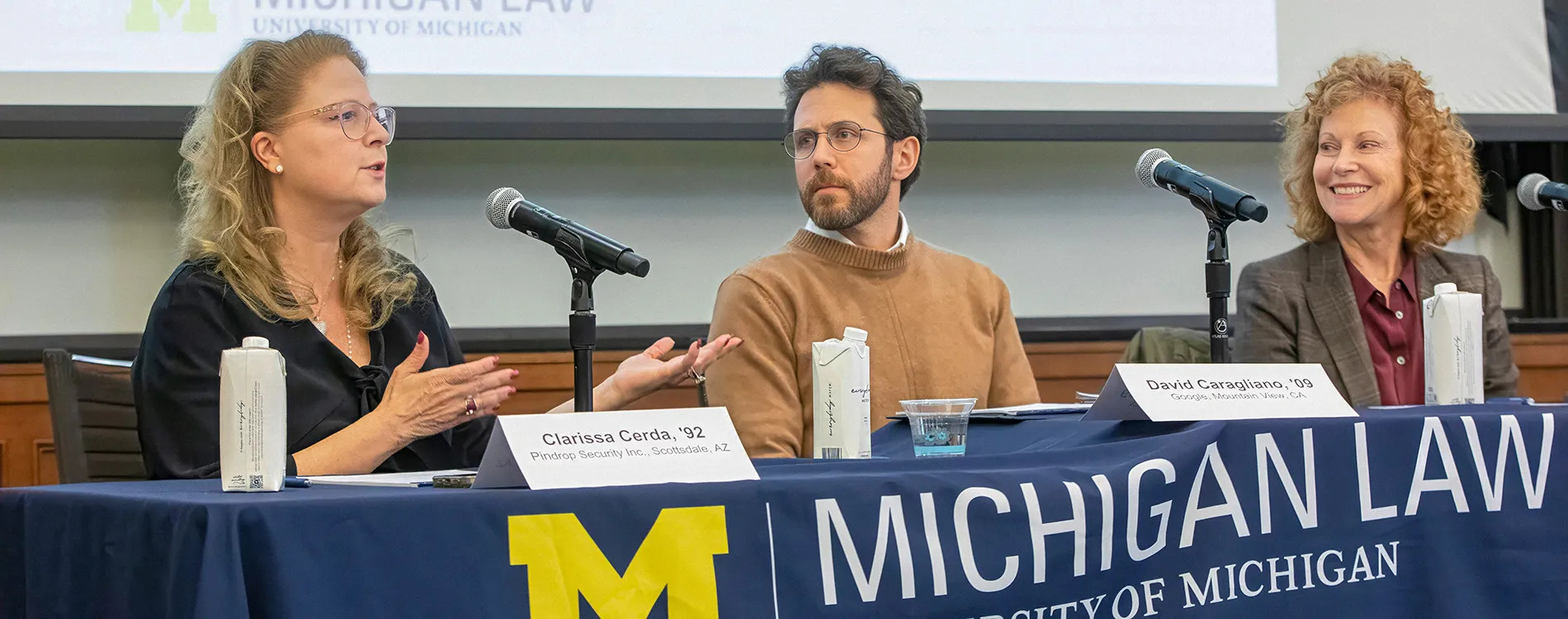
Speaking to Michigan Law students in 2025, Cerda named three interdisciplinary skills she uses every day: legal reasoning, technological literacy and ethical judgment. She paired them with three personal attributes: being proactive, curious and a continuous learner. It is a compact curriculum for anyone whose work keeps aging between breakfast and lunch.
Ambition with a handrail
There is a jaunty image Cerda uses for unequal conditions: one person may be swimming in water while another is swimming in Jell-O. Her advice is to embrace the Jell-O. Resistance builds strength, and watching the adjacent swimmer only ruins your own clock. It is memorable because it refuses both denial and self-pity. The medium may be absurd. The task remains to move.
“Swimming in Jell-O only makes you stronger.”Clarissa Cerda
The line also captures why Cerda's career does not split neatly into service, business and technology. Each chapter made the next ambiguity more legible. Government taught her the consequences of institutional decisions. Corporate practice supplied deal structure and a mentor who spotted a new specialty. Operating roles exposed the difference between advice that is legally immaculate and advice a company can actually use. Identity businesses made trust measurable. Mentorship kept the human outcome visible.
In 2026, she joined the University of Michigan Law School's inaugural AI Advisory Council, a group designed to advise the school on curriculum and strategy. She also brought her argument about deepfakes and enterprise trust to an RSAC podcast. The two appointments rhyme: one deals with people who will write tomorrow's rules, the other with organizations already facing tomorrow's impersonators.
Her public positions avoid the easy poles. She warns that rules intended to protect consumers can accidentally shelter fraudsters, and argues for adversarial testing that lets defenders probe systems without turning privacy law into a shield for attackers. She favors policy that can absorb technical change. The point is neither a lawless race nor a regulation museum. It is a framework sturdy enough to protect people and flexible enough to meet the next trick.
The person on the other end
Cerda has spent much of her career around institutions that certify things: a university certifies learning, a government certifies authority, a public market certifies disclosure, a security company certifies identity. Generative AI has made the last category wobble in public. The useful response, in her telling, combines verification with judgment and technical controls with human accountability.
The church sweeper's prayer returns here with a small revision. Large ambitions still matter. So do handrails. Cerda's scholarships, mentoring and professorship create them for future lawyers. Her work at Pindrop helps create them for interactions in which perception can no longer carry the whole load. Both projects ask how people move forward when the familiar path becomes slippery.
A career full of firsts could have hardened into a monument. Cerda made it a method instead: enter the room, learn its machinery, improve the route and keep the door in use. The gray will keep changing. It may speak in your boss's voice. The answer is not perfect foresight. It is the practiced ability to listen, verify and decide.