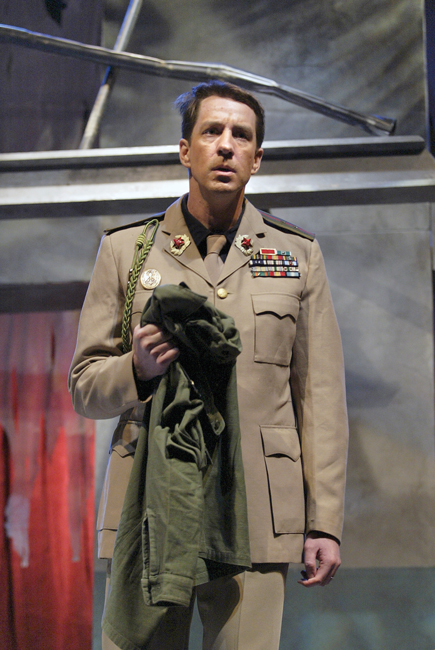
Christopher P. Austin arrived at the 2018 NIH’s Got Talent contest with a selection from Carmen and the clothes to match. He performed in period regalia and took first place. A director’s participation brought extra points under the competition’s rules, but the singing was hardly an executive’s novelty act. Austin had been taking baritone roles with professional opera companies alongside his scientific career. The cape belonged to a second working life.
There is something pleasing about an institution discovering that one of its directors can fill a stage. The organizational chart rarely includes an entry for dramatic entrance. Yet Austin’s musical life offers a useful way into his public one. Across research institutions, a venture firm, a startup, and now GSK, his work has repeatedly involved getting people with different kinds of expertise to operate together.
He has supplied the connection himself. Singing in an ensemble requires attention to other voices and instruments, he explained when leaving the National Institutes of Health in 2021. A performer has to adjust to what the group needs. The ability to produce a fine sound is only part of the assignment; knowing where that sound belongs takes another kind of skill.
Read his career through that observation and the unusual combination becomes easier to understand. Scientific expertise brought Austin into leadership. Listening, coordination, and a sense of collective purpose became part of how he described doing the job. The scientist and the singer share a practical problem: everyone arrives with a part, and somehow the parts must become a performance.
The institution is part of the experiment
Austin’s academic route ran through Princeton, where he graduated in 1982, and Harvard Medical School, where he earned his degree in 1986. Singing lessons at Princeton grew into opera performances. During his first Harvard year, he traveled between Boston and New York to perform in Fidelio at Alice Tully Hall. His calendar had acquired competing claims early.
After further training at Massachusetts General Hospital and Harvard, he entered the pharmaceutical industry at Merck. In 2002, he moved to NIH as a senior adviser at the National Human Genome Research Institute. His brief involved turning the results of the Human Genome Project into new research programs. A major scientific achievement had produced a different challenge: deciding what an institution should build around it.
That move is a useful hinge in his biography. Much of what followed concerned the machinery of research itself. Austin founded and directed the NIH Chemical Genomics Center and took on a series of other program-building roles. The work demanded attention to how people, tools, and information could move between specialties, alongside attention to the substance of the science.
When NCATS opened in late 2011, he became the first director of its Division of Preclinical Innovation. He was appointed director of the center in 2012 and remained in that role until April 2021. He was helping establish an organization while also arguing for a way of working. A new name on a building would have been the easier part.
An institution can assemble talented specialists and still leave awkward gaps between them. Who hands over a result? Who understands the assumptions behind it? Who notices that the next group needs something different? Austin’s emphasis on collective work puts those ordinary questions near the center of scientific leadership. They are less glamorous than discovery, and difficult to avoid for long.
- 2002Joins NIH from Merck
- 2012Becomes NCATS director
- 2021Moves to Flagship & Vesalius
- 2024Joins GSK
Making room for the other voices
At NCATS, Austin worked to create a culture that paired risk-taking with teamwork. The combination matters. Asking people to attempt unfamiliar work is one decision. Giving them colleagues who can help interpret mistakes, challenge assumptions, and carry the work forward is another. His public account of leadership made room for both the ambitious task and the social conditions around it.
Colleagues remembered the human side of that effort. Christine Colvis, who led partnership programs at the center, described Austin as someone who treated staff happiness as part of his responsibility. In her account, a productive organization depended on people being happy in their work. It is a refreshingly concrete detail in a career otherwise easy to summarize with titles.
There is an everyday managerial argument here. People have to be able to contribute what they know, and to recognize when someone else knows more. Listening gives that exchange a chance. An ensemble makes the requirement audible: a performer who ignores the rest of the group can be technically accomplished and still spoil the evening. The office offers fewer immediate musical clues.
Austin’s own formulation put shared purpose first. Everyone in an organization, he said, should understand the reason for the work. That is a demanding standard when different teams have different vocabularies and daily obligations. A common purpose has to remain recognizable after it passes through a meeting agenda, a technical discussion, or a decision about resources.
His comparison between music and organizational life is useful precisely because it asks something of the leader, too. The person with authority must keep attending to the ensemble. It is easy to praise collaboration in the abstract. The harder version includes changing one’s contribution when the larger effort requires it. Austin’s account of singing begins with that adjustment.
“The most important element of any organization is for everyone in it to know why they’re doing something.”
Christopher P. Austin, 2021
A new company, a different scale
In 2021, Austin left NIH for Flagship Pioneering in Cambridge, Massachusetts, joining as a CEO-partner. He also became the founding chief executive of Vesalius Therapeutics. After years spent developing a public institution, he was taking responsibility for a young company. The setting changed; the question of how to assemble a working organization remained.
Flagship publicly unveiled Vesalius in March 2022 with an initial commitment of $75 million. Austin co-founded the company with Flagship managing partner Doug Cole. Vesalius had originated within Flagship Labs in 2019. Those dates describe different stages of the enterprise: its incubation, Austin’s arrival, and its public launch. Founding stories become clearer when the milestones keep their own dates.
The financing was a company commitment, rather than a measure of Austin’s personal wealth or a completed commercial result. It gave the venture resources for its platform and initial programs. That distinction keeps the entrepreneurial chapter in proportion. A launch announces a team, a plan, and the means to pursue it. The work still has to happen.
Austin’s path through Merck, NIH, and Flagship also complicates the familiar career ladder. He had worked inside an established company, helped shape government research organizations, and then moved into startup leadership. Each setting puts different demands on a leader. His biography invites attention to those transitions, rather than treating the succession of titles as an automatic march upward.
Flagship’s initial commitment at the public launch of Vesalius in March 2022.
The farewell came with a guitar
When Austin left NIH, Francis Collins marked the departure with a song. The NIH director and Austin’s mentor picked up his guitar for a farewell based on Charlie on the MTA. The destination in this version was Boston. A colleague’s move had become an occasion for a musical send-off, which suited a departing director with another life on stage.
The tribute also made the relationship visible. Austin’s time at NIH included years of institution building under a mentor who was willing to turn a goodbye into a performance. It is a warmer picture than a departing executive standing beside a plaque. The musical joke worked because colleagues knew the singer as well as the director.
Another attachment survived the move to New England: Austin’s loyalty to the Baltimore Orioles. His affection for Memorial Stadium and Camden Yards did not come with an agreement to transfer allegiance to Fenway Park. A career can cross sectors and cities while a baseball preference stays exactly where it was. Some forms of continuity require very little strategic planning.
These details give the formal biography its proportions. Austin has sung baritone roles with Baltimore’s Opera Vivente, appeared in a workplace talent contest, and received a guitar-accompanied farewell from the head of NIH. They show music running through his adult working life, including its public moments. The stage was close enough for colleagues to recognize it as part of him.
Still listening, in a larger organization
Austin’s Vesalius and Flagship chapter ran from 2021 to 2024. He joined GSK in 2024 and now serves as Senior Vice President, Head of R&D Technologies. His remit brings together discovery platforms, data, artificial intelligence, and engineering technologies. It places him inside another large organization where different technical disciplines must contribute to a shared undertaking.
The current role gives the biography a new endpoint. Vesalius remains a founding chapter, and NCATS remains a substantial public-service chapter. Neither is his present executive post. At GSK, his responsibility is again concerned with the systems and technologies through which scientific work gets done. The organizational setting has changed once more, with familiar questions about coordination following it.
Across these moves, the recurring interest is how a group becomes capable of doing something its members cannot accomplish separately. Austin has approached that question through research programs, institution building, and company leadership. The opera comparison gives it an unusually tangible expression. Different contributions need preparation, timing, and attention to one another before they can form a coherent whole.
The image of Austin on stage is therefore a useful place to leave him. He is carrying a part within a performance, listening for the other parts, and bringing years of preparation to the moment. His career gives that image a second setting in the workplace. Even with the title of director or chief executive, there is still an ensemble to hear.