Insurance usually enters a life at an awkward moment. A house has changed hands. A business has bought a machine. A farm has added a building, a vehicle, or a fresh risk that refuses to fit inside yesterday's form. The customer wants certainty. The policy arrives carrying definitions, exclusions, and a small weather system of fine print. Somewhere between those two facts sits Christine Young. Her work has been to keep the people in that gap talking to one another.
Young is Chief Marketing Officer of Mutual Fire Insurance and Four Points Insurance in Langley, British Columbia. The title suggests campaigns and brand plans. Her remit is considerably more muscular: broker relationships, pricing and strategic initiatives, administration, communications, and marketing. It crosses the organization because the promise made in public has to match the decisions made inside it. A polished message cannot rescue a confusing process. A clever slogan cannot make a broker feel consulted. In a mutual insurer, where eligible policyholders can become members, closeness is not decorative. It is part of the structure.
This is why Young's career reads less like a climb up a single ladder and more like a walk around the entire building. She began in a small family-owned brokerage in Surrey, in Cloverdale's town centre. The agency was a local go-to for insurance needs. Customers were neighbours in the practical sense, the people whose shops, homes, and routines gave the work its stakes. Insurance there was not an abstract exercise in risk transfer. It was a conversation across a counter.
The counter was the classroom
Cloverdale supplied an early education in proximity. When people return to the same local office, the person selling a policy may later hear exactly how well it performed. There is no comfortable distance between a promise and its consequences. The brokerage's community ties shaped Young's appetite for service, a word that can sound bland until somebody needs help understanding what they have bought.
After the agency was sold, she moved into the insurance division of a large provincial credit union in a senior leadership role. Other roles followed across underwriting, internal and external training, senior management, marketing, and business development. Training became a particular passion. It makes sense. Teaching insurance is the art of keeping the precision while removing the fog. The teacher has to know where confusion begins, which detail changes a decision, and when a familiar phrase is hiding an unfamiliar idea.
A career built in useful layers
That tour through the business matters. Underwriting teaches respect for the sentence that changes coverage. Training teaches respect for the person encountering it. Business development teaches respect for the broker who must turn the whole arrangement into a recommendation. Marketing, when it finally appears in the title, becomes less about making noise and more about arranging clarity.
Relationships with an operating system
By 2018, Young was Mutual Fire's Business Development Manager. In 2020 she was speaking as Vice President of Business Development, responsible for partner relationships, social media, and company marketing. The list could sound miscellaneous. In practice, each item answered the same question: how does an insurer remain legible and present to the people around it?
Her preferred vocabulary gives away the method. People. Partners. Shared values. Connection. These are soft nouns attached to hard commercial consequences. Mutual Fire distributes through a broker network, so the relationship is a route to market and a feedback loop. Brokers hear the objections, odd cases, changing exposures, and plain-language questions that a head office can miss. Keep that loop healthy and the company learns. Let it wither and strategy begins talking to itself.
Young once described two tests for choosing a vendor: shared values and a people-first approach to partner service. It is a tidy filter. Expertise gets a supplier into the conversation. Behaviour determines whether the relationship survives it. This is not sentiment draped over procurement. It is a recognition that complex work travels through handoffs, and every handoff is a chance for ambiguity to multiply.
The same instinct appears in community work. Young is active on Mutual Fire's Donations and Sustainability Committees. In a 2020 conversation about the company's Vancouver Giants partnership, she talked about support for youth programs, hospices, recovery centres, community initiatives, and food banks. The hockey partnership let the insurer meet people in the Fraser Valley and share game-day tickets with partners. One favourite memory was Legends Weekend, a cheerful collision of insurance hospitality and Hockey Hall of Fame history.
There is a temptation in corporate life to treat community as a department and generosity as content. Young's story offers a more durable arrangement. Her community instinct began at the local brokerage, travelled through business development, and remained visible as her remit expanded. The through-line is continuity. If the idea survives changes in title, company scale, and responsibility, it has probably become a conviction.
A bigger title, then a bigger table
On June 30, 2025, Young became Chief Marketing Officer of both Mutual Fire Insurance and its commercial-insurance subsidiary, Four Points Insurance. The appointment expanded a portfolio she had already helped shape. She would lead marketing tied to long-term goals, grow the brands, deepen engagement with members and policyholders, and widen their reach. The promotion was a date on the calendar. The preparation had occupied most of a career.
Her sequence is worth stealing. Do not accumulate titles alone. Accumulate vantage points. Learn what the customer hears, what the broker needs, what underwriting can support, what a colleague struggles to explain, and what the community remembers after the banner comes down. Range creates judgment. It also makes a leader harder to fool with a beautiful plan that fails at the first real handoff.
Later in 2025, the view widened again. Young joined the board of the Canadian Association of Mutual Insurance Companies as a director for Western Canada. CAMIC is the national voice for Canadian mutual and cooperative insurers, bringing members together around advocacy, shared learning, and industry priorities. Her board role places the woman who started in a neighbourhood brokerage inside a national conversation about the model's future.
The role is a natural extension of her work at Mutual Fire. Inside the company, she carries information between brokers, policyholders, members, teams, and strategy. On the board, the crossings happen between regions, mutual insurers, and policymakers. Leadership is often pictured as a person standing at the front. Young's career suggests another useful image: a person moving between rooms, understanding the dialect in each, and helping the occupants hear one another.
Clarity without losing the human scale
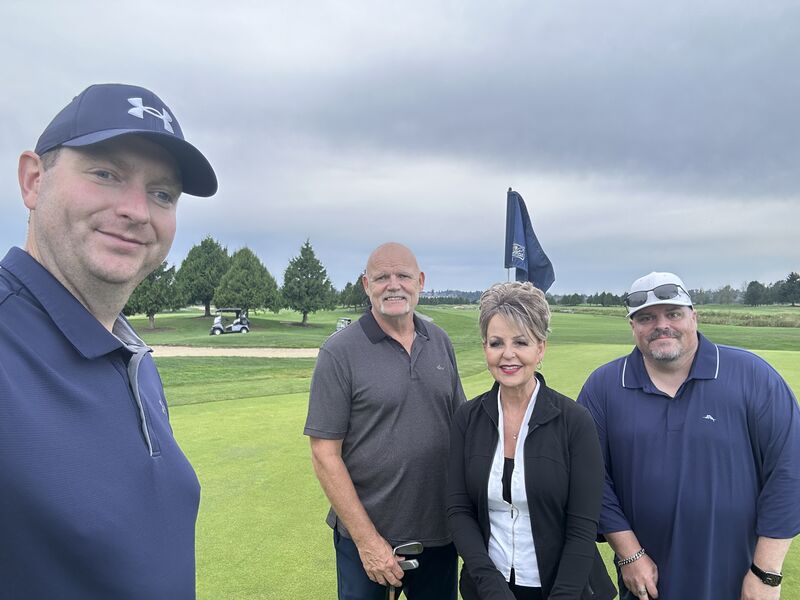
The private details that do appear in Young's public biography are pleasingly ordinary. She attends concerts with her husband. She spends time with family and friends. A partner's 2024 post records an afternoon of golf in Surrey with colleagues and vendors, under merciful West Coast weather. The photograph has the easy look of business people briefly freed from conference-room lighting.
Those details fit the larger pattern without needing to carry a grand lesson. A concert, a hockey game, a round of golf: these are places where people share attention before they exchange anything useful. The insurance business is full of formal mechanisms for managing risk. Trust remains stubbornly informal. It grows through repeated evidence that someone will be clear, present, and decent when the conversation becomes complicated.
Young's CIP and CAIB designations signal technical study on both insurer and broker terrain. Her Mutual Insurance Director recognition adds governance to that mix. Yet the most instructive credential is the shape of the career itself. She has occupied enough seats to know that every policy is also a relay. Product teams pass it to brokers. Brokers translate it for customers. Claims later tests the shared understanding. Marketing is useful when it makes the baton easier to carry, not merely shinier.
In a loud industry, Young's approach has a quiet advantage. It does not depend on being the most visible person in the room. It depends on noticing who is missing from the conversation, which promise needs translation, and which relationship needs another visit. The work compounds slowly. So does trust.
The child of this approach is not a viral campaign. It is an organization that can listen in several directions at once. From Cloverdale's town centre to Langley's executive offices and a national board table, Young has kept returning to the same practical idea: stay close enough to understand. Insurance may be written in clauses. It is remembered in moments. Her career has been built in the space between them.