In June 2023, EcoRegistry tokenized carbon credits representing 10,000 tonnes on the Chia blockchain. The credits went into the Carbon Opportunities Fund’s wallet. Chia’s account even supplied the block number: 3,582,007. Here was a financial transaction with an unusually specific receipt.
A carbon credit is an awkward thing to buy. Its value depends on events elsewhere, recorded by organizations the buyer may never meet. Has the credit been issued? Transferred? Retired? Has somebody counted the same benefit twice? The promise of Chia Network begins with making those records easier to inspect. The trees, mercifully, remain outside the computer.
- The machine: a public blockchain secured by disk space and proofs of elapsed time.
- The tools: verifiable databases, asset tokens, peer-to-peer Offers, and recoverable vaults.
- The evidence: carbon-registry infrastructure and a released consumer wallet.
- The bill: integration work, custody responsibilities, and changing farming requirements.
01 / The carbon credit needs a receipt
Chia supplies technology for Climate Action Data Trust, a metadata platform established by the World Bank, Singapore, and the International Emissions Trading Association. Registries publish records into a common framework while retaining control over their own data. Buyers and researchers gain a way to compare histories across institutional boundaries.
In September 2024, CAD Trust reported seven participating registries covering 85% of globally issued carbon credits. A December 2025 World Bank Partnership for Market Implementation update reported ten registries representing more than 85% of global issuance. Those figures describe the platform’s coverage, rather than Chia’s customers or sales. Still, this is a useful place to look for evidence: an application with a reason to exist beyond watching a coin’s price.
CAD Trust’s reported coverage of globally issued carbon credits in September 2024. A partner-platform measure, not Chia’s market share.
The limitation belongs in the same breath. A ledger can help expose inconsistent records. It cannot establish that a forest project delivered the claimed benefit. Environmental measurement and registry governance still matter. An immaculate receipt can accompany a disappointing purchase.
02 / A hard drive gets a second job
The architecture came first. Bram Cohen, who invented BitTorrent, co-founded Chia with Ryan Singer in 2017. Mainnet launched on March 19, 2021; transactions followed in May. Cohen brought experience building systems in which independent computers cooperate without putting one central operator in charge.
Bitcoin makes miners compete through repeated computation. Chia’s farmers first generate cryptographic data, called plots, and keep it on disks. The network challenges that stored data. Separately, programs called timelords supply proofs that time has elapsed. Proof of Space and Time combines the two.
Generating plots requires work; maintaining a farm still consumes electricity. Chia’s design aims to reduce the ongoing computational race associated with proof of work. It does not turn hardware into an object beyond economics. Drives cost money, fail, and occupy space. Expected rewards depend on competition and the value of XCH, the network’s native currency.

There is one particularly easy misunderstanding to dispose of: those disks are not hosting your holiday photographs. Farming plots contain generated proof data. Chia’s system for application records, DataLayer, is a separate piece of software. A farm and a file-storage service may both possess hard drives; that does not make them the same business.
03 / The useful part is the paperwork
Chia’s enterprise proposition has three verbs: tokenize, custody, trade. Its products attach ownership and spending rules to digital assets, let holders manage them, and provide a way to exchange them. The intended buyers include financial institutions, businesses, carbon-market participants, and developers building applications for those groups.
Chialisp is the programming language underneath the rules. DataLayer lets organizations keep tables off-chain while publishing cryptographic commitments on-chain. A recipient can check that a supplied table matches the committed version. The original files still need hosts and mirrors; publishing a fingerprint does not preserve a missing document.
Offers address another practical problem. A maker creates a file describing an exchange and sends or publishes it. A taker accepts the conditions. The exchange settles atomically: its required transfers happen together. Sending the file by email does not require handing the assets to the email provider.
The file carries the proposal. The network enforces the exchange.
Ethereum and other public smart-contract platforms compete for similar applications. Permissioned ledgers offer more restricted participation. A conventional database may suffice when everyone already trusts its operator. Chia’s distinctive package combines a storage-based public network, a coin-based programming model, and tools for shared records and custody. Choosing it means accepting its ecosystem and learning its conventions.
04 / A wallet for people who lose things
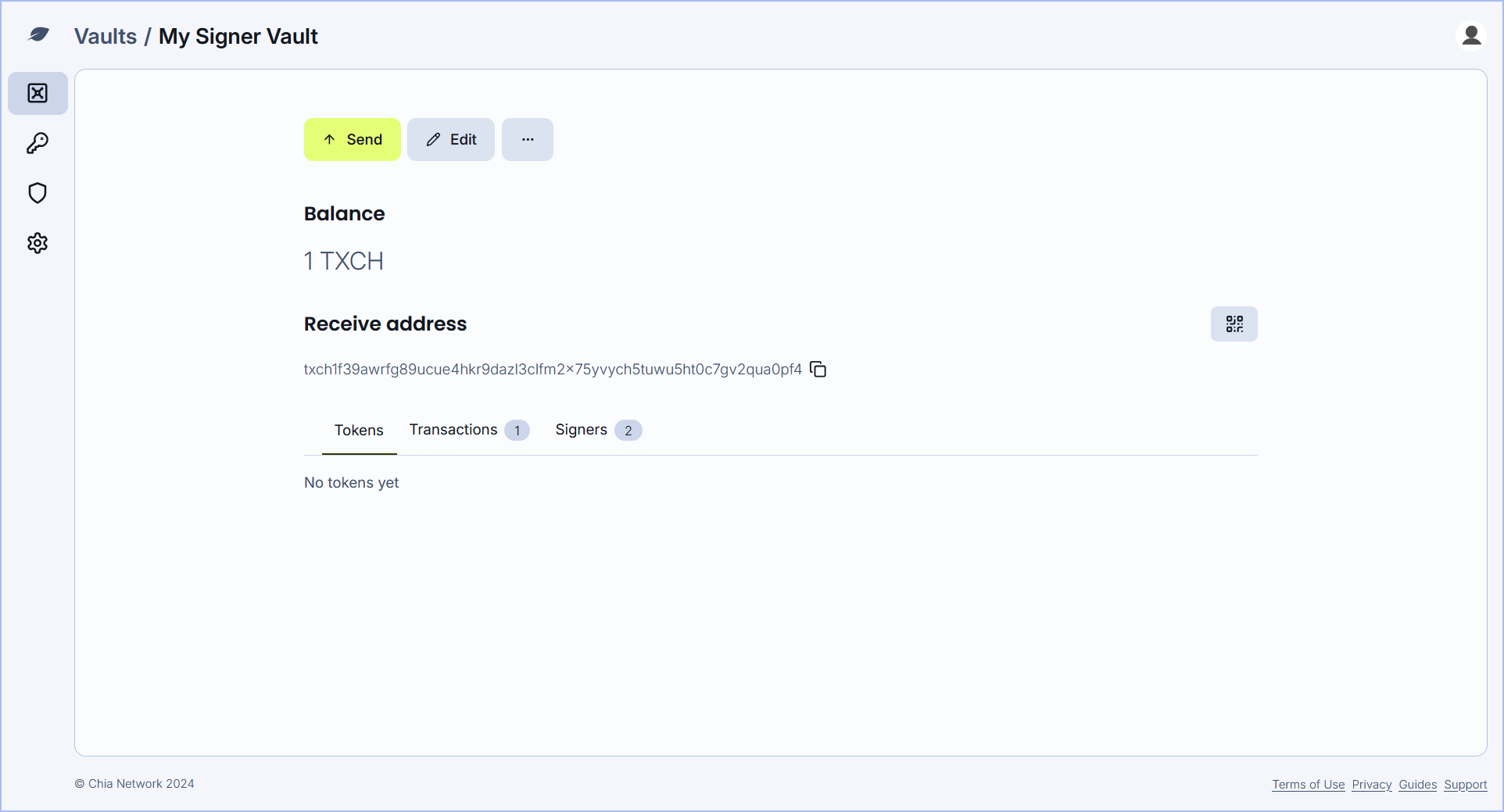
Self-custody sounds splendid until somebody loses a phone. Chia’s Cloud Wallet, released generally on October 29, 2025, puts that ordinary accident close to the centre of the product. Users manage XCH, asset tokens, NFTs, and Offers through a web interface, while vault rules govern access to the assets.
The current vault model separates a spending key from a recovery key. Depending on the configuration, a recovery delay gives the legitimate holder time to challenge an unauthorized recovery attempt. Passkeys and the Chia Signer app provide routes to signing. The company’s documentation says it does not hold the user’s spend or recovery keys.
Recovery has conditions. Lose both the spending credentials and the recovery credentials permanently, and Chia says it cannot restore access. The product changes how users manage the problem; it cannot abolish the problem. That distinction should interest any business considering a wallet for customers who have better things to remember than seed phrases.
05 / Who pays for the plumbing?
The public network and Chia Network Inc. have separate finances. The company develops open-source software and offers enterprise and cloud services. Cloud Wallet’s core features are free; its October 2025 announcement described a forthcoming Pro plan with advanced tools. Blockchain transaction fees and farmer rewards do not automatically become company revenue.
In May 2021, Chia raised $61 million in Series D Preferred equity, led by Richmond Global Ventures and Andreessen Horowitz. Its February 2022 business white paper described approximately $77 million raised across four financing rounds, plus a $10 million strategic-partner convertible note. The investors bought into the company. Holding XCH is a different proposition.
Funding became harder. In October 2023, Chia announced 26 job cuts, citing a difficult financing environment and the failure of its underwriter. By 2025, company posts explicitly discussed selling portions of its strategic XCH reserve to support operations. Good network engineering had not removed the company’s need for cash.
Permuto illustrates the less obvious costs. Its proposed trusts would separate a stock’s asset and dividend components. Gene Hoffman explained in April 2025 that a blockchain-only distribution approach ran into state securities-registration requirements. The plan expanded toward national-exchange distribution and a transfer-agent bridge. In December, he described further delays from a requested filing-regime change and a federal shutdown.
The attraction was administrative efficiency: batch payments, fractional entitlements, and ownership records useful for tax reporting. Hoffman estimated a typical bulk-payment fee around $20, rising toward $100 under severe congestion. That was the company’s estimate for a particular mechanism, not a universal enterprise price or an independently demonstrated saving.
“We let our securities be securities and our commodities be commodities”
Chia Network’s stated regulatory philosophy
06 / The GPUs changed the bargain
The storage idea has its own moving parts. Compression techniques let farmers trade some storage for additional computation. That creates pressure on a design meant to favour disks over a processing race. Chia’s engineering team has been developing a new proof format to address changing hardware economics and security requirements.
March 2026 documentation said the project was not expected to be finalized until 2027 and that continuing farmers would need to replot. The schedule remains subject to development. The September 10 release of client 2.7.4 added security hardening and preparation for a later hard fork. A farmer evaluating costs must therefore include maintenance and future migration, alongside drives and electricity.
What changed the engineers’ minds was the technical landscape. What changed the financial product’s distribution plan was the legal landscape. Both changes are instructive: assumptions about a system’s surroundings expire even when its central idea remains appealing.
07 / A small experiment beats a grand conversion
An enterprise reader can copy something quite modest from Chia’s approach. Pick one troublesome handoff: a registry update, an asset exchange, or the recovery of an account. Identify who controls each record and what another party must verify. Then test the workflow before replacing an institution’s plumbing.
Chia offers a testnet wallet and test currency for that first experiment. Developers can inspect its open-source code and explore Chialisp or DataLayer. Carbon-market organizations can examine the registry and tokenization applications. The relevant measure is whether a real process becomes easier to verify or operate.
In 2026, Chia also announced work with ANAAR on artisan identities and a gaming beta. These widen the applications, but announcements alone cannot establish adoption. The useful question remains pleasantly unfashionable: who needs the record, who accepts it, and what does maintaining it cost? Chia’s wager on boring money will be judged in those details.