The leads were arriving. That was the awkward part. At Tipalti, lead volume grew while lead-to-opportunity conversion declined. Marketing had activity to report. Sales had people to chase. Somewhere between those two reassuring facts, the business was losing the plot.
CHEQ’s case study describes Tipalti deploying Form Guard and traffic intelligence. The analysis classified 15.1% of more than 200,000 leads as malicious. The queue was busy. The queue was also compromised.
- CHEQ checks the authenticity of digital traffic, then applies the result to ads, forms, analytics and data controls.
- Its customers want less wasted spend, fewer junk leads and numbers they can use to make decisions.
- AI agents have changed the assignment: some machines should be welcomed, others restricted.
This is CHEQ’s territory: the gap between a digital interaction and a commercially useful one. A click is easy to count. The intention behind it is considerably less obliging. CHEQ has built a software business around investigating that difference, connecting security judgments to the places where companies attract, measure and convert demand.
01 / The expensive pleasure of being popular
In ordinary marketing arithmetic, attention is the beginning of success. Buy traffic, improve the page, collect the enquiry, book the meeting. Each stage produces a number, and each number offers a small temptation to congratulate yourself. Invalid traffic can pass through this machinery wearing a succession of respectable labels: visitor, audience member, conversion, lead.
The financial damage can travel. An unwanted click consumes advertising spend. If that visitor enters a remarketing audience, later campaigns can spend money pursuing it again. A fake form submission creates a task for sales. Polluted analytics can encourage a team to improve the wrong page or favor the wrong channel. CHEQ’s product range follows those different consequences.
Acquisition protects paid campaigns and audiences. Form Guard screens submissions before they become someone’s follow-up problem. Analytics supplies a view of traffic quality for reporting, segmentation and experimentation. The appealing proposition is practical: give the marketing system a way to question its inputs before the business mistakes activity for demand.
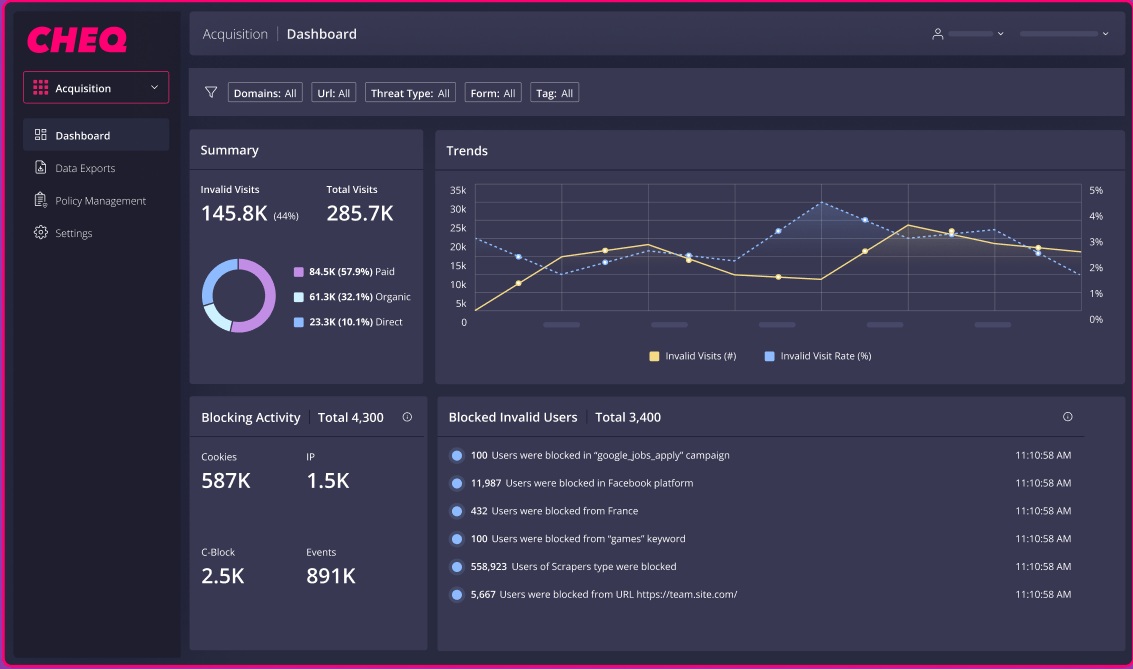
Tipalti’s reported results appear below. These are customer results published by CHEQ, rather than a promise about the next account. Cleaner acquisition traffic does not, by itself, establish an equivalent increase in revenue.
“The most valuable thing CHEQ gives me is specificity”Stacy Pinkerton, Tipalti / CHEQ-published case study
02 / A security company walks into marketing
CHEQ was founded in 2016 by Guy Tytunovich, Ehud Levy and Asaf Botovsky. Its early public positioning centered on ad verification: fraud, brand safety and whether an advertisement had a fair chance of being seen. In November 2019, it announced a $16 million Series B from Battery Ventures and MizMaa, with plans to extend its capabilities into channels including connected television and console gaming.
That history matters because CHEQ’s later phrase, “go-to-market security,” describes a change in the boundary of the problem. Advertisements were an entry point. The wider subject became the customer journey and the systems surrounding it. The person buying the software might sit in marketing, but the decisions involve security, sales operations, analytics and privacy.

The acquisitions tell the expansion story neatly. ClickCease joined in 2020, adding an established click-fraud protection business. Ensighten followed in 2022, bringing privacy enforcement, customer-hijacking prevention and controls against data exfiltration. Deduce arrived in January 2025 with identity intelligence aimed at fraud, including AI-generated identities. Each deal added a different place where a digital interaction could go wrong.
CHEQ Manage and CHEQ Enforce occupy a less theatrical corner of this world. Manage gives teams control over tags and data collection across client-side and server-side environments. Enforce aims to stop unauthorized or unconsented tracking. A consent banner is a visible promise; the code running behind it determines whether that promise survives contact with the website.
The distinction is useful for buyers. Reducing fraudulent ad clicks and governing third-party scripts require different controls. Putting both in one portfolio can help a company coordinate them. It also means a prospective customer needs to specify the problem it wants solved, rather than assume the company name describes a single universal switch.
03 / The machine may have a shopping list
The old instinct was straightforward: find the bots and keep them out. AI agents make that instruction less comfortable. An automated visitor might be collecting content without permission. It might also be acting for a customer researching a purchase. Treating both visitors alike can sacrifice useful demand along with unwanted traffic.
In June 2026, CHEQ announced Agent Intent, scheduled to launch at Cannes Lions on June 22. Its framework separates four questions: what entity operates the visitor, whether its claimed identity holds up, what it intends to do, and what action the website should take. Available actions include allowing, blocking, redirecting and rate-limiting traffic.
- EntityWho operates it?
- IdentityDoes its claim check out?
- IntentWhat is it trying to do?
- ControlWhat should happen next?
Identity and permission are different questions. Even a recognizable agent may request something a business does not want to provide. Equally, a useful automated visitor need not behave like a person moving a mouse. CHEQ’s bet is that businesses will need more context to govern these interactions than a label reading “bot.”
In July 2026, the company appointed CyberArk founder Udi Mokady chairman of its board. CHEQ says he had served on the board since December 2023. The appointment accompanies the agent-focused product expansion; it gives the company an experienced identity-security voice as its commercial vocabulary moves beyond protecting campaigns.
04 / Buying fewer mistakes
CHEQ says more than 15,000 organizations use its technology. Its public customer stories span software companies such as Cvent and Paycor, retailers including The Good Guys, universities, financial services and Heineken. The common feature is a dependence on digital interactions, with enough volume or consequence to make unreliable traffic expensive.
It sells B2B software through direct sales and partner channels. Enterprise product pages invite a demo or sales conversation. The budget question therefore belongs in a scoped proposal: which properties, workflows and protections are required, and what business outcome justifies the spend? The financing is more visible. A $150 million Series C, led by Tiger Global in February 2022, supported plans to expand research, development and commercial teams.
Integration is part of the appeal. CHEQ documents connections to advertising platforms, Salesforce, HubSpot, Adobe tools and analytics systems, alongside deployment options involving Cloudflare, CloudFront and Akamai. Those connections let a traffic judgment influence an existing workflow. An integration listing should not be mistaken for a promise that every customer needs every component.
Its competitive position sits across several buying categories. Bot and agent controls overlap with the jobs served by Cloudflare, Akamai and DataDome; paid-traffic protection also invites comparison with tools such as Lunio. CHEQ’s argument rests on linking traffic intelligence to marketing, identity and data-governance decisions across the journey. Buyers should compare the particular job, deployment and evidence, since the portfolios differ.
05 / Count what survives the inspection
The lesson a reader can copy is a sequence: inspect traffic quality, connect it to downstream outcomes, then optimize. In the opening case, the sales conversion problem came before the traffic diagnosis. That is more useful than declaring a whole advertising channel good or bad from an aggregate chart.
A sensible evaluation would track qualified opportunities alongside invalid traffic, check that legitimate customers still get through and account for the cost of deployment and operation. Fewer visitors can accompany better performance. Fewer blocked visitors can also accompany a healthy audience. The raw count becomes meaningful only when tied to the business outcome.
Traffic protection has limits. It cannot create product demand, rescue an unattractive offer or repair a sales process that ignores good leads. Restrictive controls can exclude legitimate visitors; agent access needs policies that reflect the site’s purpose. CHEQ’s tools make the visitor question more explicit, but the company using them still has to decide what welcome means.
That is what makes this company interesting. It asks a commercially impolite question at the precise moment everyone would prefer to celebrate: before we admire the size of the crowd, are we sure anyone here came to buy?
Follow the visitors
Explore CHEQ’s products, customer accounts and conversations.