Liz Egan once took a job at a company she did not entirely understand. The company was Yext. It had about 75 people, roughly $10 million in revenue, and an office with an energy she could feel. She liked the people. She saw room to matter. And if she could not quite explain what Yext did, she reasoned, perhaps the place could use some marketing help.
This was not a grand theory of executive decision-making. It was better: a live reading of a room. Egan had already spent two years in consumer public relations and worked at a tiny iPhone app called Stamped. Google Ventures, an investor in Stamped, introduced her to Yext after Yahoo acquired the app in 2012. To Egan, 75 employees looked enormous. In retrospect, she had arrived near the beginning.
She stayed for almost a decade. During that span, Yext crossed from small business into the enterprise, expanded internationally, added products, surpassed 1,000 employees, and became a public company. Egan moved across marketing’s internal borders as the business changed. She started in brand and communications. After helping lead the business side of the 2017 initial public offering, she moved into demand generation. The company reported $117 million in revenue after the IPO; she remained through its climb toward roughly $400 million.
The accidental marketer
Classics, economics, and the family business of invention
Egan studied classics and economics at Northwestern University. Marketing entered by parental suggestion. They thought she might be good at it, and a pair of college internships in New York public relations led to a job after graduation at Weber Shandwick. She worked on established consumer brands including Hanes, WeightWatchers, and Degree Men at the moment social media began swallowing attention.
The industry had not yet settled on the word influencer. Egan and her colleagues merely knew that social mattered and spent their days figuring out what that meant. It was a useful education in traditional marketing during a decidedly nontraditional transition. It also clarified what she did not want. Big brand PR felt too far from the act of making something.
Her grandfather had been a professional inventor. Her father worked in invention, innovation, and manufacturing. Egan has described a pull toward that world as something in her blood. In the early 2010s, technology startups were where invention seemed to be moving, so she followed it. Stamped was so early in the app economy that people asked her whether groups of employees really worked on apps. They did, briefly. Yahoo bought the company in 2012.
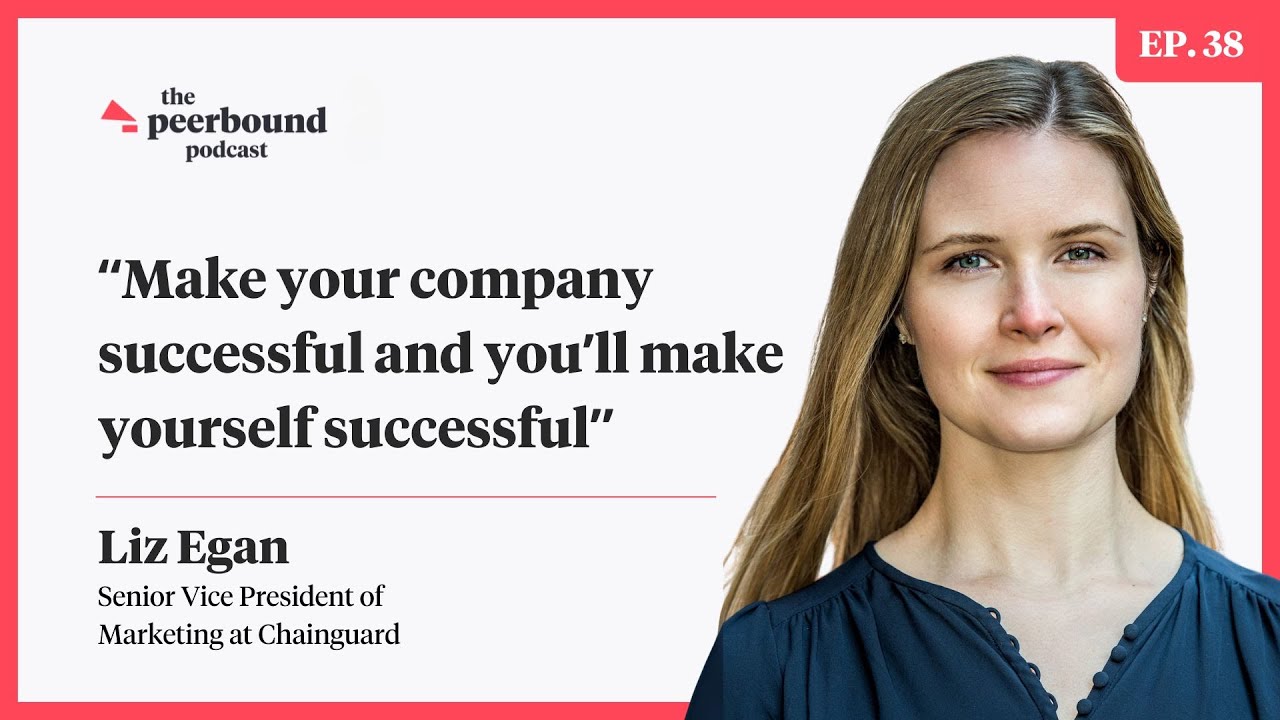
I don’t actually identify as a marketer… I feel I am a company builder.Liz Egan on the Peerbound Podcast
That sentence is the cleanest explanation of her résumé. A marketer can defend a function. A company builder follows the work wherever the company needs it. At Yext, that meant helping explain an obscure category, shifting attention from plumbers and locksmiths toward giant enterprises, learning how partnerships supplied a major portion of revenue, and later sitting with the arithmetic of demand generation.
She learned attribution models and dashboards partly by searching for them, a confession that makes executive growth sound refreshingly like everyone else’s. She also learned where expertise should live: hire people stronger than you are, set direction, and inspect the work without confusing leadership with omniscience. Her edge was institutional fluency. She knew the company, spoke the language of sales, and could persuade large groups to move.
A bridge that is never finished
Her favorite operating metaphor comes with orange paint
Egan compares scaling a company to painting the Golden Gate Bridge. Finish one stretch, move on, and eventually discover that the world has changed behind you. A market position needs refreshing. A customer has grown more sophisticated. The campaign that failed five years ago may suddenly work because competitors have educated the buyer, the execution can improve, or the company itself is ready.
Her point is not to romanticize repetition. When somebody says an idea already failed, she asks why and digs until the failure becomes useful. Only then is another attempt more than corporate amnesia. This tolerance for building up and tearing down is not universally pleasant. Egan happens to like it.
She nearly left that education for business school. Applications were ready. Then an opportunity appeared to report directly to Yext co-founder Howard Lerman. She decided to see where a year beside the CEO might lead. It became, she later said, the best decision she could have made.
One early lesson arrived as a question from Lerman: If he made her CEO tomorrow, what would she do? Egan, very young and cornered by a hypothetical promotion, suggested giving people raises. His answer was vision. People need to know what they are building and why it deserves the inevitable discomfort. Egan carried that into her own management: explain the destination, what it means for the company, and what it can mean for the people doing the work.
Feeling, meet spreadsheet
The CMO has to count and still bring “the extra”
Egan’s experience on both sides of marketing left her suspicious of tidy divisions between art and numbers. Demand generation requires knowing where the dollar went, what it returned, and whether it produced pipeline. Enterprise marketing also requires a real partnership with sales. She favors finding one or two salespeople who will test the work honestly before the larger team sees it. A beautiful deck that sales distrust is merely expensive stationery.
Yet numbers offer the tempting illusion that everything worth doing can be proved in advance. Brand, confidence, taste, and energy misbehave under that demand. Egan tells her teams that “marketing is a feeling.” If marketing presents at an all-hands meeting and nobody leaves fired up, she considers that a warning. The function has to bring what she calls “the extra”: a sharper tone, better design, a bolder idea, or simply a more confident way of appearing in public.
You really do have to balance the hardcore numbers… with being the heart and soul of the company.Liz Egan
Her husband is a creative director in advertising, which gives her a close view of creative motivation. He concentrates on making special work. She concentrates on what special work must accomplish for a business. The distinction is affectionate and practical. A CMO who understands why creatives care can protect their best instincts while supplying the strategy an agency engagement needs.
That dual fluency brought recognition early. Forbes named Elizabeth Walton, as she was then professionally known, to its 2018 30 Under 30 list in marketing and advertising. DMN put her on its 40 Under 40 list in both 2017 and 2018. Awards freeze a moment. Egan kept moving.
A new category to explain
From employee software to software supply chains
After Yext came chief marketing officer roles at Sprig, the product research platform, and Lattice, the people management software company. At Sprig, she taught a launch playbook built around paid, owned, and earned media. Her blunt summary was that “if you build it, they will come” does not work. A product has to be carried toward the right people through relationships, messages, channels, and patient conversation.
In 2024, she joined Chainguard to lead marketing. The product lives in the hidden foundations of modern software: hardened container images and other trusted builds of open source components. The value is concrete but the vocabulary can be forbidding. Vulnerabilities, provenance, attestations, compliance, and software supply chains rarely arrive with the instant charm of a consumer app.
This makes the assignment familiar. Early Yext also required education before demand. Chainguard asks Egan to translate technical rigor without sanding off the rigor itself. She helped bring customers and practitioners together at the company’s first Assemble conference in San Francisco in March 2025. By September, writing as chief marketing officer, she connected Chainguard’s Cloud 100 and workplace recognition to a larger claim: the company must shape its culture while it shapes a market.
AI adds urgency to both stories. Egan sees generative tools as a calculator moment. They can outline, draft, compose a quick song, or assemble a visual mood board. They do not remove editing. They shift more of the job toward asking well, choosing carefully, and refining without mercy. A narrow role may disappear even when the broader profession remains. Curiosity becomes job security.
At Chainguard, AI also changes the environment being secured. More software is written faster, by people and agents. The marketer’s task is to make the foundation legible: trusted components, less vulnerability toil, clearer provenance, and engineering teams free to build rather than patch. It is unglamorous material with enormous consequences, which is precisely the sort of challenge Egan has repeatedly chosen.
The company hat
A career moves quickly when the institution moves with it
Egan’s most portable advice is almost suspiciously simple: keep the company hat on. Make decisions for the health of the whole business, not merely the comfort or status of a department. When the company succeeds, the people who expanded what they could do often move with it. Her own path through Yext is the evidence: communications led to an IPO, the IPO led to demand generation, and the breadth led to CMO work.
This approach does not ask employees to surrender judgment. Egan calls herself a “really big feedback person.” She wants disagreement early enough to improve the work and buy-in deep enough to help it travel. It takes longer than issuing a decree. It can also prevent the lonely executive error of mistaking a title for universal expertise.
There is a sly consistency to her story. The classics graduate learned marketing because the work was available. The PR professional moved toward invention. The app employee chose people before a perfectly legible product. The communications leader learned revenue mechanics. The CMO describes herself with a different noun.
Company builder suits her. It leaves room for the spreadsheet and the feeling, the customer and the creative, the first coat of paint and the inevitable return. At Chainguard, the technology may be designed to make software less surprising. Egan’s work is to make the company impossible to overlook.