The useful thing about a pharmacy counter is that it leaves very little room for theory. A customer arrives. A prescription has a price. An insurance card has a promise. Then the register renders its verdict. Chang Lu worked on one side of that counter and watched thousands of people discover, in public and under fluorescent light, that the promise and the price were not always on speaking terms.
It is the sort of ordinary scene that can rearrange a career. Lu had entered medical school at 17. At Brown University he pursued the BS/MD path and studied neuroscience and economics, two disciplines preoccupied with decisions for rather different reasons. He also conducted zero-shot modeling research at Emory’s Winship Cancer Institute. The path in front of him was respectable, difficult and clearly signposted. The counter supplied a less tidy question: why could a person carry coverage and still be surprised at checkout?
In 2026, Lu surfaced in San Francisco as co-founder and CEO of Insurf, a small company with a large spreadsheet of a problem. His co-founder, Bryan Chung, was not a stranger assembled by an online matching service. The pair met during orientation at Brown. Years later, their company joined Y Combinator’s Summer 2026 batch.
The number that behaves like a decoy
An insurance premium has the polished authority of a price. It arrives with a dollar sign and a monthly cadence. It is also only one input. Deductibles, networks, drug tiers, copays and out-of-pocket limits wait behind it like footnotes with invoices. Choosing a plan by premium alone can resemble choosing a restaurant by the price of the bread.
Insurf’s response is a product called Surely. It is meant to rank plans by their modeled year-long cost rather than the most conspicuous number on the brochure. The company says it uses figures from government filings and accounts for the less photogenic machinery of a plan. Its public launch offered a deliberately sharp example: in 2,000 simulated years from its data, the lowest-premium plan was never the lowest-cost option. In one scenario, the cheaper sticker price would have cost $8,052 more in a bad year.
These are company claims, not a universal law of coverage. But the underlying observation needs little ornament: the price most visible during enrollment is not necessarily the amount most relevant to a household or employer. Lu’s wager is that a more complete calculation can happen before enrollment rather than as a series of expensive revelations afterward.
The premium is a headline. Lu is building for the article underneath it.
A loop hiding inside two products
Surely is only half of the design. Insurf’s second product, Inveto, is built for clinics handling denials and prior authorizations. A clinic supplies the relevant denial and record; the software prepares source-cited material for physician review and signature. The distinction matters. Insurf describes the system as extraction rather than free-form generation, an attempt to keep the work tied to documents that can be checked.
Plenty of startups would stop there, content to make an unpleasant workflow shorter. Insurf’s more interesting bet sits in the join. With contractual authorization and de-identification, outcomes from that work can become information about how coverage behaves. Surely can use that information when estimating what a plan may actually cost. One product encounters coverage at the moment of friction; the other tries to price that friction earlier.
and decisions
data
cost model
That architecture reveals something about Lu’s taste as a founder. His public biography is short, but its recurring interest is legibility. Neuroscience studies a system whose outputs must be inferred from signals. Economics asks how incentives and constraints produce choices. Zero-shot modeling asks software to operate on categories it has not seen in training. Insurance asks everyone to bring a magnifying glass.
It would be too neat to pretend these experiences marched in a straight line toward Insurf. Careers rarely offer that courtesy. Still, the company does look like the work of someone comfortable at the border between evidence and decisions. Its ambition is not simply to write documents faster. It is to make a notoriously difficult system answer a plain question: what is this choice likely to cost?
The friendship before the company
Lu and Chung’s first shared institution was Brown, not Insurf. They met at orientation, the university ritual designed to produce equal quantities of friendship and lost lanyards. Chung brought a background in competitive computer science and physics. Lu brought the medical track, research and the economics of the pharmacy counter. The eventual pairing has a certain complementary logic: one founder steeped in technical competitions, the other drawn to systems where calculation collides with lived experience.
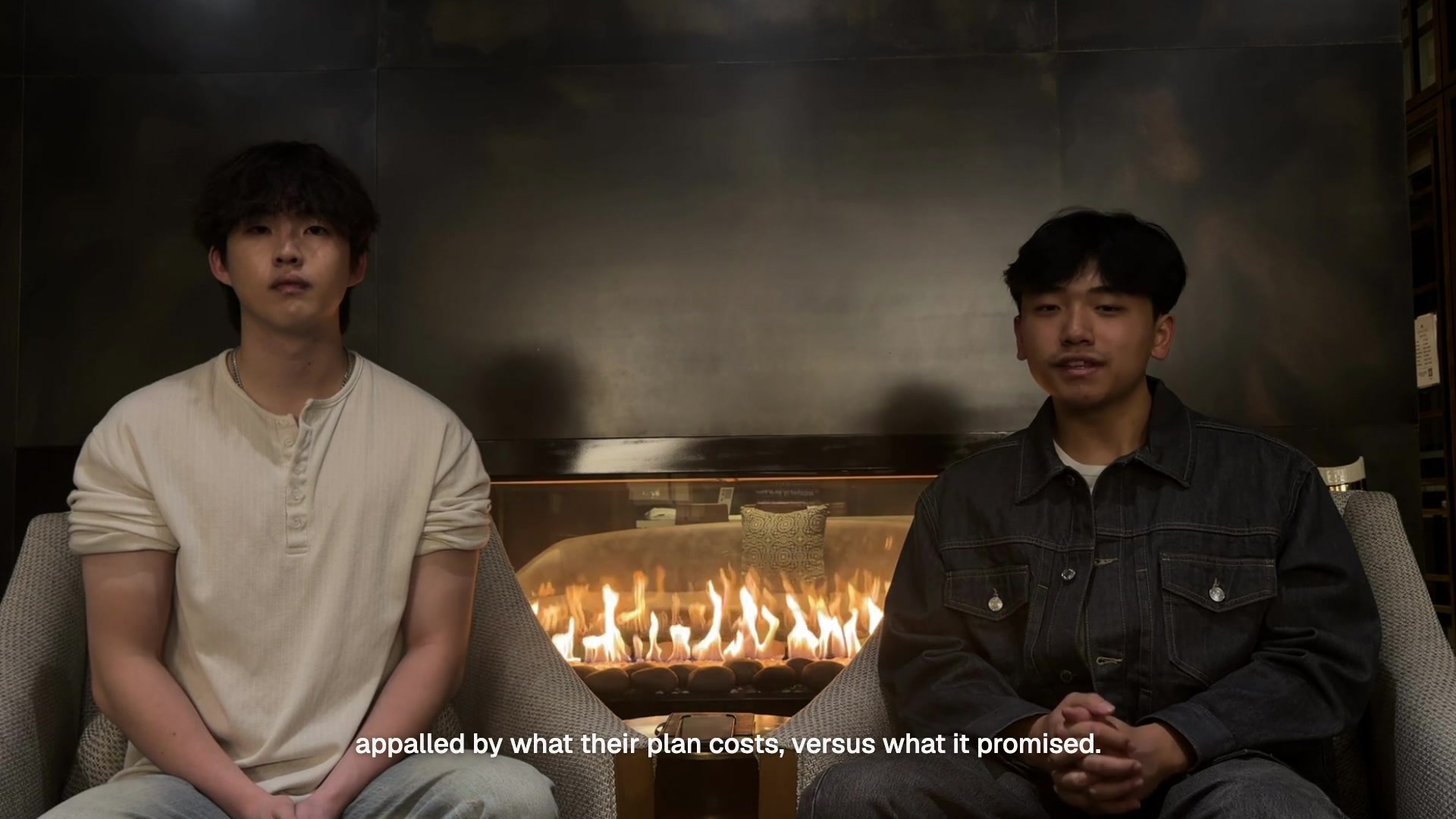
Their public launch begins with the intimacy of a two-person operation: “Hey everyone - we’re Chang and Bryan.” The language then becomes blunt. The existing method of choosing coverage, they argue, relies too much on guesswork, while the consequences arrive through denials and surprise costs. Surely addresses the choice. Inveto addresses the consequence. The founders describe the combined data as their moat.
Lu’s own announcement was considerably lighter. “W sidequest,” he wrote on LinkedIn, adding that he would be in San Francisco for the summer and crediting Chung. It is a funny way to describe entering Y Combinator while stepping away from a degree path that had begun with medical-school admission at 17. A sidequest is optional by definition. It also tends to be where the odd characters, useful tools and better stories are found.
Small team, unfashionably large paperwork
Insurf began with two founders and a problem whose vocabulary alone can exhaust a lunch break. That mismatch is part of the appeal. Software companies often hunt for glamorous surfaces. Lu and Chung chose paperwork, filings, plan documents and the gap between a policy’s language and its operation. There is no velvet rope around a prior authorization. There is, however, a great deal of structured information trapped in tedious work.
The company says Inveto is working with clinics in Texas, Georgia and California. Surely is pitched to individuals, employers and brokers. Insurf’s public materials make ambitious projections about future plan shopping and employer savings, but the young company will ultimately be judged on humbler things: whether its calculations hold up, whether its citations are dependable, and whether users can act on the results. Infrastructure earns trust line by line.
Lu’s early story offers one operating lesson worth borrowing. Look for a task that produces information useful to a second task. Inveto’s work is not merely an end; it can teach Surely. Surely is not merely a calculator; it gives the operational data a place to matter. When the pieces reinforce each other, a small team can attempt something larger than either feature.
There is another lesson in the company’s choice of language. “Source-cited” appears repeatedly in Insurf’s description of its work. In a market newly crowded with AI labels, the adjective is doing more work than the noun. A fluent answer is cheap; an answer that shows its paperwork can be inspected. For clinics, employers and brokers, persuasion matters less than provenance. Lu’s research background does not prove the product will earn that trust, but it helps explain why the company presents evidence as part of the interface rather than decoration beneath it.
This also gives Insurf a useful constraint. The company cannot rely on novelty for long. Its output touches decisions with real financial consequences, so each calculation must survive questions from people who are paid to be skeptical. Brokers will compare. Clinic staff will check. Employers will ask where a number came from. The work is less like producing an oracle and more like assembling a case that another person can audit. Lu’s counter began with surprise. His company’s credibility will depend on how little surprise remains after the model speaks.
Before surprise becomes a bill
There is a temptation, when profiling a young founder, to write the ending early. Insurf was founded in 2026. Its Y Combinator chapter is current, its team compact, its thesis still meeting the market. The honest story is not conquest. It is commitment: Lu saw a contradiction at a pharmacy counter and has chosen to keep pulling at it.
That choice has carried him from Brown orientation to research at Emory, from a BS/MD program to a San Francisco startup, and from watching price surprises happen to trying to model them in advance. The route is unusual without requiring mythology. It is held together by a preference for evidence, a co-founder friendship and one irritatingly persistent question.
Insurance will probably never become charming. Too many tables have given their lives in the attempt. Lu is aiming for something more practical: a plan whose economics can be understood before it is used, supported by data from what plans actually do. If Insurf works, the quiet victory will happen before anyone reaches the counter. The register will still render a verdict. It simply will not be the first time the customer has heard it.