Inside a biosafety cabinet in Alameda, a vial of human T cells flows through a chip the size of a thumbnail. The cells hit a row of microscopic ridges, get squeezed flat, snap back open, and in that half-millisecond of panic they swallow whatever gene-editing cargo you sent in with them. Then they keep going - alive, mostly unbothered, ready to become medicine. This is CellFE's whole argument, condensed into a single pass through a plastic channel.
CellFE - short for Cell Fluidics Engineering - is a biotechnology company that makes the tools other companies use to build cell therapies. It does not make the therapies themselves. It makes the machine and the consumables that get genetic instructions into living cells without wrecking them. That distinction matters more than it sounds, and it is the entire reason the company exists.
A cure that kills the cell first
Cell therapy is one of the genuine miracles of modern medicine. You take a patient's own immune cells, reprogram them to hunt cancer, grow them up, and put them back. When it works, it can clear tumors that nothing else touched. The catch is in the word "reprogram." To edit a cell, you have to get large molecules - mRNA, CRISPR machinery, DNA - across a membrane that exists specifically to keep large molecules out.
For decades the field has had two main options, and both come with a tax. Viral vectors are efficient but slow, expensive, and carry their own regulatory baggage. Electroporation - zapping cells with electricity to punch temporary holes - is faster and cheaper but rough on the cells, often killing a meaningful fraction and stressing the survivors. Either way, you pay in cell health, time, or money. Usually all three.
Here is the irony the field had quietly learned to live with: to make a therapy that saves a cell, you often had to damage a lot of cells. The healthier the starting material, the better the therapy - and the existing methods were, in their own way, slightly hostile to the very thing they were trying to improve.
Three engineers, one microfluidic hunch
CellFE's founding team did not come from immunology. They came from fluid dynamics and mechanical engineering, which turns out to be exactly the right wrong background. Alla Zamarayeva earned her PhD in engineering at UC Berkeley working on flexible health-monitoring systems. Todd Sulchek and Alexander Alexeev are both professors at Georgia Tech who spent years studying how cells behave when you push, squeeze, and flow them through tiny spaces.
Their bet was mechanical, not chemical or electrical. If you flow a cell fast enough through a channel that briefly compresses it, the membrane opens on its own - a process called mechanoporation. No virus. No electric shock. Just physics, applied gently and very, very quickly. The cell deforms, takes up the payload, re-expands, and reseals. The whole event lasts under ten milliseconds. A human blink takes ten times longer.
PhD in engineering, UC Berkeley. Came out of work on flexible, fluidic health-monitoring systems.
Professor of mechanical engineering at Georgia Tech; PhD in applied physics, Stanford.
Professor at Georgia Tech's Woodruff School of Mechanical Engineering; NSF CAREER awardee.
The company grew out of the MBC BioLabs incubator in the Bay Area and was formally incorporated in 2019. The founders were not promising a new drug. They were promising a better way to make every drug in a fast-growing category. That is a quieter pitch, but a stickier one - sell the shovels, not the gold.
How CellFE got here
A chip, a box, and a kit for the cells nobody could touch
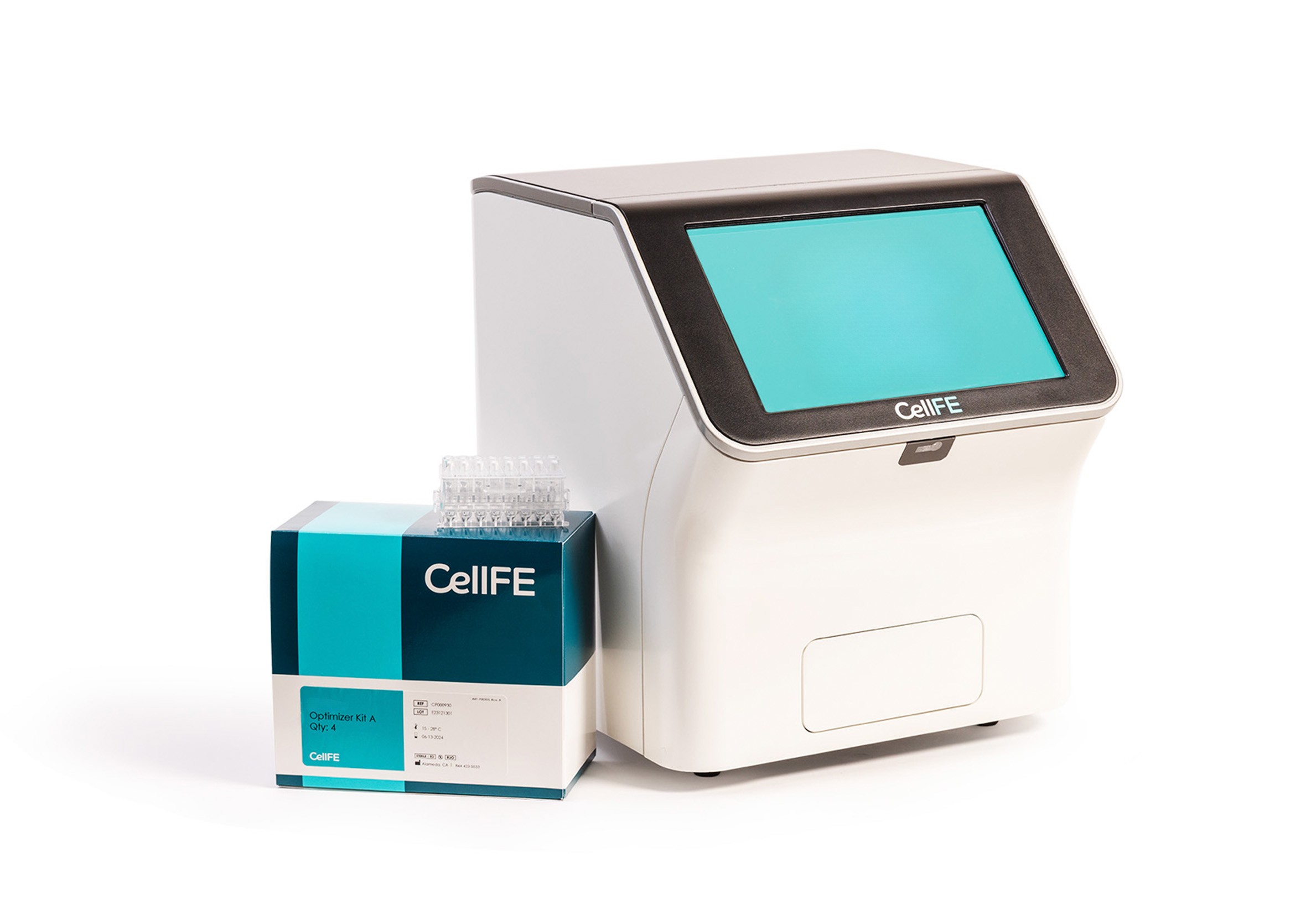
CellFE's flagship is the Ryva Mechanoporation System - a benchtop instrument that fits inside a standard biosafety cabinet, runs from a touchscreen, and processes up to eight samples at a time. The intelligence lives in the consumable: single-use microfluidic chips called PUPs (Processing Units). One version lets researchers tune the ridge geometry to dial in a new protocol; the other is a fixed chip for workflows that are already locked down.
Ryva System
Benchtop mechanoporation platform. Squeezes cells through a microfluidic chip in under 10 ms, up to 8 samples per run, with run tracking and a touchscreen interface.
Ryva PUPs
Single-use processing chips. The Optimizer tunes ridge-gap size for new protocols; the Standard runs established ones. Each handles up to ~2 million cells.
High Volume Cyva
Clinical and manufacturing-scale platform for larger-volume, cGMP-oriented workflows - the bridge from bench to production floor.
T-Rest Kit
First-in-class media for editing resting (non-activated) T cells, reporting over 80% CRISPR-RNP efficiency while preserving the cells' stemness.
The T-Rest kit is the tell. Most platforms can only edit T cells after activating them - a step that pushes the cells toward exhaustion and away from the long-lived, "young" state that makes for durable therapies. Editing resting T cells, gently, keeps them closer to that ideal. It is a small-sounding capability that points straight at the off-the-shelf, allogeneic therapies the whole field is chasing.
Money, partners, and a number worth squinting at
Investors with biology fluency have lined up. CellFE raised roughly $8 million in seed funding in 2020, then a $22 million Series A in September 2023 led by M Ventures - the venture arm of Merck KGaA - with GreatPoint Ventures, Riverine Ventures, Khosla Ventures and others joining. Total disclosed funding sits around $26.8 million. When the corporate VC of a global life-sciences company writes the lead check, it is usually because they have seen the data and the customer list, not just the deck.
Funding by round
Disclosed financing, USD millions - the line goes up, which is the only direction investors enjoy
The partnerships tell a parallel story. In 2025 alone, CellFE signed three. With Germany's DKFZ cancer research center and TcellTech, it paired its squeeze with a non-viral DNA vector platform to engineer cells while sidestepping CRISPR's off-target risk. With Syenex, it built a hybrid workflow blending non-viral and viral delivery. With the CDMO Made Scientific, it began generating pilot data on the larger Cyva system - the step that takes a clever bench tool toward real manufacturing scale.
One honest caveat: this is still an early commercial company. Revenue is not disclosed, the team numbers around twenty, and some third-party trackers disagree on the exact funding total. The proof here is directional - serious backers, name-brand collaborators, a product that ships - not a decade of audited blockbuster sales. Skeptics are right to keep one eyebrow raised. The interesting part is how few reasons CellFE has given them to lower it.
The MissionEveryone, eventually
CellFE's stated mission is to create a future where all patients benefit from the curative potential of cell therapies. The operative word is "all." Today these treatments can run into the hundreds of thousands of dollars and take weeks to manufacture, which keeps them rare. Manufacturing is where the cost and the wait live. Make that step gentler, faster, and more reproducible, and the math behind every downstream therapy shifts.
That is the company's real product, underneath the chips and the instruments: a smaller bill and a shorter wait for a kind of medicine that currently treats very few people. Sell enough shovels and the gold gets cheaper for everyone.
Why It Matters TomorrowThe next cures depend on how, not just whether
For years, the cell therapy conversation was about whether a given edit was even possible. That war is mostly won. The next one is about how - how cheaply, how reproducibly, how gently, how fast. That is a manufacturing question, and manufacturing questions are won by the companies that own the tools. CellFE is betting the deciding factor will not be the cleverest edit but the healthiest cell that survives it.
Back in that Alameda biosafety cabinet, the vial of T cells finishes its pass through the chip. A few years ago, getting an edit into those cells meant a virus and a long wait, or a jolt of electricity and a pile of casualties. Now it is a squeeze, a snap, and a cell that keeps going - carrying its new instructions, still alive, still itself. CellFE did not invent cell therapy. It is trying to make the part nobody talks about - the making - quiet enough that the rest of medicine can finally get loud.