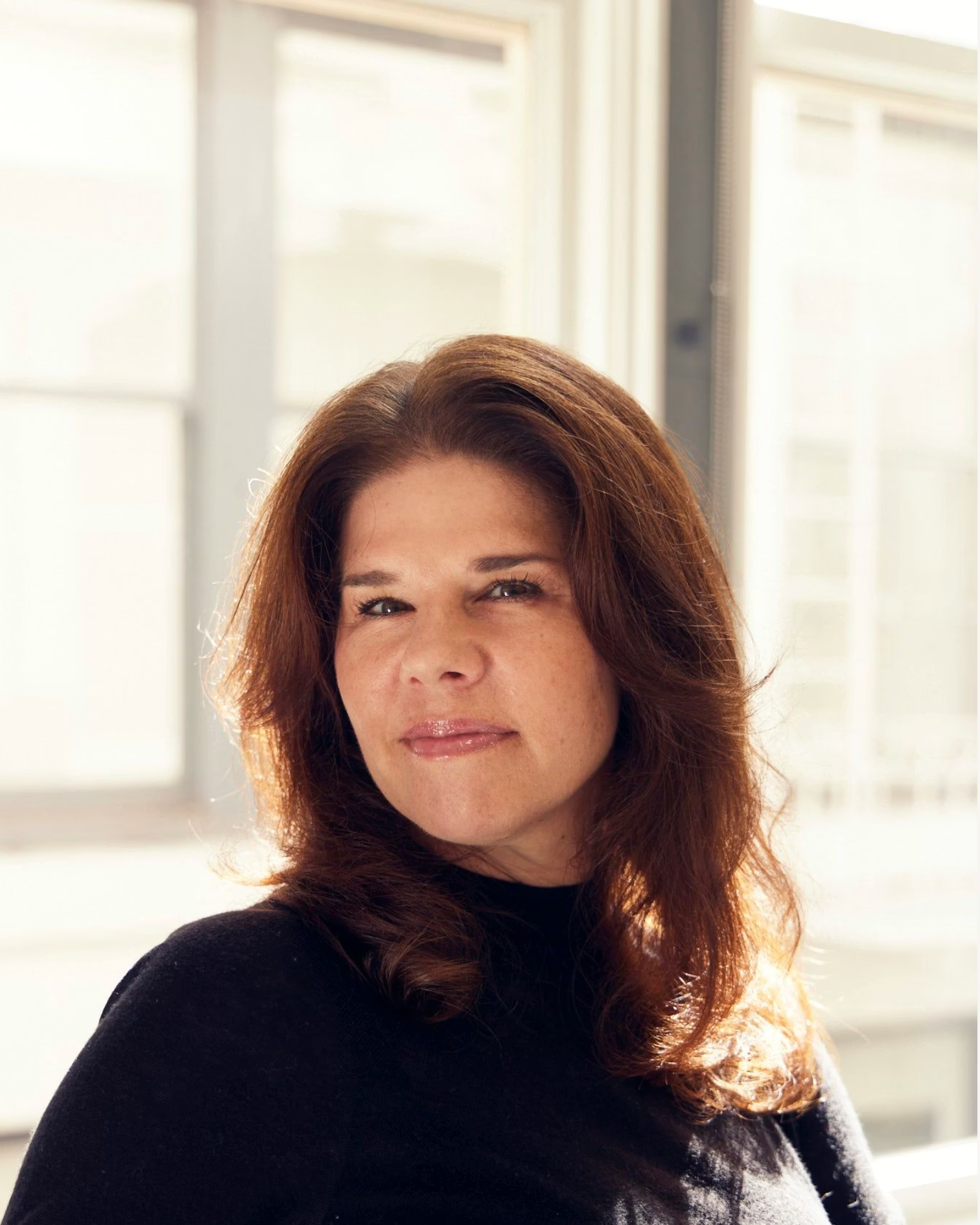
It Started With A Phone Call From Sam Altman
2006. Sam Altman was building Loopt, a location-based social app that would eventually get acquired. He needed legal help and called Carolynn Levy at Wilson Sonsini Goodrich & Rosati, where she'd been representing Silicon Valley startups for years. A few months later, Altman made an introduction that would change the trajectory of early-stage venture capital.
He connected Levy to Paul Graham and Jessica Livingston, who were running this thing called Y Combinator out of an office in Mountain View. She started working as their outside counsel. They loved her work. She loved what they were building. For six years, she remained at Wilson Sonsini while helping YC companies navigate formation, funding rounds, and the messy legal bits that founders hate dealing with.
Then in 2012, YC made an announcement: Carolynn was joining as a partner. They'd been trying to recruit her for years. She finally said yes.
The Problem Was Philosophical
Paul Graham had a habit of giving Carolynn challenges. "Clevy," he'd say (she goes by the nickname among YC partners), "we need to fix early-stage financing. If we do that, it will do wonders for the ecosystem."
The problem wasn't just practical. It was philosophical. Convertible notes were debt instruments - they had interest rates, maturity dates, and all the complexity that comes with lending money. But venture capital was fundamentally about equity, not debt. Why were early-stage startups using a financial instrument that didn't align with the nature of the relationship?
Winter 2013. YC's San Francisco office. Levy sat down to write something different. She worked with her husband Jon Levy (also a YC partner focused on legal), Kirsty Nathoo (YC's first employee and now CFO), and others. They parsed through convertible notes, identified what was essential, and stripped out everything else.
Five pages. That's what emerged. No interest. No maturity date. No complex legal overhead. Just a simple agreement for future equity - SAFE. (Kirsty came up with the name. Carolynn wrote the document.)
Then It Went Viral
YC's winter 2014 batch was the first to use SAFEs. Companies like Flexport and Cruise were in that batch. The document worked. Founders loved it. Investors adapted. Other accelerators started using it. Law firms began recommending it. The SAFE spread through Silicon Valley like a meme that actually made sense.
By 2018, Levy led the team that developed the post-money SAFE variant to address ownership tracking concerns. By 2024, 87% of all SAFEs issued were post-money versions. The evolution continued.
The numbers tell the story better than adjectives: In Q1 2025, SAFEs comprised 90% of all pre-seed deals on Carta. At the seed stage, 64% of all rounds and 86% of rounds under $500K used SAFEs. Since 2020, companies on Carta signed 101,865 individual SAFEs and convertible notes totaling $14.5 billion in capital.
When asked about the SAFE's unexpected dominance, Levy admitted: "I guess it was foolish of me not to think it would be so big."
The Journey
Joined Wilson Sonsini Goodrich & Rosati as a corporate and securities lawyer. Spent over a decade representing Silicon Valley startups and investors, building deep expertise in formation, funding, and securities law.
Sam Altman called about Loopt. The introduction to Paul Graham and Jessica Livingston followed. Started serving as YC's outside counsel while still at Wilson Sonsini.
Joined Y Combinator as in-house counsel and Partner. YC announced the hire on June 18: "We'd been trying to recruit her for a while and we're delighted she finally said yes."
Created the SAFE at YC's San Francisco office. Collaborated with Jon Levy, Kirsty Nathoo, and others to replace convertible notes with a simpler, founder-friendly alternative.
SAFE first implemented in YC's winter batch. Companies like Flexport and Cruise used the new instrument. The revolution began quietly.
Led team that developed the post-money SAFE variant to address ownership tracking and dilution concerns. Another iteration, another improvement.
SAFE reaches 90% adoption rate in pre-seed deals. Post-money SAFEs account for 87% of all SAFEs issued. The document has become the default.
Continues as Managing Director of Legal at YC, leading a team of seven lawyers handling everything from entity formation to founder breakups. Still working alongside Jessica Livingston after almost 20 years.
How She Thinks About Startups
On Legal Documents
"It's just SAFE and it's not a note." She insists on the terminology. Words matter. The SAFE isn't a convertible note. It's equity from the start. That distinction is the whole point.
On Investor Relations
"Communication with investors has always been important because this is fundamentally about a relationship. Investors are giving you money and you are being expected to turn it into a billion dollar business. Whether or not you are succeeding or failing, it's critical to communicate."
On Firing Fast
"Fire quickly. Don't let a bad employee linger. It's so easy to put off a difficult conversation, but there is only downside to procrastination." Direct. Practical. The kind of advice lawyers rarely give.
On Advice Quality
"There are so many people who want to give advice to startups, and so few people who actually give good advice." She knows the difference between noise and signal.
The Foundation
Education
- BA in Political Science, UCLA
- JD, University of San Francisco School of Law
- Member, State Bar of California
Current Role
- Managing Director of Legal, Y Combinator
- Partner, Y Combinator
- Leads team of seven lawyers
- Handles formation to founder breakups
The Team Behind The Success
Carolynn doesn't work alone. She's part of a legendary group that built Y Combinator into the world's most successful startup accelerator.
Jessica Livingston
YC co-founder and author of Founders at Work. Known as "The Social Radar" among partners. She and Carolynn have worked together for almost 20 years, helping thousands of startups. The partnership that keeps YC grounded.
Jon Levy
Carolynn's husband and fellow YC partner. Previously at Wilson Sonsini and ran ThinkEquity's private placement department. Together, they've shaped legal strategy for the world's top accelerator. A true power couple in startup law.
Kirsty Nathoo
YC's first employee and CFO. Instrumental in naming the SAFE. Works closely with Carolynn on financial and legal fundamentals. The partnership that makes complex things simple for founders.
The Details That Matter
The Nickname
Paul Graham calls her "Clevy" - a combination of her first initial and last name. It stuck among YC partners.
The Home Office
She wrote the SAFE from her earth-toned California home. Five pages that would reshape an industry, created in a comfortable space.
The Document Length
Intentionally kept the SAFE to five pages. Simplicity was the feature, not a constraint. Every lawyer knows making something shorter is harder than making it longer.
The First Adopters
YC's winter 2014 batch included Flexport and Cruise - both went on to become unicorns. The SAFE's first test subjects validated the approach.
The Scale
101,865 SAFEs signed on Carta since 2020. Each one a testament to the document's effectiveness. Each one a founder who didn't have to wade through convertible note complexity.
The Evolution
From convertible notes (debt) to SAFEs (equity). From pre-money to post-money variants. The document keeps evolving based on real founder needs, not legal theory.
The Ripple Effect
What happens when you make something dramatically simpler? It gets adopted. Fast.
Before the SAFE, founders spent thousands on legal fees negotiating convertible notes. Interest rates, maturity dates, conversion mechanics - each term a potential point of friction. The SAFE eliminated most of that. Not by adding complexity, but by removing it.
The impact extends beyond just adoption rates. By making early-stage funding simpler, Levy lowered the barrier to entrepreneurship itself. Founders in markets where legal costs are prohibitive could suddenly raise capital without hemorrhaging money on legal fees. International founders could understand the terms without a Silicon Valley lawyer on retainer.
This is what innovation in law looks like - not adding features, but removing friction. Not writing longer documents, but shorter ones. Not optimizing for lawyers, but for founders.
What She's Doing Now
As Managing Director of Legal at Y Combinator, Levy leads a team of seven lawyers handling the full spectrum of startup legal issues. Entity formation. Investment paperwork. Founder breakups. Brand protection. The messy human problems that emerge when people build companies together.
She appeared on the "Law, disrupted" podcast in October 2025, discussing the evolution of legal work in the startup ecosystem. She continues to lecture at Stanford and other universities on startup legal mechanics. She's still working closely with Jessica Livingston, Kirsty Nathoo, and the YC partner team to support batch after batch of founders.
The SAFE continues to evolve. New variants emerge based on real-world usage. The post-money SAFE solved ownership tracking issues. Future iterations will solve problems we haven't identified yet. That's the beauty of treating legal documents like products - they improve based on user feedback.