An empty theater is a remarkably expensive place to keep the lights off. Bud Mayo has spent much of his working life considering what else might happen there. A concert. An opera. A football game. Perhaps even a film whose audience can help decide what happens next. For an executive who helped bring digital projection into American cinemas, the machinery was always an invitation to improve the evening.
His career has crossed computer sales, equipment leasing, Wall Street and suburban movie houses. The connecting interest is practical: how do you get a promising idea into a room where people will actually pay to experience it? Mayo’s answer has involved acquiring theaters, raising capital, arranging distribution and repeatedly starting companies. The popcorn has had an unusually elaborate support system.
Before the movies, the machines
Mayo graduated from New York University’s business school in 1964 and began selling computers at IBM in 1965. He later co-founded more than a dozen computer services businesses and worked in corporate finance on Wall Street. In 1976 he founded Clearview Leasing, which leased computer peripherals and telecommunications equipment. The work gave him a professional acquaintance with expensive hardware and the question of who should pay for it.
That background would become useful in exhibition, an industry in which an improved picture can come with a deeply unromantic invoice. Mayo had experience with both the equipment and the financing. He would eventually add the seats, the screens and the people choosing what appeared on them.
Clearview Cinema Group began in 1994. Mayo helped build it into a circuit with almost 300 screens at 65 locations by the time he left its Cablevision successor in January 2000. The holdings included New York’s Ziegfeld Theatre, a rather grand addition to the résumé of a former computer salesman. Clearview went public in 1997; Cablevision bought it for $160 million in 1998.
A new projector needed a business plan
In 2000, Mayo co-founded Access Integrated Technologies, later known as Cinedigm. Here, the theater operator’s experience met the technology entrepreneur’s appetite. The company worked on the software, delivery systems and financial arrangements required to move cinemas from film prints to digital presentation. During his leadership it completed an initial public offering in 2003 and raised more than $600 million in financing.
The difficulty was easy to understand. Digital distribution could spare studios the cost of manufacturing and transporting film prints. Theater owners, meanwhile, faced the bill for new projection equipment. A benefit on one company’s balance sheet does not automatically purchase a machine for another company. Somebody had to connect the savings to the investment.
Cinedigm helped develop and deploy the virtual print fee model. Distributors paid fees associated with digital bookings, helping support the cost of the conversion. Integrators organized the arrangements between studios, lenders, equipment suppliers and exhibitors. A projection upgrade became a coordinated commercial undertaking, with contracts as necessary as cables.
A simplified view of the financing mechanism, rather than the terms of every contract.
The scale was already visible in AccessIT’s 2007 annual report, which described more than 2,700 digital cinema systems deployed. It also described satellite delivery tests for live events and plans for concert programming. The conversion and the programming were developing together. Once a theater could receive different kinds of digital content, its calendar could become more adventurous.
Mayo’s early work also mattered to operators outside the biggest chains. A 2022 industry discussion recalled the Cinema Buying Group’s role in helping independent exhibitors negotiate the transition. Participants described financing difficulties and the need to make arrangements work for smaller businesses. Changing an industry requires dealing with its awkward corners, including towns and theaters that do not fit a tidy national spreadsheet.
What do you put on next?
Theater economics supplied Mayo with a persistent question: what should happen between the busy weekend shows? In 2008 he was publicly arguing that more programming choice could help fill quieter weekday periods. An auditorium costs money to own even when nobody is buying a ticket. Its availability is both a problem and an opening.
In January 2009, Mayo and Mark Cuban discussed live 3D entertainment together in an interview. That month, Cinedigm participated in the live 3D cinema presentation of the Florida-Oklahoma BCS championship game, alongside partners including Fox Sports, Sony and 3ality Digital. Football gave the projection system a job beyond playing a feature film.
There was a social proposition in these experiments, too. A large screen gives an event scale; an audience gives it company. A theater could gather viewers around a shared interest without requiring that interest to be the latest Hollywood release. Mayo’s programming ambitions made room for audiences whose preferred night out might involve ballet shoes, a microphone or a scoreboard.
He retired from his Cinedigm leadership roles in June 2010. The company’s subsequent history continued without him: in May 2023, it adopted the name Cineverse and emphasized its streaming content and technology businesses. His connection to today’s company begins with its founding chapter. His own next act had already opened elsewhere.
Retirement, followed by another opening
Digital Cinema Destinations was founded in July 2010, with Mayo as chairman and chief executive. Its operating brand, Digiplex Destinations, made his programming ideas part of a theater business he could run. The timing gives his retirement a certain comic economy. June supplied the exit; July supplied another entrance.
Digiplex paired conventional film releases with other attractions. A 2011 agreement brought its theaters into National CineMedia’s advertising and Fathom Events networks. That relationship gave the circuit access to event programming as it pursued acquisitions. By June 2012, its 73-screen circuit was entirely digital, following the installation of 54 Barco projectors in acquired Pennsylvania auditoriums.
There was also an opening for filmmakers outside the usual release machinery. Digiplex partnered with Nehst on DigiNext, an in-venue film festival venture intended to bring selected films to local audiences. Screenings could include live or online conversations with filmmakers. The appeal was straightforward: viewers could encounter a film and its creators without buying a plane ticket to a festival.
By December 2013, Digiplex reported 20 cinemas and 192 screens across six states. When Carmike announced its agreement to acquire the company in May 2014, the operating count had reached 21 locations and 206 screens. The transaction was structured as a stock exchange. Mayo’s experiment in programming had acquired a physical footprint large enough to interest another exhibitor.
The audience gets a vote
At Carmike, Mayo became president of alternative programming and distribution. His next experiment asked whether the people in the seats could do more than watch. As founding chair and a financial backer of the Vista Project, he supported a student competition in interactive cinema with SMPTE and technology partner TimePlay.
Students were invited to imagine stories with interaction through a phone or tablet. The films could give an audience a part in the unfolding action. It was a curious reversal of auditorium etiquette: the small screen, so often the enemy of everyone sitting behind it, became part of the planned experience.
In 2017, Shane Murphy’s Sirens won the competition’s $5,000 grand prize, with Jon Navarro’s The Republican the runner-up. The finalists’ work was shown during CinemaCon week in Las Vegas. For Mayo, the digital theater remained a place to test a new relationship between storytelling and its customers.
A ribbon, a stage and a little clay
His interest in gathering audiences extends to live performance. Mayo’s involvement with Morristown’s performing arts center dates to 1994, and he became its chairman emeritus. In 2014, he joined chairman Joseph M. Goryeb and president and CEO Allison Larena at a ribbon cutting celebrating the center’s renovated front-of-house spaces and twentieth anniversary.
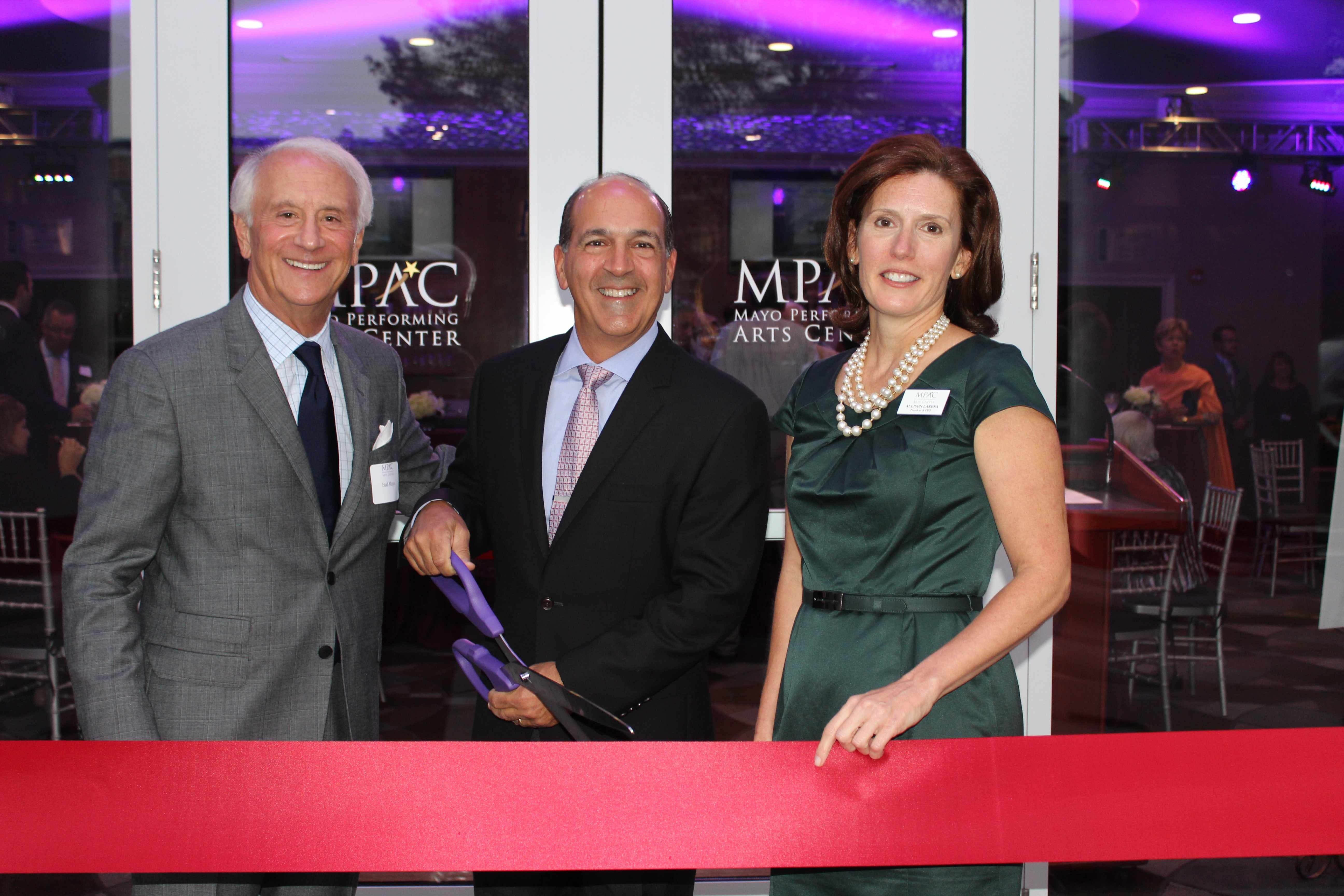
The renovations included a digital marquee, an expanded lobby and improvements to the box office and other visitor facilities. The work cost more than $2 million. These are the details that sit between an artistic ambition and a pleasant evening: getting through the door, finding one’s way and having somewhere to meet before the performance.
In 2017, Mayo joined Chuck Goldwater, Brett Marks and investment partner The Beekman Group in launching New Vision Theatres. Its initial circuit contained 184 screens at 16 theaters in nine states. Food and drink, improved seating and event programming were central to the plan. Familiar colleagues had returned to a familiar question about making the visit worth the trip.
Goldwater offered a more intimate glimpse of that working relationship. When Mayo rescheduled a business call around a weekend workshop, Goldwater assumed the workshop concerned executive duties. It turned out to be clay sculpture. Mayo’s explanation was brief: “You have to take time to feed the soul, too.” A calendar with room for an acquisition could apparently spare a little room for clay.
“You have to take time to feed the soul, too.”Bud Mayo, recalled by Chuck Goldwater
That small scene belongs beside the financing and the screens. Across his businesses and arts work, Mayo kept returning to the places where people assemble to enjoy something together. The projector could change. The program could change. There would still be the matter of giving the audience a reason to come through the door.