She reads a blood test the way a painter reads light - in color. One drop, a paper card, a phone camera, and twenty minutes instead of days.
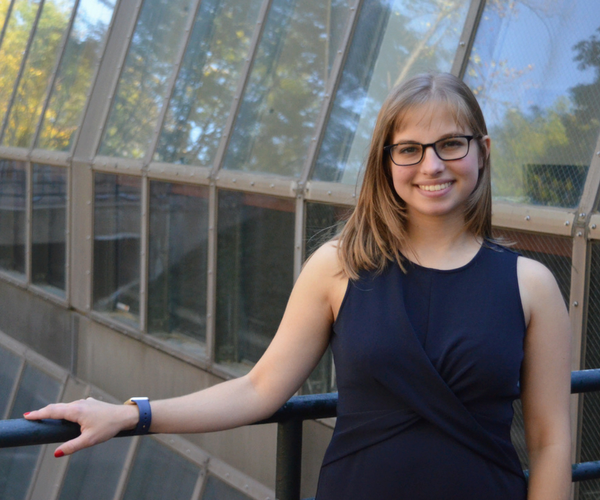
The engineer in her element on Penn's campus. She built the first device in a student MakerSpace and never quite left the bench.
Today Brianna Wronko-Stevens runs the science at HueDx, the Philadelphia company she started in 2017 as a Penn senior with a stubborn idea: that a real, lab-grade diagnostic test should not require a lab. HueDx sells two things with deceptively friendly names - the HueCard, a colorimetric test you can run anywhere, and HueCloud, the software that turns an ordinary smartphone camera into the reader. Drop on the sample, wait, photograph it. The phone does the math and hands back a number a clinician can trust.
That last part is the quiet radical bit. Most rapid tests give you a yes or a no. Hers are built to give you a quantity - the kind of measurement that usually demands an analyzer the size of a microwave and a technician to run it. She took the analyzer out of the picture and put the intelligence in the camera you already own.
In 2023 she did something founders rarely do gracefully. With the company maturing, she brought in an experienced operator, Dr. Mark A. Wingertzahn, as CEO, renamed the company from the placeholder it had carried for years, and stepped sideways into the Chief Scientific Officer seat. Less stage, more bench. For an engineer who got into this to build, that was the point all along.
She was seventeen, interning at a Philadelphia HIV clinic. A pregnant woman, HIV-positive, gave blood. The results came back days later and said her medication needed to change to keep the virus from reaching her unborn child.
The clinic could not reach her. She did not come back for six months. By then the window had closed.
Wronko-Stevens never framed this as a tragedy to be narrated. She framed it as an engineering specification. The problem was not the medicine or the science - both existed. The problem was the gap between the blood draw and the answer, measured in days the patient did not have. Close that gap and you change the outcome. That single observation is the load-bearing wall under everything she has built since.
Homeschooled through high school - self-directed long before it was a startup cliche.
B.S.E. in Bioengineering, University of Pennsylvania, with a focus on lab-on-a-chip microfluidics and device engineering.
A single pinprick of blood, serum or urine goes onto the HueCard - no venous draw, no vial, no courier to a central lab.
Chemistry on the card reacts and shifts color. The deeper truth of her work: a hue is not decoration, it is the measurement itself.
HueCloud photographs the card, normalizes for lighting, and converts color into a quantitative result in about twenty minutes.
Here is a detail that tells you everything about how she works. The company's first name, Group K Diagnostics, was not a brand. It was the label of her senior design team at Penn. She shipped it as a placeholder and got on with the science - the early tagline was, in earnest, we're looking for a catchier name.
It stuck for years. The company raised over two million dollars, ran clinical work at Penn Medicine, and got named to lists of Philadelphia's most promising startups, all while wearing a name that started life as a roster slot. When the rebrand finally came in 2023, she chose HueDx - built on the word hue, because color is the engine of the whole platform. A founder who waited to rename her company until the name could mean something is a founder who cares more about the work than the wrapper.
The KromaHealth and MultiDiagnostic platforms she developed along the way were aimed at a startling target: eventually running dozens of routine blood tests off the same simple format, shrinking a diagnostic menu that normally fills a hospital lab down to something you could hold in one hand.
Before HueDx had a name worth keeping, it had a method. Wronko-Stevens trained as a nanofabrication and device engineer, and her academic work lived in lab-on-a-chip microfluidics - the discipline of moving tiny volumes of fluid through channels thinner than a hair to make a sample do a lab's worth of work on its own. That is the engineering grammar underneath the friendly HueCard. The card looks simple on purpose. The simplicity is the achievement.
She built the first version of the device in Penn's Bio-MakerSpace, the kind of student workshop where most projects end at the demo and the grade. Hers did not end. By the time she was a few years out of school she had assembled a small team that spanned software, chemistry, business, and microfluidic engineering - the four corners you need to turn a clever card into a regulated medical product. Early clinical work for liver function testing ran through Penn Medicine, and the company started collecting the unglamorous, essential evidence that separates a real diagnostic from a science-fair trick.
What sets her apart from the founder archetype is temperament. She talks like an engineer, not an evangelist. The pitch is not that technology will save the world; it is that a specific, measurable delay between a blood draw and an answer costs specific people specific outcomes, and that delay can be designed away. Seven years of research experience taught her to be suspicious of stagnant brilliance - science that wins papers and never reaches a patient. Getting the work out of the lab was not a slogan. It was the job.
Strip away the chemistry and the cap table and you are left with a simple conviction: a test result should reach the people who can least afford to wait. Underserved clinics. Crisis settings. A bedside instead of a central lab two cities away.
When she pivoted HueDx toward selling the HueCard and HueCloud to other companies developing their own assays, she was not abandoning that mission - she was scaling it. Hand the platform to a hundred assay developers and the reach multiplies past anything one startup could build alone. The placeholder kid from a Penn MakerSpace turned her own tools into other people's foundation.
It is a Philadelphia story as much as a personal one. She built the company in a city that does not get cast as a biotech capital, raised money from people who started as skeptics, and earned a row of local honors - a Woman of Distinction nod, a top-pitch trophy, a seat on the Philadelphia Startup Leaders board - before she was thirty. The throughline is not luck or pedigree. It is a refusal to accept that a diagnosis has to live inside a building most patients will never enter.
Her diagnostics turn the smartphone camera into the reader - the most expensive piece of lab hardware is the one already in your pocket.
"Hue" isn't branding fluff - the platform literally converts color change into a number.
The entire company traces to one afternoon she witnessed at seventeen.
Homeschooled, then a Penn bioengineer, then a founder - she never took the linear route.
Sources: Technical.ly (rebrand) · Wharton · Penn Bioengineering Blog · Medgadget · citybiz · Crunchbase