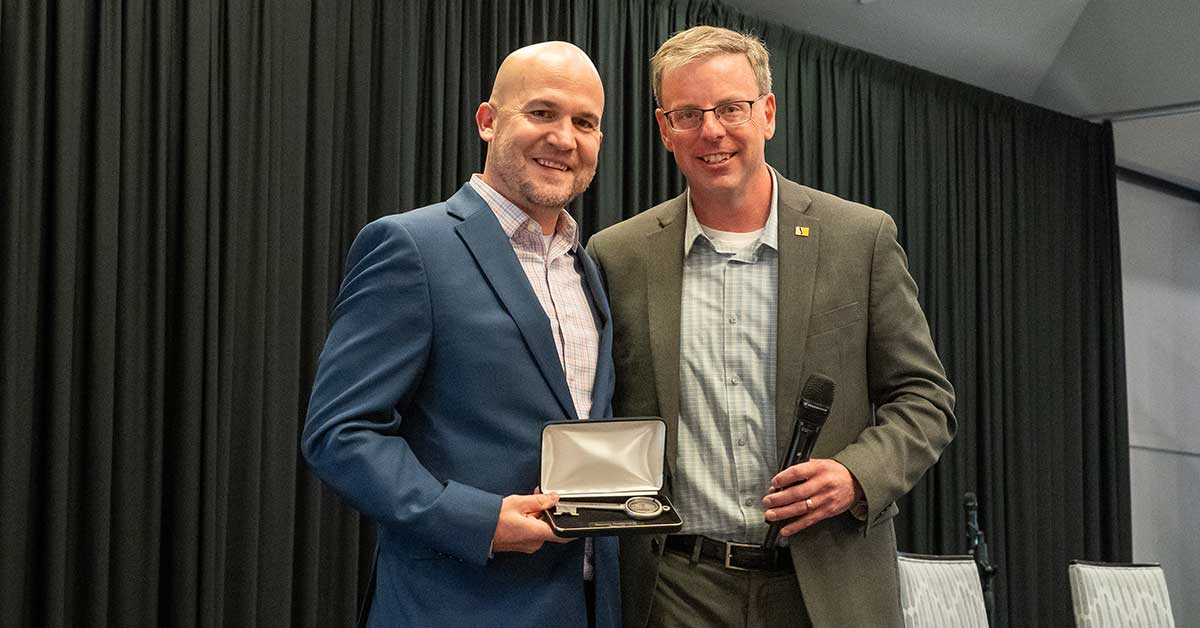
A key to a city is a pleasing object for a finance executive to receive. It opens no obvious door, depreciates according to no useful schedule, and nevertheless means rather a lot. On October 6, 2026, Brian Liddell accepted one from South Bend Mayor James Mueller on behalf of Harmony Healthcare IT. The company was celebrating twenty years. Liddell, its CEO since April, had spent much of that history helping build the business.
The presentation took place at the Gillespie Conference & Special Event Center in South Bend. Here was a company milestone with a municipal audience, and an executive whose new title rested on a long acquaintance with the work. Liddell put the emphasis on the people beside him.
“This milestone belongs to our people.”
Brian Liddell, October 2026
There is a useful way into his story in that sentence. Finance supplies plenty of numbers with which to describe a company. Liddell keeps finding reasons to talk about the people who make those numbers possible.
The local connection has practical expressions. Harmony offers employees paid time to volunteer and supports community initiatives including the Christ Child Society of South Bend. Many of its employees live in the area. These are ordinary ways for a business to participate in a place, repeated outside the anniversary photographs. They give substance to the idea of calling a city home. A company’s contribution can be measured in jobs, but also in the time its people are able to give to their neighbors.
A long apprenticeship inside his own business
Liddell is a founding partner of Harmony Healthcare IT. His company biography places his involvement in 2005; the business marks its founding in 2006. By the time the twentieth anniversary arrived, he had accumulated experience across finance, operations, and technology. The eventual CEO appointment came with considerable institutional memory attached.
His formal preparation included Indiana University’s Kelley School of Business. His degree was in marketing and management. The combination suits a career that would require both an understanding of customers and attention to how an organization actually runs. His LinkedIn education dates run from 1997 to 2001, with Beta Theta Pi among his activities.
Before Harmony, he worked as an account manager at CDW. That early technology sales experience sits at the beginning of a professional record that later became heavily concerned with budgets, purchasing, and operational decisions. It also places customers in the picture before the executive titles begin to accumulate.
The titles can make a career look tidier than the work itself. A founding partner has to help establish what a business will sell, how it will deliver, and what it can afford. In Liddell’s case, the public record includes the practical responsibilities that turn an idea into an organization with a working day.
The pleasures of a sensible spreadsheet
His LinkedIn list of specialties has an almost defiant lack of glitter: purchasing, personal finance, budgeting, team motivation, cost control. Anyone seeking an extravagant corporate slogan will have to look elsewhere. These are activities that reveal their importance when they are neglected.
Two public recommendations add texture to the list. Rick Adams describes a colleague with energy, high standards, and dedication to customers. David St. Clair, owner of Hoosier Landscapes, credits Liddell with improving financial organization, cash management, and leadership. Both accounts concern the effect of his work on other people’s businesses.
At Harmony, his responsibilities have included daily operations, forecasting, risk management, and human resources. That last item belongs naturally alongside the financial ones. A forecast describes what an organization expects to do; people must then do it. Managing the connection requires a wider field of vision than a balance sheet alone provides.
His experience also extends into investing. He founded OTS Capital and serves as managing partner of LFJPINV LLC, supporting growth-stage companies through passive minority investments. Those roles add another perspective on the familiar business questions of resources, timing, and the capacity to grow.
Plan the resourcesOperate
Deliver the workInvest
Prepare what follows
A schematic of Liddell’s documented responsibilities, rather than a numerical performance chart.
A promotion with more work attached
In July 2025, Harmony promoted Liddell to president and chief financial officer. The announcement described a broader brief: daily operations, strategic direction, improvements to the customer experience, and greater operational efficiency. The financial title remained. The operating remit expanded.
Tom Liddell, then CEO, credited Brian’s contribution to the company’s growth and fiscal discipline. The promotion expressed confidence from the team and board in his ability to take on more responsibility. It was an intermediate step with substance, rather than merely another line beneath a name.
Brian’s response emphasized technology, service, and data integrity. Those priorities connect the internal and external parts of the job. A company can organize itself elegantly and still disappoint the customer. Operational decisions earn their keep when they improve what the customer receives.
The progression also makes the later succession easier to understand. Before being asked to lead the whole company as CEO, he had been given a role explicitly concerned with how the whole company worked. The president’s office offered a wider view of responsibilities he already knew from the financial side.
The handover, without a disappearing act
Liddell became CEO effective April 30, 2026. Tom Liddell continued as chairman of the board, with an ongoing role in strategic guidance. The arrangement gave the company a new chief executive while retaining the experience of its founder in its governance.
Novacap, the company’s majority investor, described the handover as a deliberate succession plan. Its partner David Brassard emphasized the depth of leadership and planning behind the transition. Brian’s years as a financial and operational leader were central to the logic of the appointment.
The shared surname makes the announcement easy to remember. The documented working history explains why it matters. Brian had been involved in the company’s direction and operations well before the CEO title arrived, and the transition placed that experience at the center of the next phase.
For an executive accustomed to forecasting, succession is a particularly consequential form of preparation. The job changes, but the obligations survive the ceremony: customers still expect delivery, employees still need direction, and plans still need resources. April’s announcement put a new name against those continuing responsibilities.
The customer gets a calculation
Liddell’s public conversation with marketing executive Erik Johnson on the HealthData Talks podcast gives a more conversational view of his financial thinking. He describes involvement in early planning, market research, budgets, and customer discussions stretching from proof of concept to delivery.
When the conversation turns to return on investment, his emphasis is consultative. The work starts with understanding what a prospective customer already has and what it costs to keep it running. He describes upfront evaluation before a deal is signed, allowing an organization to examine the financial case while it is still exploring its options.
That is a revealing setting for a CFO: across the table from the customer, working through a decision. A spreadsheet can function as a shared language. Costs, resources, and the expected return give both parties something specific to discuss.
He also talks about wanting the business to anticipate customers’ future requirements. The aspiration makes the financial discipline more interesting. Today’s operating decisions have to leave room for tomorrow’s work. A budget is, among other things, a statement about which future a company is prepared to fund.
Jerry Maguire enters the accounts department
Asked in October 2026 about a film that inspired him, Liddell chose Jerry Maguire. His lesson was “People over profits.” He explained that ethical decisions, value for customers, and care for the team create the conditions in which growth can follow.
It is a personal reference that brings a little cinema into an otherwise practical career. The finance executive’s choice concerns loyalty and how people are treated. Commercial ambition remains in the picture; his explanation ties it to the way a business behaves.
There are less formal pleasures, too. Liddell’s biography describes him attending concerts and major sporting events around the country. The leadership directory adds skiing. Spreadsheets may occupy the working hours, but apparently they do not enjoy exclusive rights to the calendar.
A company old enough to look ahead
By June 2026, Harmony was publicly marking its twentieth year. Liddell’s anniversary message emphasized continued adaptation, expanded expertise, and investment in what customers would need next. The occasion invited recollection; his remarks kept turning toward preparation.
The company’s stated priorities included technology, security, service, automation, and improvements to the user experience. For Liddell, those subjects now sit within the CEO’s remit. They connect his earlier financial responsibilities with decisions about where the organization directs its effort.
He is also sharing that work with an established leadership team. In October 2025, when Sharon Cook was named chief revenue officer, Liddell highlighted her experience building teams and customer relationships. The appointment placed another experienced executive alongside the company’s operating and technical leaders.
The leadership directory puts names against the shared responsibilities: James E. Hammer as chief operating officer, Sharon Cook as chief revenue officer, and Matthew Cook as chief technology officer. The structure gives a concrete counterpart to Liddell’s frequent references to the team. Running the company involves several kinds of expertise, with different executives responsible for putting them to work.
His comments about Cook emphasized responsible growth and execution. Those are consistent with the habits visible elsewhere in his record: understand the customer, organize the work, and consider the resources required to deliver it. Leadership has room for ambition, but someone must still make the arrangements.
Then came October’s key, a small object with a large local meaning. Liddell had a new office to occupy and a third decade of company history ahead. South Bend supplied a handsome reminder that the business had already become part of other people’s lives.