The useful thing about a courtroom is that it does not care much for management jargon. An argument either holds or it does not. A witness answers the question or circles it. A client lives with the result. Brian L. Duffy built his career in that clarifying environment, then took charge of a global law firm without agreeing to leave it. Since 2016, he has served as chief executive officer of Greenberg Traurig. He also continues to advise companies on litigation, governance, investigations and moments when the ordinary corporate script has gone missing.
Duffy calls himself a working CEO, a phrase that earns its keep in his case. His public record includes more than 200 class actions, multidistrict proceedings involving dozens of claims, and a three-week breach-of-contract trial that ended in a $30 million judgment for an energy client. Greenberg Traurig describes him as counsel to general counsels on boards, shareholder relations and internal investigations. The executive job is an addition to the practice, not a ceremonial replacement for it.
He has explained the arrangement with the economy of a litigator. Remaining “in the arena,” as he put it, keeps a leader aware of how difficult it is to win an assignment, meet expectations and find economics that work for a client. Remove the client work and management risks becoming climate-controlled. The office is comfortable; the information arrives polished; everybody laughs a little too promptly.
“Size is largely immaterial to clients.”Brian L. Duffy on what scale must actually accomplish
The long route to the short answer
Duffy's route into law began in the Plains and settled in Colorado. He graduated summa cum laude from the University of South Dakota in 1988, then earned his law degree from the University of Colorado in 1991. At Colorado, he joined the Order of the Coif and served as notes and comments editor of the law review. A clerkship with U.S. District Judge Jim R. Carrigan followed. The sequence is tidy on paper: undergraduate precision, legal scholarship, a view of advocacy from behind the bench.
The practice that emerged was less tidy, because important disputes rarely are. Duffy worked across class actions, employment, energy, real estate, commercial contracts and product liability. He defended consumer and business claims, coordinated roughly 70 wage-and-hour class actions for a Fortune 50 company, and led proceedings that gathered 35 putative wage cases into one multidistrict fight. In another matter, he represented a pipeline company in a seven-week jury trial. The work demanded both scale and attention to the one fact that might change a verdict.
Selected litigation scale / public record
By 2009, Duffy was chairing Greenberg Traurig's Global Litigation Department, then described as a 600-lawyer operation. He held the job through 2013 and later served as firm president. The promotion to CEO arrived in 2016 as part of a planned leadership succession, with Richard A. Rosenbaum moving to executive chairman. The partnership between the two men would eventually leave the conference room and acquire wheels.
Two executives walk into an RV
In early 2021, after months in which offices had become laptop screens, Rosenbaum proposed an American road trip. The plan was to visit Greenberg Traurig's 30 U.S. offices in a used recreational vehicle, reconnecting with lawyers and professional staff at outdoor gatherings. Duffy's first thought was that Rosenbaum was joking. Neither had any notable RV experience. This was, in fairness, a sound objection. It did not survive.
They named the vehicle Mel on Wheels after firm co-founder Mel Greenberg and set off from Miami on April 10. They planned to drive and mostly live in it. Each office chose music for the route. The Miami arrival came with Will Smith's “Miami” on the speakers and about 180 employees waiting at Tropical Park. The firm paired stops with charitable donations, including food banks, shelters and education groups. A global institution had chosen a very literal way to prove that its people were not merely squares in a video call.
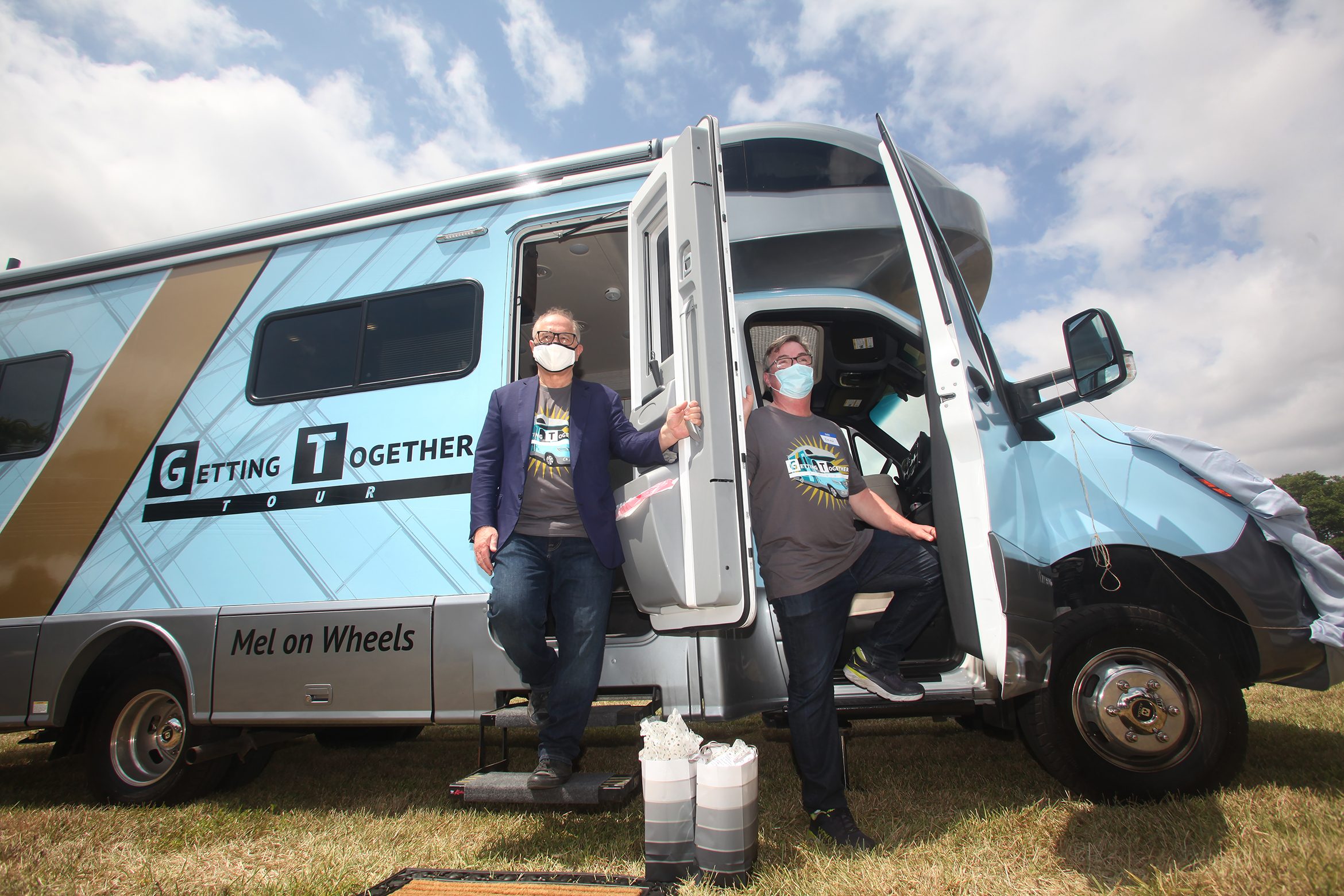
Duffy joked that the RV was much too small, but that even this was part of the fun. The line reveals more than a polished corporate statement could. He presents as practical rather than grand, willing to let an awkward circumstance remain awkward. An executive can commission a culture survey. Duffy and Rosenbaum shared a cramped vehicle and drove to the people whose opinions they wanted to hear.
The trip also clarified Duffy's operating instinct: proximity beats abstraction. Stay near clients by continuing to practice. Stay near colleagues by showing up. Stay near the next generation by giving younger lawyers consequential rooms to enter. He has described a communications forum of younger attorneys that considered many of the same subjects as the executive committee, with attention to gender, race and geography. Its value was not decorative. Different experience produced different ideas.
Growth with a cross-examination
Under Duffy's leadership, Greenberg Traurig has continued to expand. Its official account for fiscal 2025 lists approximately 3,200 lawyers, 2,400 professional staff and 51 locations, with revenue nearing $3 billion. That year marked the firm's fourteenth consecutive record result. In discussing the performance, Duffy pointed to gains across litigation, real estate, corporate and intellectual property, alongside the fact that the firm remained net cash positive.
Yet his older observation about size still hangs over those numbers like a useful cross-examination. What does scale do for a client? His answer is that a firm needs enough expertise and geographic reach to meet a real need. Beyond that, head count is not a virtue in its own right. The distinction keeps growth from becoming its own excuse.
The same test shapes his view of technology. Long before generative AI became compulsory panel chatter, Duffy said the profession should embrace anything that could deliver better service at a better price. It is a notably unromantic standard. A tool need not rescue civilization. It should help a lawyer do the job.
Awards have accumulated around the work. The University of Colorado Law School gave him its alumni award for distinguished achievement in private practice in 2015. The Denver Business Journal named him among its Most Admired CEOs in 2019. His listings include Benchmark Litigation's Litigation Star recognition for 2022 through 2026 and long-running recognition for commercial and employment litigation. They establish standing. They do not explain the style.
Colorado as a global address
Duffy's career has remained rooted in Colorado even as his assignment grew international. He works from Greenberg Traurig's Denver office and lives in Louisville, a smaller city northwest of Denver. The geography offers an appealing contradiction: the head of a 51-location firm is not installed beside the corporate towers of Manhattan, although Greenberg Traurig has plenty of those. His center of gravity remains the state where he studied law, clerked in federal court and developed his practice.
In 2019, Duffy moderated a Denver forum on attracting global business. His questions moved among airport connections, regulation, public transportation, workforce and the habits that make a city credible to companies beyond its borders. The subject suited him. A global organization is built in particular places, each with its own clients, institutions and civic character. Reach matters, but so does the ground beneath an office.
This may help explain why his leadership vocabulary rarely floats very far above daily work. Client service is measured in responsiveness. Talent is developed by responsibility. Culture is maintained through contact. Technology earns approval when it makes delivery better or less expensive. Even the firm's geographic expansion has a functional test: does it give clients the expertise and reach they require?
The formula is portable because it is concrete. It can govern a Denver trial team, a younger-lawyer committee or colleagues spread across Europe, Asia, Latin America and the Middle East. It also gives the CEO a defense against imperial tendencies. Fifty-one offices are not a collection of pins belonging to headquarters. They are places where the work happens.
Responsibility before polish
For that, pro bono work offers a better window. In a 2026 conversation with Caroline Heller, chair of the firm's Global Pro Bono Program, Duffy described volunteer legal work as both an obligation and a privilege. He also treated it as practical education. A young lawyer can receive meaningful responsibility, learn direct client communication and develop confidence more quickly than the usual hierarchy might allow.
The idea connects to his own career. Judgment is not downloaded with a title. It develops through exposure to facts, people and consequences. Pro bono matters can feel intimidating because they may fall outside a lawyer's familiar subject. Duffy's response is not to pretend away the discomfort but to surround the lawyer with support and let the responsibility do its work.
A through-line emerges. The trial lawyer learns by standing up in court. The associate learns by taking responsibility for a client. The CEO learns by remaining close enough to the firm's work that bad news can arrive without an appointment. None of this makes management simple. It makes management harder to fake.
Duffy now leads an organization that spans regions, practices and time zones, but his public language keeps returning to service, talent and culture. In 2015, before taking the CEO title, he said he worked for his partners, whose job was to help the firm's shareholders serve clients. The org chart ran downward from responsibility rather than upward toward privilege.
A decade later, the firm is larger and the legal industry is busy renegotiating its relationship with technology. Duffy's answer remains grounded in the same questions a courtroom imposes. Does the argument work? Is the client served? Are the people closest to the matter being heard? There are flashier theories of leadership. Few come with a seven-week trial, a 30-city road trip and the humility to admit that the vehicle is too small.