Boyd Bailey’s professional history includes a rather good costume change. First he was a television reporter, asking the questions. Later he was an airline marketer, helping a company answer them. In 2020 he founded Reputable, a communications firm whose name makes a promise before anybody has opened the proposal. The work has changed sides of the interview. His interest in the interview has survived.
That is the thread worth following through Bailey’s career. A public relations executive can describe success in placements, campaigns, reach and visibility. Bailey, reflecting on six years of building his firm, returned instead to the machinery of news: the way stories develop, the judgments reporters make, the moment an issue starts attracting wider attention. He sounded like someone who had changed professions without entirely leaving his first one.
There is an appealing complication here. A reporter works toward a story that serves the audience. A communications adviser works for a client who has something at stake in that story. The two interests can meet, but they require care. For Bailey, the point of contact is expertise: connecting someone trying to understand an issue with someone who knows enough to explain it.
The question came first
Bailey’s newsroom experience began before his first full-time reporting job. He has recalled working at a local CBS affiliate while in high school. During college he interned at WFAA-TV in Dallas and later at ABC News with World News Tonight. After Baylor University came reporting at WIBW-TV in Topeka, Kansas. The sequence runs from early exposure to national television and back to the daily work of local news.
His later account of those years is useful because it identifies what held his attention. “How stories form.” “How reporters decide what matters.” These are short questions with long consequences. A business can spend months preparing an announcement and discover that the interesting part, to somebody outside it, is a detail relegated to paragraph seven. Curiosity rearranges the furniture.
Reading Bailey’s career through those questions gives his move into communications a coherent shape. The newsroom became an early vantage point on an enduring problem: how to make information useful to somebody who has their own priorities. The audience owes a company nothing, including attention. A reporter, inconveniently for the company, is allowed to agree.
Bailey’s professional path then included Home Front Communications, now Avoq, and the media business associated with Clear Channel and iHeartMedia. Those roles put communications and commercial work into the same career. By the time aviation became a sustained part of his working life, he had experience on more than one side of the exchange between a story, a business and its audience.
- REPORTERWIBW-TV · Topeka
- MARKETERQatar Airways · U.S.
- ADVISERThe Moak Group · Washington
- FOUNDERReputable · Santa Barbara · 2020
Career sequence; spacing does not represent duration.
Three American gateways, one very specific message
At Qatar Airways, Bailey spent six years overseeing U.S. marketing and public relations. A November 2010 appearance in JAXFAX, the travel trade magazine, captures him in that period. Identified as the airline’s marketing executive for the Americas, he described daily nonstop services from New York, Washington and Houston to Doha: 21 weekly flights from the United States.
It is a modest archival detail, and a revealing one. The message was concrete. Three gateways. A frequency. A destination with onward connections. For a travel seller, those particulars help turn an airline’s ambitions into an itinerary somebody can actually buy. The language of aviation marketing has to land somewhere, preferably at an airport the customer can reach.
There is also a small lesson in what survives. Years later, an enthusiastic adjective tells us little about a business. A route and a schedule tell us what it was offering. Bailey’s appearance belongs to a moment in Qatar Airways’ U.S. development, rather than to the airline’s present timetable. Keeping that distinction is part of taking his early work seriously.
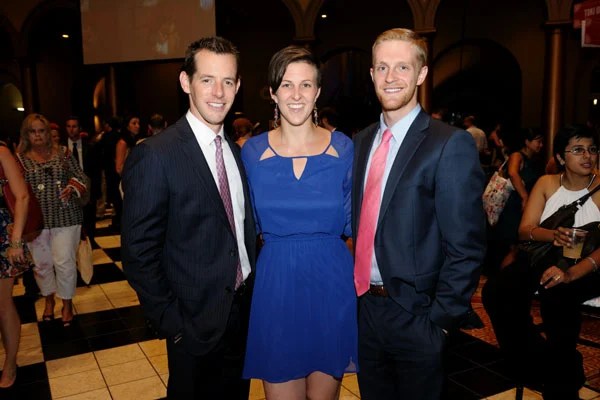
A different trace appears in a 2014 Washington party gallery. Bailey is photographed with Sara Snyder and Jeff Kline at the AT&T Best of Washington event. Elsewhere in the gallery, guests try luxury airline seats in the Qatar Airways lounge. It is a reminder that marketing also happens away from the announcement: in rooms, in introductions, in experiences people can describe afterward.
The schedule Bailey described in November 2010, across New York, Washington and Houston. A historical snapshot.
Washington widened the map
Bailey’s next substantial chapter was The Moak Group in Washington, where he served as vice president overseeing marketing and communications. His work there included international airlines and travel businesses: China Eastern Airlines, Alitalia, Delta Air Lines, Royal Air Maroc and AirAsia X, alongside The LINE Hotel and airport operator Aeropuertos GAP.
The variety matters more than a parade of logos. Airlines, hotels and airports participate in a connected travel economy, yet they have different things to explain. An airline sells access across a network. A hotel gives a destination somewhere to stay. An airport is both a place passengers pass through and an institution with its own commercial interests. A communications brief has to recognize the difference.
These assignments place Bailey’s career beyond the boundaries of one carrier or one market. They also explain why his eventual company would concentrate on fields where the public story can be tangled with technical and commercial detail. Aviation sits comfortably beside aerospace, transportation and travel in that professional history. The connection is practical rather than decorative.
The move from working inside one airline to advising several businesses is another change of vantage point. At a carrier, the corporate identity is given. At a consultancy, a new assignment brings a new set of priorities. Viewed as an apprenticeship for founding a firm, that stretch offered Bailey a broader range of organizations to understand and represent.
A company named for the thing it has to earn
In 2020 Bailey founded Reputable. He is its founder and CEO, based in Santa Barbara, California. The geography is a pleasing turn in a career that had already included Kansas reporting and Washington communications: a coastal base for work involving businesses whose concerns cross borders. Reputable serves clients globally and describes itself as a principal-led firm.
The word “Reputable” is unusually exposed as a company name. It announces the desired outcome every time it appears in an introduction. A bakery can have a fanciful name and still be judged on the bread. A reputation adviser naming the business Reputable has put the assessment on the shopfront. The name is tidy; the obligation behind it is less so.
For Bailey, that obligation now sits alongside the responsibilities of ownership. He works with founders, chief executives and executive teams. The person who once approached organizations as a reporter now has an organization of his own, and advises other people carrying responsibility for theirs. It is the career’s clearest pivot: professional experience assembled into a business he leads.
Michael Wascom is Reputable’s executive vice president. Like Bailey, he previously worked at The Moak Group. His career has included government and international affairs at American Airlines and roles at the U.S. Department of Transportation. Their backgrounds bring different kinds of institutional experience into the same firm. Bailey’s route includes journalism and marketing; Wascom’s includes the public affairs of aviation.
The call he still enjoys taking
Bailey’s reflection on the firm’s sixth year returns the story to a smaller scale. He described the pleasure of a reporter calling for context and his being able to connect that reporter with a founder or CEO who could contribute. After the job titles, airline names and company launch, the satisfying unit of work remains a conversation.
That detail gives his account a human center. The useful moment is when two people need something the other can provide: a reporter needs an explanation, and an executive has relevant knowledge. Bailey describes enjoying the introduction. Read that way, his enthusiasm concerns the work of making a connection, with all the ordinary listening and judgment that entails.
It also offers a sensible way to understand authority. An executive’s title establishes a role inside a business. Outside it, authority has to travel through what that person can explain. A clear answer can make a complicated subject accessible. An answer full of ceremony can leave everybody exactly where they began, except a few minutes older.
Bailey’s story has room for ceremony of a lighter sort. Reputable’s leadership page includes Fig, its “Chief Fetch Officer,” whose listed interests include the beach and hiking around Santa Barbara. A firm working on corporate reputations allows itself a joke about an office title. Fig’s brief, at least, is admirably easy to understand.
“How reporters decide what matters.”Boyd Bailey, reflecting on his interest in news
Still interested in the news
There is no need to turn this career into a fable about inevitable success. Its documented shape is interesting enough: an early attachment to news, a reporting job, communications and media roles, years at an international airline, consultancy work in Washington, and a firm founded in California. Each stage changes Bailey’s position in the conversation.
What persists is the question of relevance. Why does this development matter? Who understands it? What would help someone else make sense of it? Those questions are useful whether the immediate task is a television report, a travel trade explanation or an introduction between a journalist and an executive. They give the career continuity without pretending every step was planned.
Six years into Reputable, Bailey’s own account was still animated by that process. The pleasure he described was recognizable and specific: helping informed people take part in a story while it is developing. The company bears his ambition for its work in its name. The reporter’s questions remain a good place to begin.