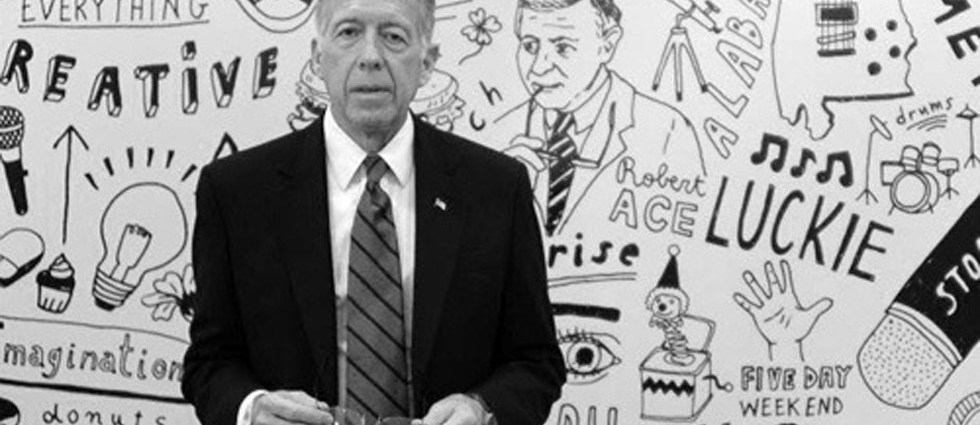
The trophy is topped with half a sandwich. Not a lion, a torch or one of those abstract metal swirls that corporate awards favor, but lunch interrupted by generosity. Luckie & Co. created the Bobby Luckie Character Award after the Birmingham advertising executive retired, borrowing its odd little crown from a habit everyone around him recognized. When someone sat beside Bobby Luckie at lunchtime, he was apt to offer half of what he was eating.
A sandwich is a minor object. That is its advantage. Grand gestures can be arranged; habits escape the rehearsal. Bobby, known around the agency as “B3” because he was Robert Ervin Luckie III, spent 43 years in a business trained to package meaning. His colleagues found the cleanest expression of his character in something he did without an audience.
His formal story sounds like a familiar family-business ascent. He joined the company his father founded, learned its departments, eventually became chairman and CEO, and helped it grow beyond its Alabama base. Yet the family name did not exempt him from the unglamorous rooms. Accounts of his career place him everywhere from the mailroom to account service before the corner office arrived. He understood the machinery because he had stood beside its gears.
The bow that looked like a bone
Before the agency years came Tuscaloosa. Born in Birmingham in 1947, Bobby finished at University Military School in Mobile in 1965 and went to the University of Alabama, where he earned a marketing degree in 1969. On campus he saw Jill Harris walking near Bidgood Hall. A bow in her hair looked, he thought, like a bone. It is the sort of visual observation one hopes an advertising man might make, although it was not yet a pitch.
Their first date, in December 1968, was a basketball game followed by “Laugh-In.” They married in February 1970 and raised three daughters: Mary Katherine, Casey and Laura. Alabama football became the household calendar. The family returned for homecoming, watching the parade from the steps of the Phi Delta Theta house. Bobby acquired a formidable knowledge of the football program. A profession devoted to grabbing attention had nothing on an autumn Saturday in that family.
After college, he served in the Alabama Air National Guard from 1969 to 1975 and began his working life selling radio at WAPI. In 1971 he joined the family firm, then Luckie & Forney. He already knew the place from college summers. What followed was neither a quick coronation nor a restless tour of employers. It was a long apprenticeship to one institution.
A career with the seams showing
Luckie worked in nearly every capacity at the agency. That range mattered in a trade where the finished advertisement hides the negotiations, revisions, media plans, invoices and anxious minutes that made it possible. His own phrase for the necessary discipline was “buttoned up.” Pay attention. Get the detail right. Give the client the best possible job. The words are modest, almost clerical, which may be why they are useful.
The clients were not minor. They included Blue Cross and Blue Shield of Alabama, Regions Bank, Little Debbie, American Cast Iron Pipe Company and BellSouth/AT&T. These were brands woven into daily life across the South, institutions that needed wit but also dependability. Bobby's professional manner, remembered as soft-spoken and exacting, suited work in which trust compounds slowly and can disappear before lunch.
His route through the company also corrects an easy misunderstanding. Bobby did not found Luckie & Co.; his father, Robert E. Luckie Jr., started the business in 1953. Bobby inherited a name and an opportunity, then spent four decades earning the authority attached to both. The distinction matters. A family connection may open a door, but it cannot write the brief, calm the client or make a payroll. The length and variety of Bobby's apprenticeship gave his eventual title some weight.
The agency itself changed around him. The firm he entered carried John Forney's name and the atmosphere of regional advertising. By the time Bobby led it, the company was Luckie & Co., serving major accounts across several industries and operating beyond Birmingham. He and Tom represented a second generation without treating the first generation's achievement as a museum piece. Expansion to Atlanta and San Antonio put physical distance between teams, making a recognizable internal standard even more valuable.
Alongside his younger brother Tom, he helped expand Luckie & Co. to 132 people, with offices in Birmingham, Atlanta and San Antonio. Bobby served as CEO from 1996 to 2009. In 2000, the Birmingham advertising community gave him its Silver Medal, while his university named him a Distinguished Alumnus. Twelve years later, the College of Communication and Information Sciences inducted him into its Hall of Fame.
“Every young person entering the business world could learn much about leadership and life from Bobby.”Tom Luckie, on his brother's retirement
The tribute works because it does not specify a management technique. Bobby's lesson was visible across accumulated conduct: learn the work, keep standards high, remember the human being on the other side of the table. Advertising made him prominent. Consistency made him credible.
He also had the social memory the agency business rewards. The obituary description that he “never met a stranger” can sound like a piece of Southern shorthand, but his calendar gives it substance. Clients, university friends, civic colleagues, golfers, football companions and agency staff occupied overlapping circles. He did not need to become a different Bobby for each room. The same courtesy that worked across a conference table appeared again at a club meeting or an ordinary lunch.
Birmingham was the other office
Some executives collect board seats like cuff links. Bobby appears to have treated them as jobs. He chaired Goodwill Industries of Alabama and Easter Seals of Central Alabama. He led the Crippled Children's Foundation, served as president of the Kiwanis Club of Birmingham, sat on the board of Vulcan Park, and worked with university advisory groups in communication and nursing. In 1985, he captained the Monday Morning Quarterback Club. The list is long enough to suggest that being “buttoned up” applied after business hours too.
A city-sized second shift
Service was a family inheritance, but not the ornamental sort. His father, agency founder Robert E. Luckie Jr., helped organize the UAB School of Nursing's Board of Visitors and supported scholarships. Bobby later chaired that board. His daughter Mary Katherine helped establish its junior counterpart. Three generations translated gratitude into committee work, money and time.
That continuity is one reason the list of appointments feels less like a résumé appendix and more like a portrait of place. Birmingham was not merely the address beneath the agency letterhead. It was a network of schools, charities, businesses and friendships that required maintenance. Bobby kept returning to the work. Leadership rotated - he was a chairman here, a president there, a board member somewhere else - but the geography remained close to home.
Bobby also gave the role a specific ambition. He wanted the nursing board to support broader use of nurse practitioners in underserved Alabama communities. It was an operator's aspiration: identify the gap, strengthen the people positioned to close it, and expect a board to make itself useful.
Leisure became service too. A golfer since childhood and a collector of golf memorabilia, he served as president of the Country Club of Birmingham in 1990 and Shoal Creek Golf Club from 2008 through 2011. He led The Club atop Red Mountain and, in 2000, served as king of the Beaux Arts Krewe. His Birmingham was made of agencies, campuses, clubhouses, charities and the recurring pleasure of seeing someone he knew. Friends said he never met a stranger. Jim Brown of Blue Cross and Blue Shield of Alabama offered the more polished version: “the ultimate gentleman.”
The useful size of a legacy
Bobby retired in 2014 and died on November 7, 2019, at 72. The titles stopped, as titles do. The institutions continued. So did the family ritual of passing opportunity forward. Jill later endowed the Robert E. Luckie III Business Scholarship at the University of Alabama for students who have faced hardship and might otherwise be unable to attend.
There is something fitting in a scholarship bearing the name of a man who learned one company from the bottom up. It turns memory into a beginning for someone else. The same logic lives in the character award. Both honors are verbs disguised as nouns: help, notice, share.
Modern leadership language is hungry for systems. It wants culture decks, principles, metrics and memorable acronyms. Bobby Luckie's story offers a system small enough to practice before noon. Prepare the work. Honor the relationship. Give away half the sandwich. The first two built a durable advertising career. The third explains why people still tell the story.
The corner office described his authority. Half a sandwich described how he used it.
That distinction is the charm of B3. He spent his professional life helping brands decide what the public should remember. In the end, the people closest to him selected the image themselves. Not the chairman at the head of a long table. Bobby at lunch, looking toward the person beside him, already dividing what he had.