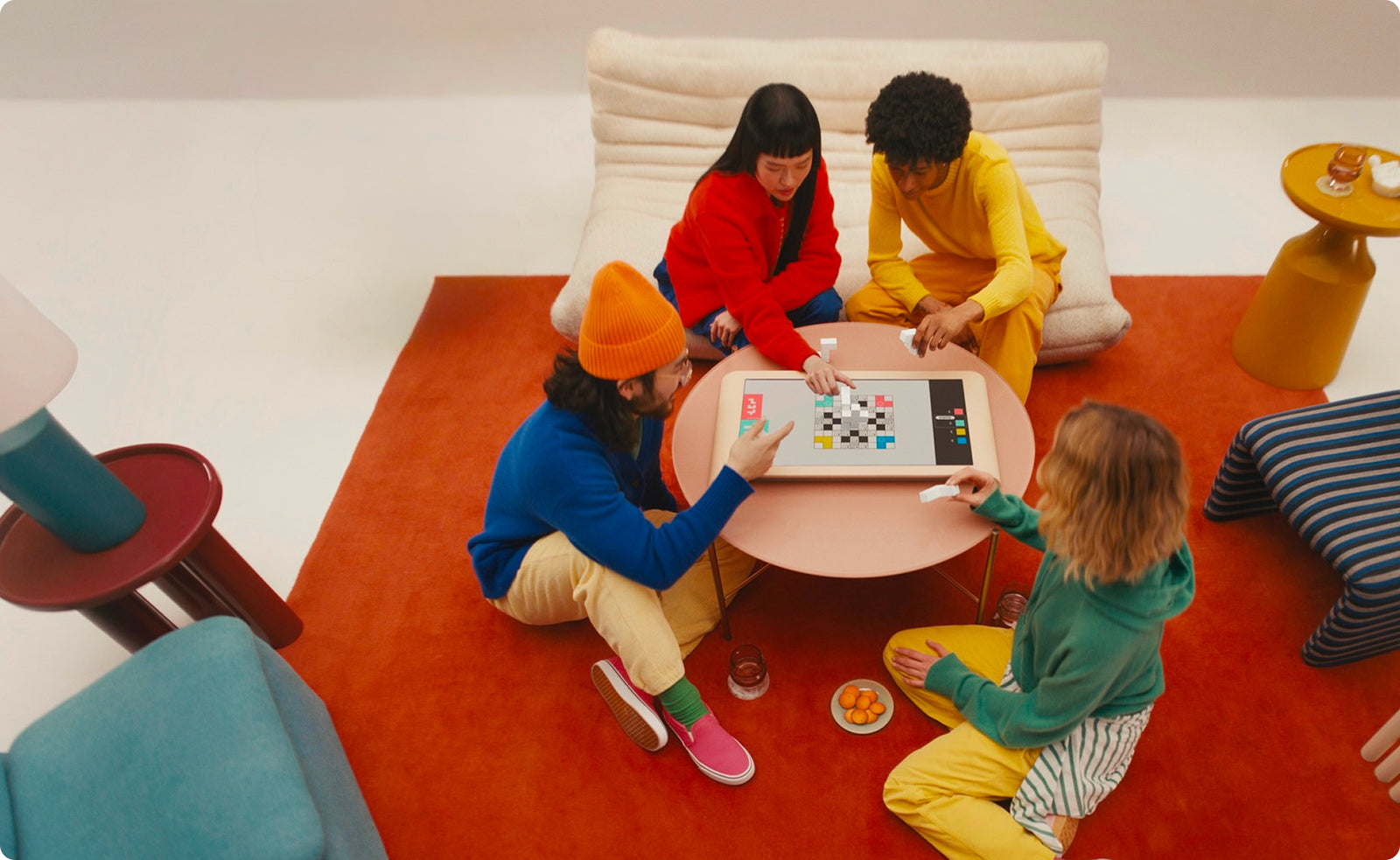
It is a Tuesday night, and somewhere a kitchen table has gone quiet in the good way. Four people lean over a 24-inch slab of glass set in a wood frame, arguing about a sponge. A grandmother places a small rocket piece; the screen recognizes it instantly and the game lurches forward. Nobody is holding a phone. This is Board, and this is the whole point.
Board makes a single, slightly stubborn claim: that the most interesting thing a screen can do is get you to stop looking at it alone. The company calls its category "together tech," which sounds like a slogan until you watch one in a room. The device sits flat on a table - big enough for a group, low enough to lean over - and reads physical pieces you place on its surface. Put a piece down and, in the company's own words, it knows exactly what it is, where it is, and what it can do.
A nation of people in the same room, looking elsewhere
The problem is not that screens are bad. The problem is that screens are lonely. We have built a century of glowing rectangles optimized for one pair of eyes, one set of thumbs, one person at a time. Family game night lost to the group chat. The living room turned into five separate living rooms, each about six inches wide.
Board's founder knew the genre from the inside. Brynn Putnam built Mirror, the connected-fitness display that put a personal trainer inside a slab on your wall, and sold it to Lululemon for $500 million in 2020. Mirror was a triumph of the solo screen: you, your reflection, your workout. Useful. Also, by design, something you did by yourself.
Build the opposite of the last thing
Here is where most fitness-founder second acts would have produced another fitness product. Putnam did something stranger. She decided her next screen should do the precise opposite of her last one - pull people toward each other rather than into themselves. The bet was that the analog warmth of a board game and the responsive magic of a video game were not rivals. They were a product nobody had bothered to build.
It is, admittedly, a contrarian thing to fund: hardware, in a software world, aimed at the unglamorous goal of family dinner. Investors disagreed about the gamble in the most flattering way possible - by writing checks. Lerer Hippeau, which had backed Mirror's seed round years earlier, led an initial $15 million. In June 2026, Union Square Ventures led a $20 million Series A, with USV's Michael Mignano joining the board.
The angel list reads like a who's-who of people who think a lot about attention: Twitter co-founder Biz Stone, author Tim Ferriss, Adobe's Scott Belsky, Exploding Kittens' Elan Lee, Pinterest's Evan Sharp, and former Twitter product chief Kayvon Beykpour, among others. People who built the attention economy, putting money behind a machine designed to interrupt it. Make of that what you will.
There is a tidy symmetry in the funding story. Lerer Hippeau had led Mirror's seed round back when "connected fitness" was an unproven phrase, then came back for Board's first round before most people had seen one work. Conviction, it turns out, compounds. The Series A then handed the company something a hardware startup rarely gets at this stage: enough runway to keep manufacturing physical objects, ship them to real homes, and still fund the software ambitions that come next.
How Board got to the table
A picture frame that happens to be a console
The hardware is deliberately unintimidating. No controllers. No logins to fumble. No tower humming under the TV. Board is a 24-inch touchscreen wrapped in a wood-finish frame that, switched off, could pass for something you hang in a hallway. Switched on, it becomes whatever game you place pieces onto.
Those pieces are the trick. They are physical, playful, and a little absurd on purpose - a sponge, a rocket, a knife - and the board recognizes each one and reacts. The console ships with a set of exclusive titles and their custom piece sets, spanning arcade, strategy, action and tabletop RPGs, with early games like Chop Chop, Snek, Space Rocks and Board Arcade. More games, most of them cheap and some of them free, live at board.fun/games, each arriving with its own little bag of parts.
And then there is the part that is unmistakably 2026: Board Studio, announced alongside the Series A. The pitch is that you describe a game in plain English and get a playable prototype back in about an hour. A console that ships with games is normal. A console that lets the dinner table invent its own is the kind of thing that turns customers into a catalog.
The proofThe numbers that make skeptics pause
Engagement is where novelty gadgets usually go to die - bought in December, forgotten by March. Board's numbers point the other way. The company says 85% of customers average 30 or more play sessions a month. For a piece of hardware, that is not a launch spike; that is a habit. The devices have spread beyond living rooms into schools, hospitals and restaurants in all 50 states, which suggests the appeal is less "cool toy" and more "thing that reliably makes a group of people enjoy each other."
Those last three settings are worth lingering on. A hospital does not buy a gadget for whimsy; it buys something that gets a waiting room to relax or a recovering kid to forget, for twenty minutes, where they are. A classroom needs the same thing a family does - a reason for a group to face the same direction. That Board landed in all three without much marketing muscle hints that the product is solving an old human problem, not chasing a trend.
Two screens, two intentions
Where Board's bet differs from the rest of the rectangle economy
Bars are illustrative; the "85%" and "50 states" figures come from the company. "Zero phones" is the entire business model in one statistic.
Technology that points people at each other
Strip away the wood frame and the funding rounds and Board is an argument about what technology is for. Putnam's framing of her own pivot - from a product about herself to a product about her family and friends - is also the company's thesis. Build screens that connect people in the same room rather than scatter them into separate ones. It is a modest-sounding mission that quietly contradicts most of the industry that funded it.
Whether that holds at scale is the open question. Hardware is hard. Tastes move. The same novelty that sells a $399 console can curdle into a drawer of forgotten pieces. But the early evidence - the repeat play, the spread into hospitals and classrooms, the AI tooling that turns owners into makers - suggests Board has found something durable hiding in plain sight.
Back to the kitchen table
Return to that Tuesday night. The table is still loud, still arguing about the sponge, still phone-free. A grandmother and a nine-year-old are tied. Nobody planned a "family activity"; they just turned on the thing in the frame and a room reorganized itself around it. That is the change Board is selling - not a faster console or a sharper screen, but a room full of people who, for one evening, chose each other over their feeds.
If the next decade of screens is going to be built anyway, Board is making the case that at least some of them should be pointed inward, at the table, at the people already in the room. It is a strange thing to need a $20-million Series A to remember. It may also be exactly the right thing to build.