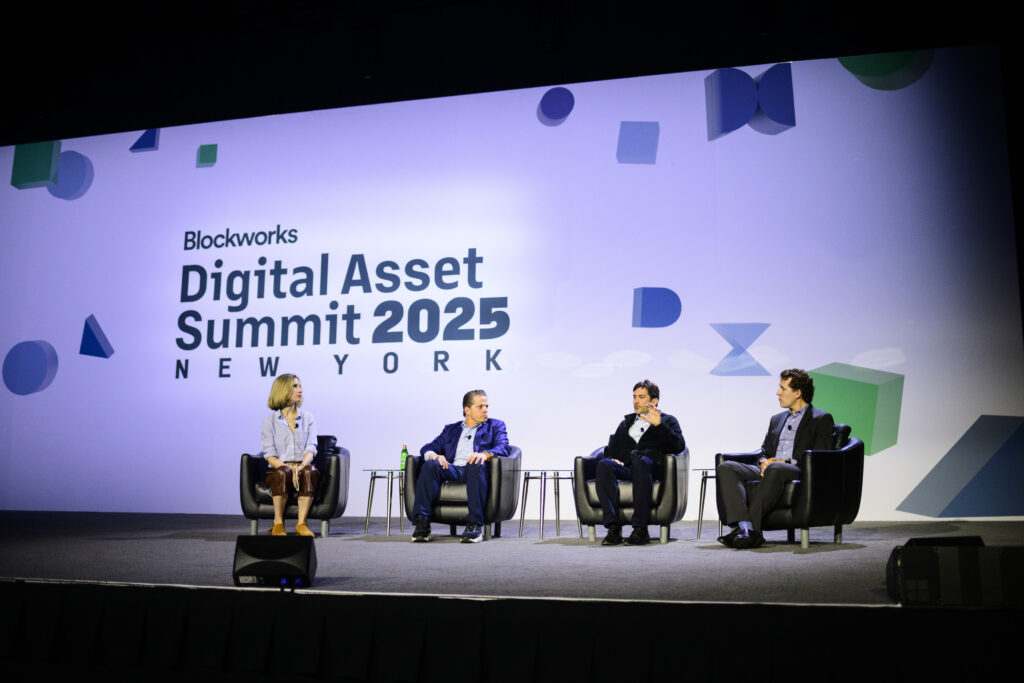
In 2018, Jason Yanowitz and Michael Ippolito had a sensible little business. They put finance people and crypto people in the same room. The finance people wanted a guided entrance into digital assets. The crypto people wanted capital, legitimacy, and someone who knew how to order enough chairs. Blockworks sold the meeting.
Then meetings became illegal, or at least unwise. COVID erased the calendar and took 82% of the company's revenue with it. An events company without events is a philosophical problem with payroll. The first Blockworks model did not fail because customers disliked it. It failed because the room itself disappeared.
The company has disclosed the percentage decline, not the underlying dollar figures. Indexing the before period to 100 makes the shock visible without inventing precision.
The useful accident
The room became a microphone
The founders moved toward podcasts. It looked like diversification, but it did something more valuable: it made Blockworks habitual. A conference is a date on a calendar. A podcast is Tuesday morning. By 2024, Yanowitz said the network produced 21 million downloads. The audience arrived without a conventional paid-marketing machine, creating what he cheekily called reverse customer-acquisition cost.
That phrase sounds like founder folklore until you inspect the loop. Sponsors pay to reach listeners. Some listeners buy conference tickets. Some work at funds that need research. Some run protocols that need investor relations. Media does not merely advertise the paid product; it reveals who the customer is and what keeps bothering them.
“Publishing is not the problem. Knowing who it reached is.”Blockworks Investor Relations
The product ladder
Attention went in. Workflows came out.
Blockworks Research launched in 2022 after the team kept hearing a professional complaint: serious crypto analysis required too many tabs, too many dashboards, and too much faith in mismatched numbers. Research bundled protocol models, onchain analytics, governance, analyst calls, and market commentary. This was the hinge. Readers became subscribers; content became a working surface.
Podcasts + newsletters
Free, frequent programming creates habit and keeps the brand inside the market's daily conversation.
Events
DAS brings institutions together. Permissionless was built for developers, founders, and crypto-native builders.
Research + data
Professional analysis, dashboards, models, governance, market data, and an API support investment and risk work.
IR + advisory
Issuers publish disclosures, measure firm-level interest, commission reports, and run tokenholder communications.
The customers are correspondingly specific: hedge funds, family offices, banks, exchanges, asset managers, auditors, fintechs, developers, regulators, and token issuers. They are not paying to be told that Bitcoin had an interesting day. They are paying for comparable protocol financials, point-in-time prices, diligence, clean feeds, or evidence that a disclosure reached the right firm.
The event economics are unusually visible. For the 2026 Digital Asset Summit, advertised tickets ranged from free for approved institutional allocators to $1,999 for VIP access. Fortune also reported a rate card in which sponsored speaking opportunities could cost tens of thousands of dollars, with the most prominent format exceeding $100,000. That arrangement buys reach, but it also creates an editorial question Blockworks has to manage carefully: when access is the product, the line between authority and sponsorship must stay bright.
The second turn
A media company decides it is a data company
In October 2025, Blockworks closed its dedicated news division. The decision was a blunt acknowledgment that fast news and proprietary data have different economics. News is costly, public, and easy to summarize elsewhere. A trusted dataset, wired into a bank's risk dashboard or an exchange's asset page, becomes harder to remove.
The company had changed its mind because customers had changed the evidence. Analytics was growing faster. In April 2026, Blockworks raised a Series A extension at a $192 million valuation to consolidate a fragmented crypto-information market. In June it acquired Messari, once a direct competitor. By September, the combined Unified API advertised market data across more than 40,000 assets and 300 centralized and decentralized exchanges, plus standardized fundamentals for 400-plus DeFi protocols.
This is where the Bloomberg comparison becomes tempting, and where it should be handled with care. Bloomberg owns a mature terminal, communications network, and decades of pricing power. Blockworks is earlier and narrower. Its distinction is that it can combine a crypto-native audience with onchain data and issuer participation. The media layer finds demand; public blockchains supply raw material; issuer tools add disclosures that a third-party scraper cannot simply infer.
The Token Transparency Framework makes that strategy concrete. It asks projects to disclose supply schedules, insider incentives, market-maker agreements, related-party transactions, revenue, governance, and financial information. It began with six participating projects in 2025. By September 2026, the registry showed 178 disclosures. Investor relations then turns those filings into profiles, reports, dashboards, and signals about which kinds of firms are paying attention.
The clever two-sided bet: investors want more reliable issuer information; issuers want credible distribution to investors. Blockworks sits in the middle and sells tools to make the exchange measurable.
The portable lesson
Copy the sequence, not the costume
It would be easy to copy the visible pieces - start a podcast, host a summit, bolt on a dashboard. That misses the order. Blockworks first earned repeated access to a narrow professional community. It used that access to hear the same costly problems. Then it built products that moved closer to the customer's decision: from an episode, to a report, to a dataset, to a workflow embedded in the organization.
The Blockworks playbook, minus the crypto vocabulary
- Begin with a specific professional audience, not a giant demographic.
- Use editorial products as a listening system for recurring, expensive problems.
- Move from occasional attention to habitual use, then to embedded workflow.
- Let free distribution lower acquisition cost, but charge for decisions, data, and coordination.
- When the market contradicts the original identity, believe the usage.
There is a condition attached. This sequence works when the niche is valuable, the information is difficult to normalize, and the audience trusts the operator. It weakens when the data is commoditized, the community is casual, or sponsorship compromises credibility. It also demands the nerve to retire products that once defined the company. Blockworks shut a newsroom and bought a rival database. Both moves say the same thing: the label mattered less than the job customers were hiring it to do.
The company now describes that job as building trust in onchain markets. Grand language, certainly. But beneath it is a practical business: make messy assets comparable, make issuers legible, and make the information useful inside an actual decision. The conference room did not disappear after all. It expanded until it had an API.