Rent has none of the emotional sparkle of a plane ticket and all of the financial weight. It arrives every month, swallows a large piece of a household budget, then disappears without so much as a thank-you point. That asymmetry was Bilt's opening. The New York company made a dull obligation useful: pay housing, collect rewards, and - if you opt in - put a record of on-time rent onto files at all three major credit bureaus.
The pitch was immediately legible. A renter could earn transferable points without paying the customary card fee on rent. A property manager could add a loyalty benefit and modernize collections. A travel or neighborhood partner could meet a consumer through the payment most likely to happen every month. Bilt did not need to manufacture a new behavior. It attached itself to the calendar.
That first idea, incubated by founder Ankur Jain in 2019 and launched publicly in 2021, has grown into something harder to summarize. Bilt now describes itself as a membership for where you live and a hospitality platform around it. By August 2026, the Bilt Alliance spanned more than 7 million homes. Its products touch rent, mortgages, restaurants, fitness, rideshare, travel, property operations, amenity booking and an AI-enabled concierge. The credit card still matters. It is no longer the whole diagram.
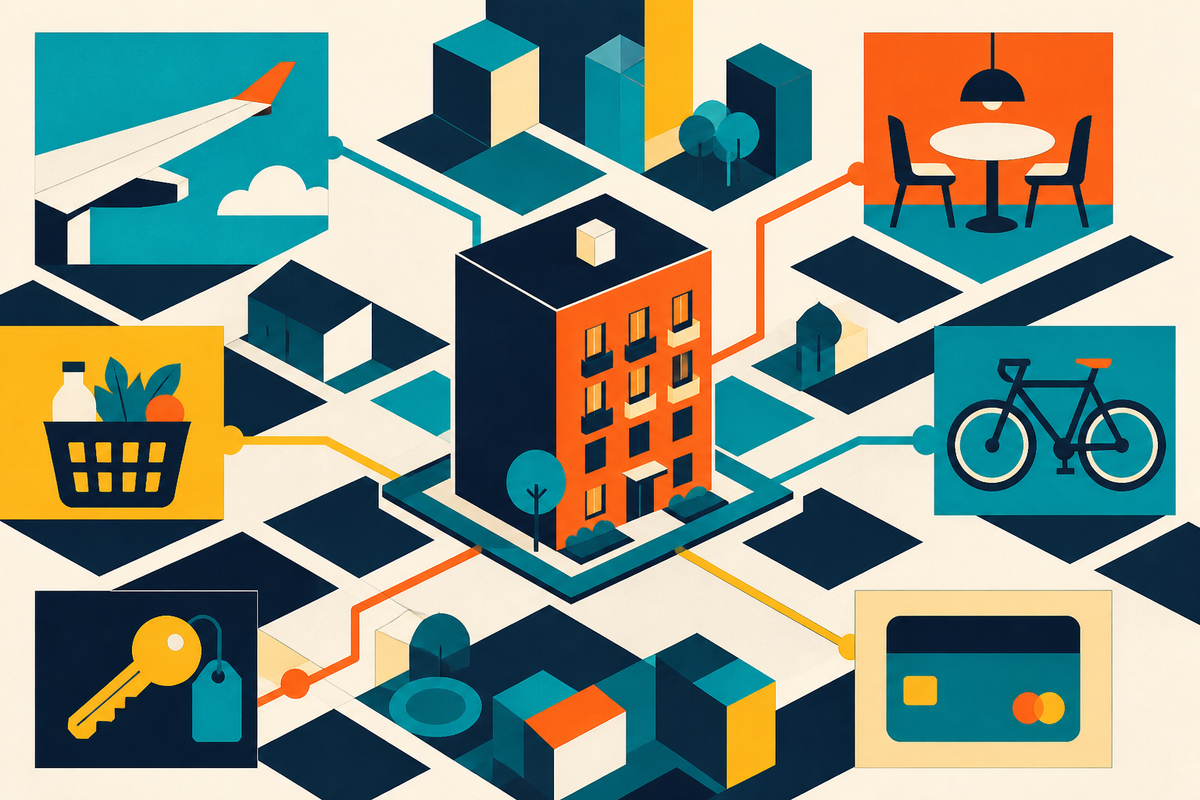
A very large bill becomes a very small habit
Bilt's consumer machinery starts with repetition. Members in participating properties can pay inside a resident portal; people outside the network can use BillPay methods supported by the app. Points can move to airline and hotel programs, pay down rent, cover selected student loans, or contribute toward an eligible home down payment. Rent Day, staged on the first of each month, adds temporary transfer bonuses, neighborhood experiences and chances at free rent. It turns the date most renters dread into the program's release day.
The free credit-reporting feature solves a quieter problem. A mortgage payment normally appears on a credit file; rent often does not. Bilt's Credit Boost can report on-time rent to Experian, Equifax and TransUnion. That does not guarantee a higher score, but it gives a recurring payment a chance to count. In this way, Bilt bundles aspiration into the points loop: today's rent can help build a record for tomorrow's borrowing, and the points can even be aimed at a future down payment.
“The concierge at a great hotel doesn't give you a list of restaurants. It makes the reservation, tells the kitchen you're coming, and charges it to your room.”Ankur Jain, founder and CEO
The card is the hook. The network is the company.
A conventional reading puts Bilt beside rewards cards from American Express, Chase or Capital One. That comparison is useful but incomplete. Bilt also competes with rent-reward programs such as Stake and Piñata, rental-reporting services such as Esusu, property software from AppFolio or RealPage, and dining platforms that help restaurants recognize and reacquire guests. Few of those alternatives occupy all the same seats at once.
Bilt's advantage is context. It knows where a member lives, processes or observes a recurring housing relationship, and can connect that member with the businesses nearby. A property brings a cluster of residents into the system. Those residents bring spending. Merchant-funded offers make membership more attractive. Better benefits give property managers another retention tool. Bilt said in July 2025 that more than 85 percent of members used its platform without the Bilt card - a telling figure for a business often mistaken for a card program.
The home-to-neighborhood loop
The business model follows those connections. Cards contribute annual fees on premium tiers and a share of card economics. Housing partners pay for or participate in payments and resident-loyalty services. Merchants can buy access, offers and marketing to nearby members; property managers may share in commerce generated by their residents. New hospitality software adds another enterprise layer. Bilt does not carry every role itself - its 2.0 cards are issued by Column, serviced by Cardless and supported by capital from Fidem and its partners.
The four-bananas test
Reward programs look effortless because their accounting is hidden. Bilt's 2026 card overhaul pulled that accounting into view. Card 2.0 introduced three tiers: the no-annual-fee Blue, the $95 Obsidian and the $495 Palladium. It extended rewards to mortgage payments and added Bilt Cash, a second currency designed for benefits inside Bilt's ecosystem. But the original presentation made housing-point earnings depend on Bilt Cash generated by everyday card use. Some members found the mechanism confusing.
Two days after the launch announcement, Jain published a clarification and added a simpler choice. Cardholders could earn housing points automatically at a rate tied to everyday spend, reaching up to 1.25 points per dollar, or keep earning Bilt Cash and choose how to apply it. His explanation included the most memorable unit in fintech economics: if members buy only “four bananas” and earn free rent points, the generous proposition cannot support itself.
of original active cardholders requested a Card 2.0 during the migration, Bilt reported. More than 30 percent of those who moved selected a paid premium tier.
The episode showed both responsiveness and risk. Bilt changed a major product quickly because members objected. It also demonstrated how far the company had moved from the exquisite simplicity of “points on rent.” The new design asks members to understand two currencies, three card tiers and alternative housing-earning paths. A network becomes more valuable as it gains nodes; a consumer product can become less graceful for the same reason.
The card partnership itself had already supplied a warning. Wells Fargo stopped accepting applications for the original Bilt card in late 2025, and those cards ceased working for Bilt payments in February 2026. Reporting put the bank's losses on the portfolio at about $10 million a month. Bilt's replacement structure distributes issuing, servicing and capital among new partners. The transition kept points attached to the membership rather than the old bank account, reinforcing the company's argument that the card is an accessory to the network.
Hospitality, stretched across a city
Bilt's newer products sound less like finance and more like hotel operations. Neighborhood Concierge began in beta in February 2026, promising not only to suggest a restaurant or ride but to act. Housing tools now let residents reserve an amenity, pay for it and complete move-in checklist tasks in the same app used for rent. Property teams can ask the concierge to manage bookings. A dining product called Bar Tab lets guests open and close a tab on a phone; if someone walks out without closing, the system can do it at shift's end.
In August, Bilt extended its hospitality operating system to travel advisors. The early-access product combines bookings, itineraries, commission tracking and an agentic concierge, while letting advisors retain their client relationships. It is Bilt's broadest leap yet: from serving the place a member lives to providing software for the person who sends that member away.
Bilt says the broader network is working. In its 2026 annual letter, the company reported that migrated cardholders increased monthly spend with Bilt partners: dining rose 20 percent, rideshare 22 percent, fitness 47 percent and travel 320 percent in the first 30 days. These are company-reported early figures, not a complete measure of long-term retention. Still, they express the strategy cleanly. Win the housing habit, then earn a place in the rest of the member's week.
Where Bilt fits - and where it can stumble
Bilt sits at an unusual intersection: consumer fintech, loyalty, property technology and local-commerce software. It raised $250 million at a $10.75 billion valuation in July 2025, after earlier rounds that included large property owners, Mastercard, General Catalyst and pension capital. Its investor list doubles as a map of the system it must coordinate - finance, housing and long-duration institutions.
Its expertise is integration. Rent portals, bank rails, credit bureaus, reservation systems, point-of-sale terminals, pharmacy receipt data, airline accounts and mortgage systems were not built to behave like one product. Bilt's first acquisition, item-level data company Banyan, added technology that had analyzed more than 20 billion receipts. That makes automatic FSA/HSA benefits at merchants such as Walgreens possible and gives Bilt finer tools for relevant offers.
Integration is also where trouble concentrates. In its annual letter, Bilt acknowledged that customer-support response times suffered while it scaled multiple systems and completed the card migration. Every new category introduces another partner, edge case and promise. The company must keep housing payments reliable, rewards understandable and merchant experiences useful while persuading each side that value is not being extracted for somebody else.
The original Bilt proposition succeeded because it made one expensive, joyless transaction feel fractionally better. The company now wants to apply that instinct to the entire neighborhood. If it works, Bilt will be less a card in a wallet than an invisible operating layer between a person, a property and the places outside the front door. The sharper test is whether it can make that larger machine feel as simple as getting points for paying rent.
Keep exploring